Company News
Top insights for P&C leaders from the Federato Insurance Leadership Summit
Federato

June 4, 2026

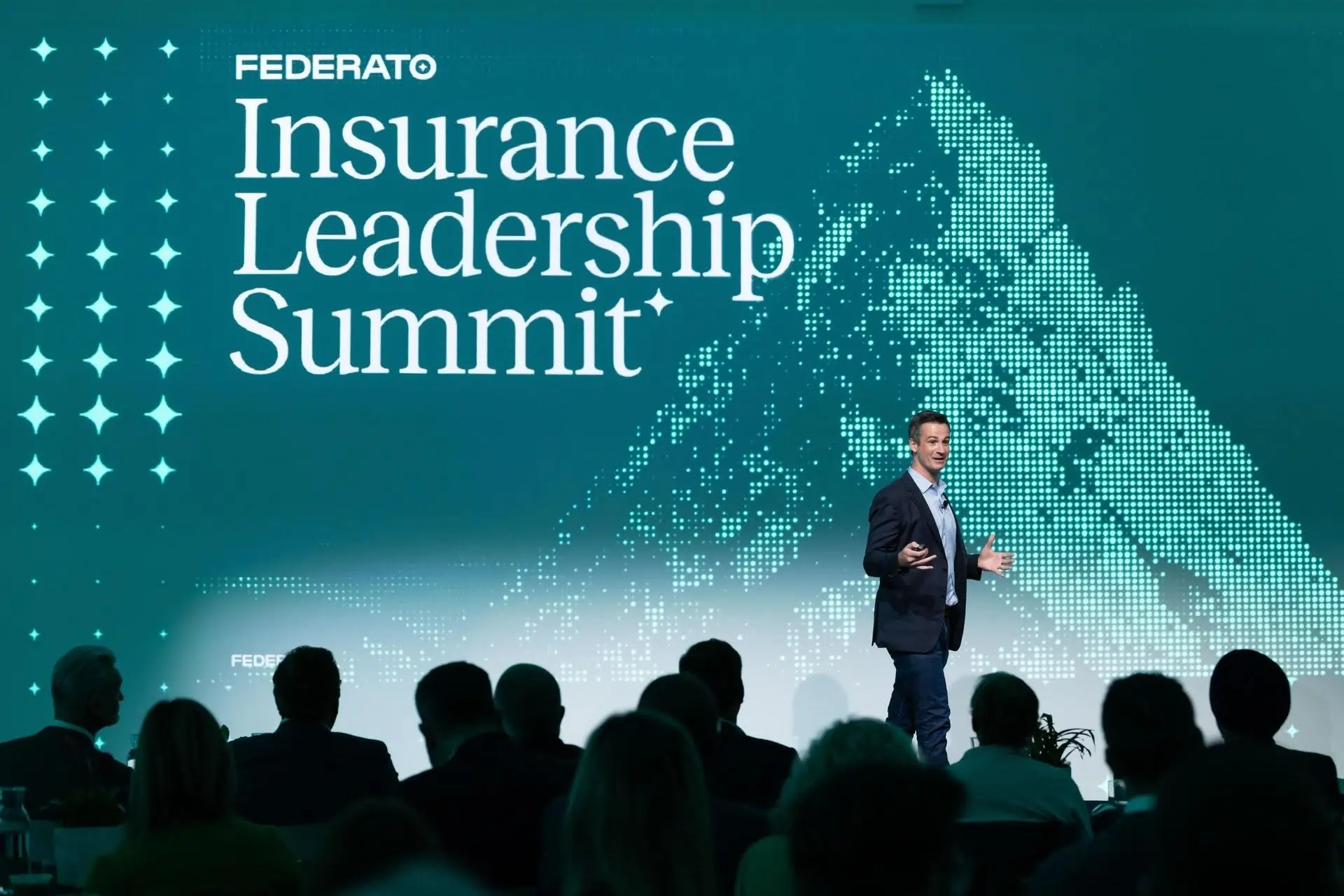
On June 2, 2026, a group of senior executives in P&C insurance gathered at Lavan Midtown in Manhattan for Federato's Insurance Leadership Summit to explore what performance looks like in an era of discontinuity.
We built the event around a single premise: that the leaders who set their organizations on the right path during a period of genuine discontinuity have a rare opportunity to make disproportionate gains. We curated sessions that focused on execution, not AI strategy theater, and structured the day around six conversations we think every P&C leader should be having, and may not be having anywhere else. Here’s what came out of them.
Will Ross, CEO and Co-founder of Federato, delivered an opening keynote that skipped the standard industry alarm bells and went straight to the data. ACORD's 2025 U.S. P&C Value Creation Study found that nearly half of the 100 largest U.S. P&C insurers destroyed value over the last 20 years. In 2021, that number was 9%.
P&C insurance is splitting into a bimodal distribution that’s creating a group with a distinct advantage, and the gap is widening. The organizations falling behind are trying to bolt AI onto legacy systems. The ones making gains are using AI to redesign their workflows from the ground up, and to rethink how risk capital gets allocated. Labor is a small percentage of an insurance company’s expense, so the productivity-replacement framing driving most AI investment misses the real opportunity: the capital-to-risk allocation across layered distribution and reinsurance structures.
He also laid out three organizational realities that block progress — incentive misalignment, technical debt, and functional fragmentation. His closing line set the frame for the day: you can't draw a new future on a broken canvas.
Cassie Kozyrkov, former Chief Decision Scientist at Google and CEO of Kozyr, brought frameworks from her work advising organizations including Meta, Salesforce, and NASA. She diagnosed "random acts of AI": organizations deploying AI tools without a coherent decision-making framework underneath them.
The session's central argument was that AI doesn't improve decisions, it amplifies them. An organization with poor decision infrastructure will make poor decisions faster and at greater scale when it adds AI to the stack. The executives who will win are the ones who build decision quality into the workflow before they automate it.
Kozyrkov offered concrete frameworks for how insurance leaders can move from AI experimentation to AI-first leadership — a shift that starts not with the technology but with clarity about which decisions the organization is actually trying to improve.
McKinsey's directive to CEOs — to move beyond pilots focused on productivity and seek a deeper understanding of how AI can change the economics of the business — framed this conversation between Anthropic's Mike Ram and the Financial Times' Varada Bhat.
The diagnosis they laid out: the majority of AI initiatives in insurance today are what Bhat calls "pilot theater." They look credible in a presentation and are funded through an innovation budget, but they don't scale. Why? Because they were never designed to change a core operational decision, just demonstrate activity.
Ram drew on Anthropic's direct experience working with carriers to describe what separates the organizations making measurable progress. The ones achieving real scale have identified the decisions that drive the most loss ratio and expense ratio risk, and they've built toward automating or improving those decisions systematically. The conversation pushed executives to audit their AI portfolios not by the number of pilots running but by how many of those pilots are connected to a decision that moves a number that matters.
Jared Klyman, Global Head of Insurance Asset Management at Goldman Sachs, presented findings from the 14th annual Goldman Sachs Global Insurance Survey. He offered a fresh perspective on the most important findings for P&C insurers, including data and analysis on how industry leaders are positioning portfolios, managing risk, and navigating the evolving landscape.
The headline: AI adoption in insurance has accelerated significantly, rising from 29% of insurers actively using AI in 2024 to 48% in 2025 to 62% in 2026. Today, 96% of insurers are using or actively considering AI. That sounds like progress. But the data beneath the headline tells a more complicated story.
Reducing operational costs remains the dominant AI use case by a wide margin — holding steady at roughly 80%. The application of AI to actual underwriting decisions has declined year over year. This is the gap between AI adoption and AI advantage: most carriers are using AI to do existing work faster, not to make better decisions or reshape how risk is priced and selected.
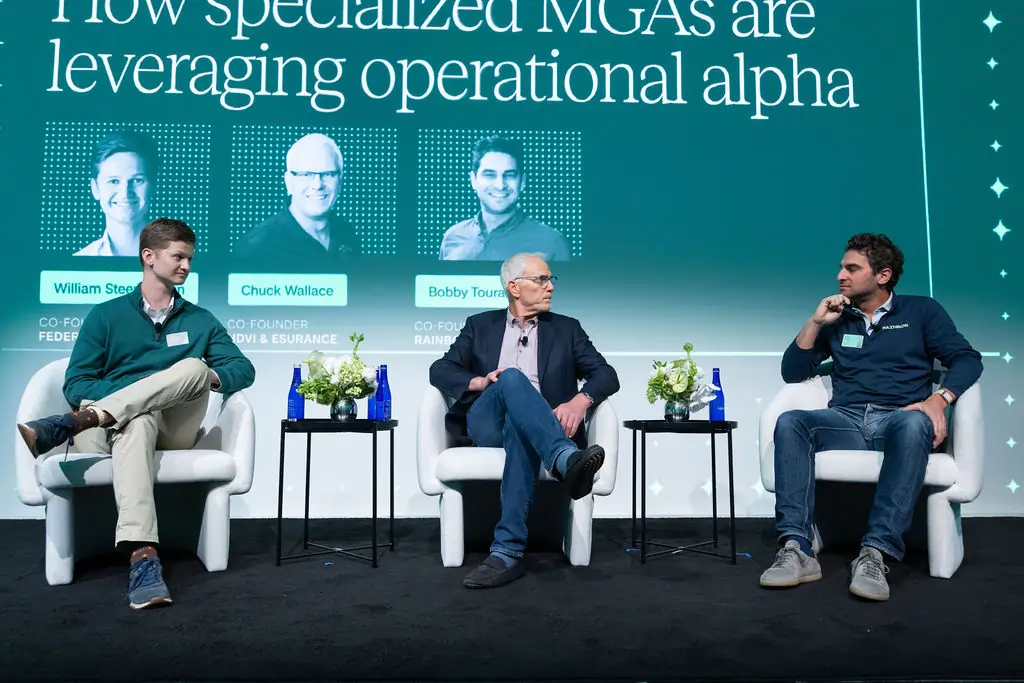
William Steenbergen, co-founder and CTO of Federato, moderated a conversation between two serial founders who have each built MGAs from scratch in different eras of the market. Chuck Wallace, co-founder of Esurance and HDVI, noted that the MGAs worth building today don't improve one thing incrementally, but improve the economics of an entire niche substantially. Bobby Touran co-founded Rainbow with a different thesis: distribution, product, systems, and customer experience built through a single industry lens compounds into an advantage that becomes very hard to compete with.
The session was direct about what separates the MGAs winning right now from the ones running on borrowed time: operational rigor, the right technology decisions, and people who understand both the insurance and the technology side of the house. On build versus buy, Touran's framework was straightforward — build first if possible, and treat technology like a garden requiring constant care, not a one-time implementation.
Kelly Galanis, Partner at Goldman Sachs, and James Thaler, Head of News Content at The Insurer at Reuters, had a direct conversation about what the technology transformation in banking and financial services actually produced — what worked, what failed, and what insurers can do differently.
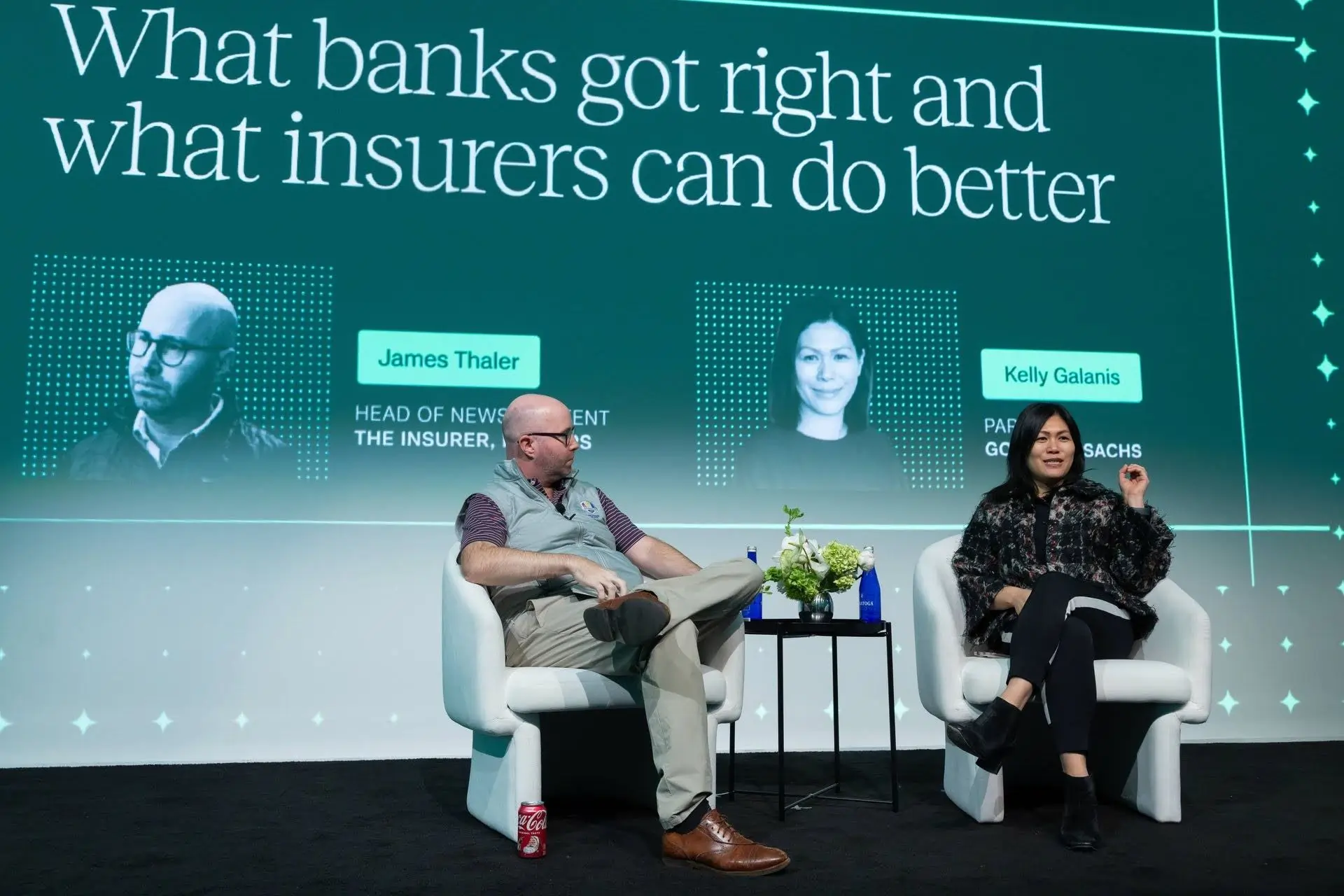
The core lesson: banks that won the digital transition integrated data across the full customer lifecycle, from acquisition through servicing, while their competitors kept accumulating disconnected systems. The "80% legacy tax" that Galanis described, where maintaining legacy infrastructure consumes 60 to 80% of corporate IT budgets, left most banks with little capital for genuine innovation. The same math applies to insurers today.
On the topic of evaluating AI proposals, Galanis's litmus test for distinguishing a real AI investment from expensive wallpaper: ask whether the technology is changing a decision, or just describing the decision more quickly.
Will Ross and Robert Pick, CIO of Tokio Marine North America, closed the day with a much anticipated session on what transformation actually looks like inside one of the largest insurers in the world. Pick's argument on core systems was direct: Incumbent carriers with complex system portfolios do not need a full replacement of existing infrastructure to modernize meaningfully. Building a modern ecosystem that integrates with what already exists, while establishing rigorous governance and maintaining an unwavering focus on safety, is a legitimate path. For organizations operating at serious scale, it is often the faster one.
Pick also walked through Tokio Marine's approach to AI, which follows a three-layer model: broad AI access for productivity at the base (getting the entire organization comfortable using AI in daily work), followed by AI capabilities from existing platform partners who already understand the environment, and then custom-built AI at the top of the pyramid for specific cases where neither of the first two layers solves the problem.
His closing advice to the room: stop listening to analysts who have never underwritten a policy or settled a claim. The organizations making good AI decisions are the ones moving at a pace they can control — not reacting to pressure from people who don't live inside insurance.

Federato's inaugural Insurance Leadership Summit was designed for the executives who already know what's changing and need a sharper view of what to do about it. And from what we heard and saw on June 2, attendees left with practical roadmaps and expert advice for the road ahead.
Interested in attending next year? Sign up to receive updates on Insurance Leadership Summit 2027 and how to apply.