Insurance
One audit trail for every decision: how Federato makes AI explainable for Australian insurers
Federato

November 11, 2026

Australian regulators have made their position clear. APRA’s April 2026 letter on AI and ASIC’s May 2026 open letter both expect insurers to explain, evidence and own every decision AI touches. Both regulators have said they will act where AI risk isn’t managed. For insurers and underwriting agencies, the practical test is the same: can you explain, evidence and own every decision AI touches?
Explainable AI in insurance underwriting means an underwriter, auditor or regulator can see what data an AI system used, where that data came from, how a recommendation was arrived at and who made the final decision. Most insurers can’t do that today, and the reason is structural. AI tools keep their own logs, while underwriters record decisions in a different system. When an auditor asks why a risk was written, someone has to stitch the story back together from multiple sources.
Federato takes a different approach. With Federato, that information is captured in a workflow as each decision is made. AI reasoning and human decisions are recorded together, in one log, on the same platform, as the work happens across the whole policy lifecycle.
A black-box recommendation such as “high risk, decline” gives an underwriter nothing to check. Federato uses chain-of-thought reasoning, so AI agents work through a submission step by step, in plain language, covering location, operations and loss history before reaching a recommendation. Underwriters can see how the AI got there, and push back where it’s wrong.
Chain-of-thought reasoning makes a recommendation reviewable, but it isn’t always a complete account of how a model reached its output. That’s why Federato pairs it with source citations, human review on every decision and ongoing testing of AI outputs.
An AI audit trail is a record of every action an AI system takes, including its inputs, reasoning and outputs. Federato combines this with the human decision log, so each risk has one record covering both the AI and the underwriter.
Reasoning is only as good as the data it runs on. Every field Federato extracts from a broker submission carries a citation as to its source and a confidence score. Low-confidence data is flagged for review instead of flowing silently into rating. We cover this in more depth in why provenance matters for agentic AI.
This is where Federato differs from AI added onto a legacy core. Because agents and underwriters work in the same workspace and data model, every risk carries one continuous decision record. Nothing has to be reconstructed after the event. Six months later, anyone with access can see what the AI saw, what it recommended, what the underwriter changed and who signed off.
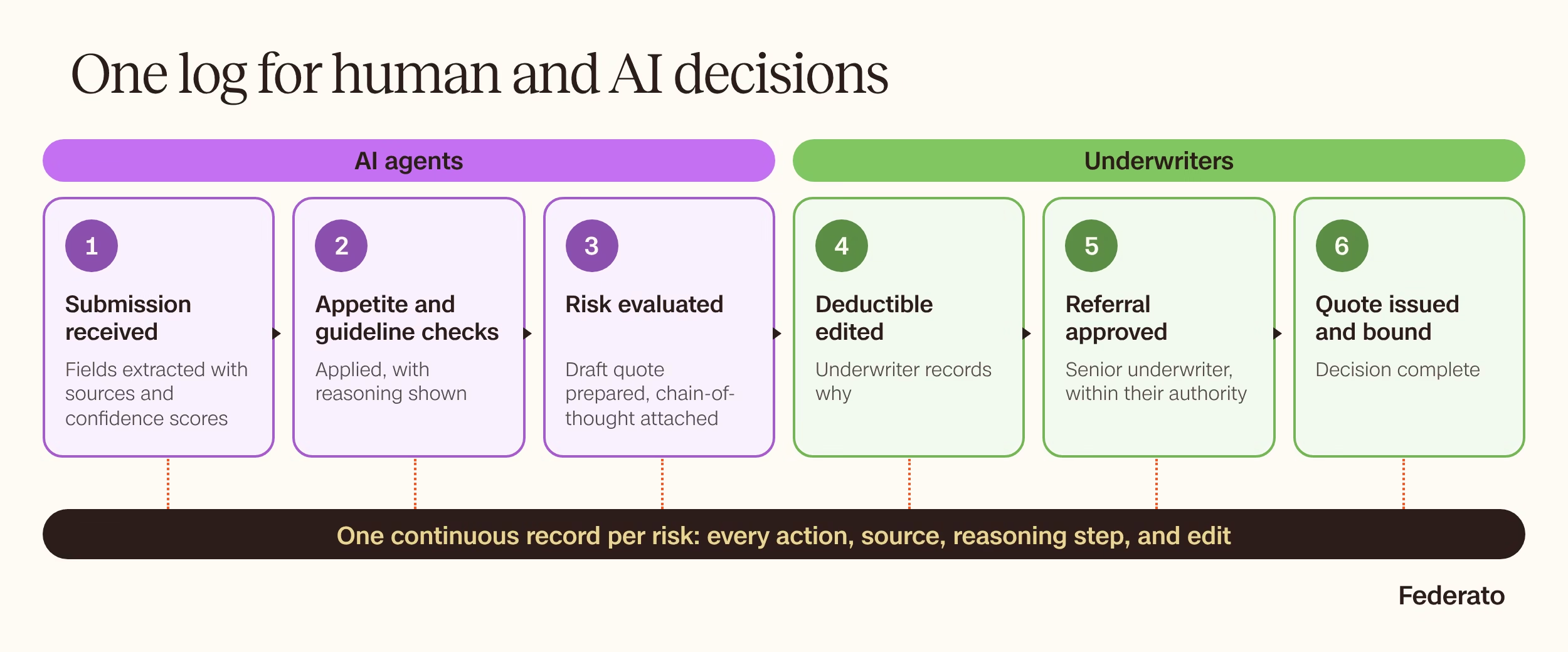
Most insurers use separate tools to manage clearance, documents, rating and policy administration. Every tool keeps its own logs and the decision trail breaks at every handoff.
Federato offers a unified, AI-native core. Submission triage, clearance rules, document management, rating, quoting and claims all run on one platform using one integrated data model. That means a premium can be traced back to the original submission in one record, through the underwriter who approved it and the guidelines AI cited. There are no exports or reconciliation, and no gaps between systems for an auditor or regulator to navigate.
Delegated underwriting authority is a large part of Australian commercial lines. Underwriting agencies and brokers hold an AFSL and answer to ASIC under s912A. They usually meet APRA’s expectations through their contracts with insurers, and those insurers increasingly want evidence of how AI is used. The same decision record answers both: the agency can show its own controls, and the insurer can see how each risk was written under its binder.
The same records roll up into Control Tower, which shows in real time how the book is tracking against appetite and portfolio targets. A CUO can see drift as it forms. A board can see how AI is being used across the portfolio, backed by evidence rather than a vendor slide deck, which is the gap APRA called out in its letter.
Transparency also covers infrastructure. Federato runs each customer in a single-tenant environment with data sovereignty options for ANZ customers, so your data, configuration and decision records are isolated from other insurers. Data sovereignty options mean ANZ insurers can keep data in-region to support their CPS 230, CPS 234 and privacy obligations.
ANZ insurers don’t need more AI pilots. They need AI they can defend to a board, a reinsurer or a regulator. When every decision carries its own reasoning, sources and sign-off, explainability becomes simply part of the way the work gets done.
APRA expects ownership of AI decisions, human involvement in high-risk decisions and continuous monitoring. ASIC expects boards to see evidence that controls work. Federato’s unified decision record, chain-of-thought reasoning and Control Tower provide that evidence directly within the platform. Citations allow underwriters to trace every AI decision back to the submission document values it considered, the guidelines that it cited, and the reasoning that it used.
Our Sydney team will walk you through a commercial lines submission from intake to bind, including every AI and human step in the audit trail.