Insurance
Duck Creek competitors: 7 options for P&C insurers
Federato

October 26, 2026
Duck Creek is one of the best-known names in P&C core systems, and it often appears alongside Guidewire on a large carrier's shortlist. Its suite covers policy, rating, billing, and claims, and it emphasizes rapid deployment through pre-built carrier playbooks and industry-standard processes. That can make it a suitable option for carriers that want to manage all these functions under a single vendor.
But implementing Duck Creek and updating products once it’s live can still be a major undertaking, particularly for carriers with complex products. There are three areas worth considering:
For existing customers running Duck Creek on-premises, a planned move to Duck Creek OnDemand is another opportunity to reassess their options. Migrating to the cloud can involve substantial work, including adapting existing configurations, moving data, and updating integrations.
Before committing to that investment, carriers should consider whether staying with the Duck Creek suite offers the best long-term value or whether an alternative platform would better meet their needs.
In this article, we compare seven leading alternatives to Duck Creek, starting with Federato, and examine how they differ in implementation, product configuration, and AI capabilities.
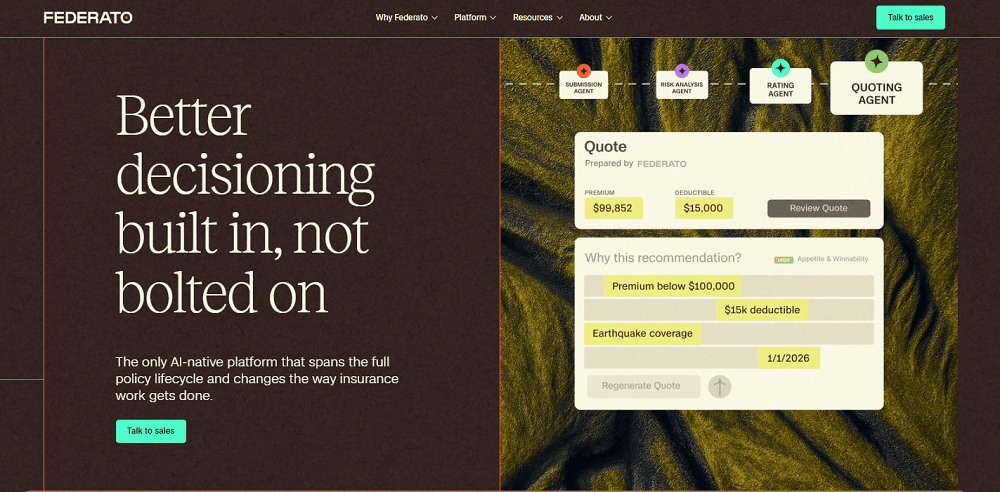
Federato is the only AI-native platform that spans the full policy lifecycle. While many established core vendors have added agentic AI to their existing systems, Federato builds AI into the core itself, giving it direct access to the data, business rules, and workflows it needs to make decisions and carry out tasks.
Policy data, product definitions, billing activity, and claims history all live in one data model, so a change made in one place carries through the rest of the lifecycle. Billing and claims data can also feed back into risk selection and pricing. That lets leaders steer the book (the insurer's portfolio of policies) as results come in, instead of correcting it after the fact.
A first implementation of Federato typically takes about 17 weeks, and implementing each additional line of business takes about eight weeks on average. Federato's team works closely with each insurer to configure workflows and connect data sources, which helps insurers avoid the system integrator costs that often balloon on legacy implementations.
One MGA, for example, set up 30 underwriting rules during its initial configuration, and those rules now handle 95% of its referrals (submissions that would otherwise go to a manager for approval) automatically. It also reworked several workflows partway through implementation with minimal impact on its timeline.
Existing records come across as part of the move. Federato maps an insurer's current policy data into a consistent schema, so historical records can move to the new core without being rebuilt by hand.
Below, we look at the main capabilities of Federato's core in more detail.
In Federato's 2026 State of P&C Insurance Technology report, 64% of insurers said they depend fully or mostly on IT to implement operational changes. For product and pricing teams, that's why new products, rate changes, and rule updates often wait in a development queue, sometimes for so long that the market conditions that prompted them have shifted.
Federato's Product Studio keeps that work with the teams that own the products. Rating, forms, eligibility rules, and coverages sit together in one product definition, and product teams can change any of them without code or an IT ticket. Each change applies automatically from its effective date.
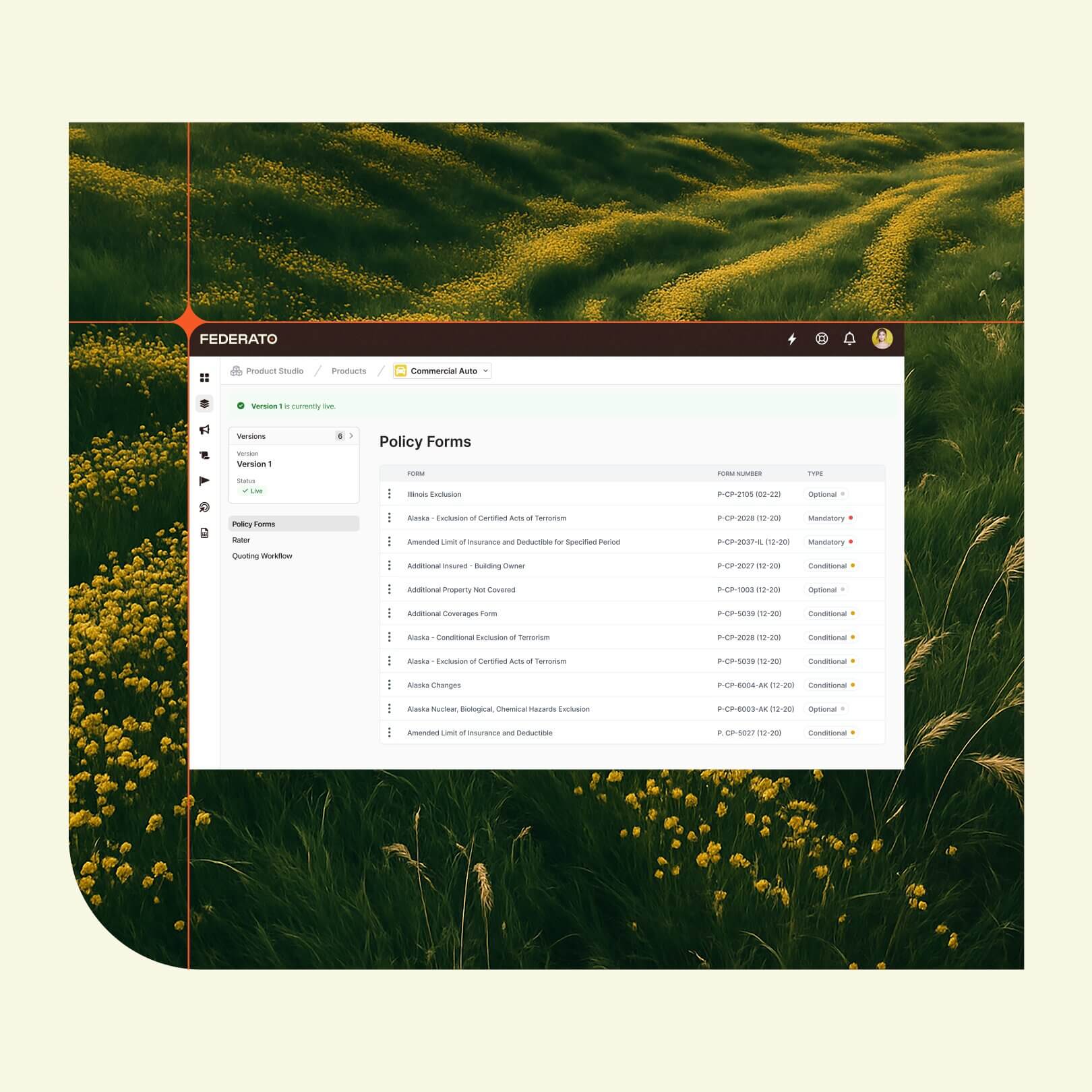
A single change also carries through the whole lifecycle. An update to a product definition reaches rating at quote, forms at issuance, and eligibility rules for both new business and renewals, so teams only have to make it once.
Other vendors are also applying AI to product setup. Duck Creek's Agentic Product Configurator, for example, generates product configurations for Duck Creek Policy from rating guides and forms, but it's currently offered in controlled availability through Duck Creek's Professional Services team as a statement-of-work engagement.
In Federato's Product Studio, product teams make and publish changes themselves. Every change is also logged, so when a regulator asks what was in force on a given date, the answer is on record.
AI added to an older core takes on that core's limits. It has to pull context from modules that were built to work separately, rely on fragile connections between them, and absorb delays that build up at each step. The result is often AI that speeds up an existing process without addressing any of the underlying issues.
Federato's AI agents and portfolio management are part of the core itself, so they share one platform and data foundation. The federated context graph maps how guidelines, product definitions, past decisions, claims histories, and billing insights relate to one another. The agents use that context to gather what a decision needs, apply the insurer's own rules, and produce a result for a team member to review and approve.
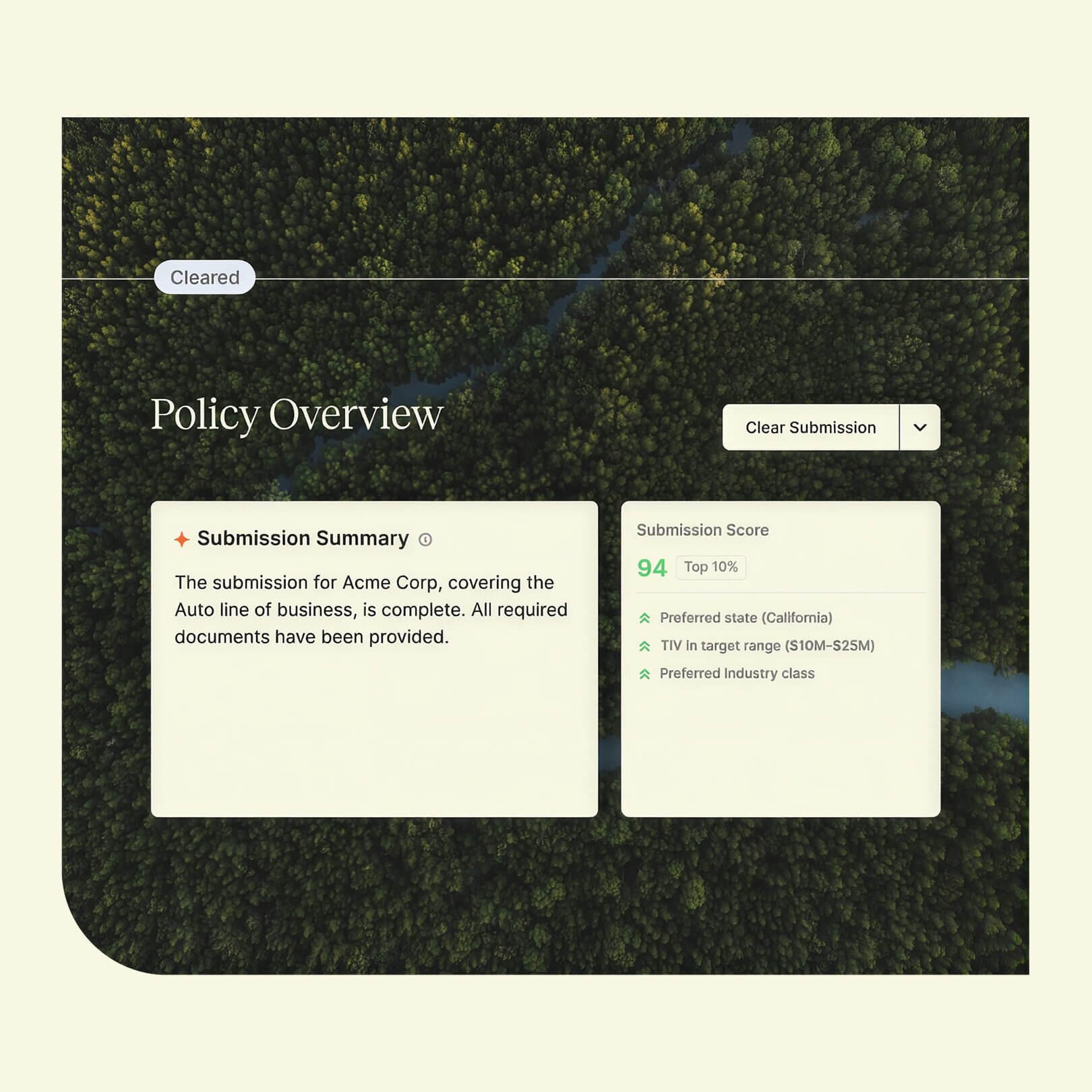
When a new submission comes in, Federato can:
Each quote comes with its reasoning and sources, so whoever reviews it can see why each number was chosen and refine it before acting. The audit trail builds up as the work happens, which gives compliance teams a clear record of each decision.
Velocity Risk, a commercial excess and surplus property insurer, has nearly quadrupled the share of its bound policies that meet its definition of high appetite.
Control Tower, Federato's portfolio oversight tool, turns portfolio strategy into three working parts:
Objectives and controls can be set at whatever level fits the business. A carrier might set them by line of business and program, while an MGA can give each program its own guardrails, which roll up into one view of combined exposure across its carrier partners.
That view also draws on billing and claims data. Billing patterns, such as rising delinquency, and claims trends, such as shifts in coverage decisions or reserves, can reach pricing and product teams while claims are still being handled. Then, if late payments start to climb in one program, for instance, the pricing team can review that segment's rates while there's still time to act.

Many established core systems have grown by acquiring other companies and connecting their products afterward. Take a broker who asks for a higher coverage limit partway through a policy term. The policy system updates the terms, a rating engine recalculates the premium, a document system produces the endorsement, and billing adjusts the next installment. When each step runs in a separate application with its own data model, any information that doesn't carry through leaves staff to reconcile records by hand, and an AI layer added on top has to work through the same connections.
Federato brings policy management, billing, and claims handling onto a single, shared data foundation:
Consolidation on this scale has paid off for insurers and MGAs. QBE North America replaced 14 tools with one, bringing seven lines of business and five systems of record into a single view for more than 300 underwriters and staff. HDVI, a commercial trucking insurer, consolidated nine separate systems into one and cut the time to quote a small fleet from one week to half a day.
Request a live demo to see how Federato brings policy, billing, claims, and portfolio management together on one AI-native core.
Guidewire is one of the platforms most often weighed against Duck Creek. Guidewire InsuranceSuite lets carriers architect custom workflows across policy, billing, and claims, with Guidewire PolicyCenter at the center of the policy administration system. Like Duck Creek, Guidewire focuses on property and casualty insurance and supports all lines of business, from personal and commercial lines to excess and surplus and workers' compensation.
Guidewire also sells a separate core, InsuranceNow, which is built for regional and super-regional insurers and MGAs in the US. InsuranceNow came from Guidewire Software's acquisition of ISCS in 2017, so the two cores have different origins. Insurers should confirm early on which product would apply to them.
Advanced Product Designer helps business users model products, though Guidewire notes that developers will still need to be involved for tasks such as rating, forms, and integration. More recently, Guidewire added an Agentic Framework to Guidewire Cloud Platform, the foundation under InsuranceSuite, along with agents for specific areas such as claims and underwriting. Guidewire describes its approach as keeping agents close to core data. As with other AI added to an existing core, though, the framework sits on top of separate applications, so its agents work through connections between them.
Key features:
Insurity takes a portfolio approach, with a separate policy product for each type of business rather than one suite for all of them. It sells cloud-based core systems to P&C carriers, MGAs, and brokers across commercial, specialty, personal, workers' comp, and marine cargo lines, and it deploys them on both AWS and Azure. For commercial and specialty insurers, it's a common alternative to Duck Creek.
Its insurance software offering includes Ratio Policy AI for complex commercial lines, Policy Decisions for carriers and MGAs, and Pro Suite, a modular core for growing carriers and MGAs. Separate suites cover workers' comp and marine cargo, and much of that range is a result of acquisitions. Insurers that write more than one type of business should check which products they'd need and how those products share data. Insurity works with system integrator partners alongside its own services team.
Key features:
Majesco sells a broad portfolio of insurance software, with separate P&C cores for carriers and for MGAs. It offers cloud core systems to P&C carriers in personal, commercial, specialty, and workers' comp lines, as well as to MGAs and managing general underwriters (MGUs). Like Duck Creek, its core suite covers policy, billing, and claims, and Majesco sells separate solutions for rating, underwriting, and distribution. It also sells software for life, annuity, and health insurers and for pensions, so its P&C products are one part of a wider portfolio. Most Majesco customers run on its cloud platform.
Intelligent Core is Majesco's main P&C suite, while CoreConnect is aimed at MGAs, MGUs, and smaller P&C insurers. Majesco works with several large consulting firms as implementation partners, so insurers should clarify which parts of an implementation Majesco would deliver and which would go to a partner.
Key features:
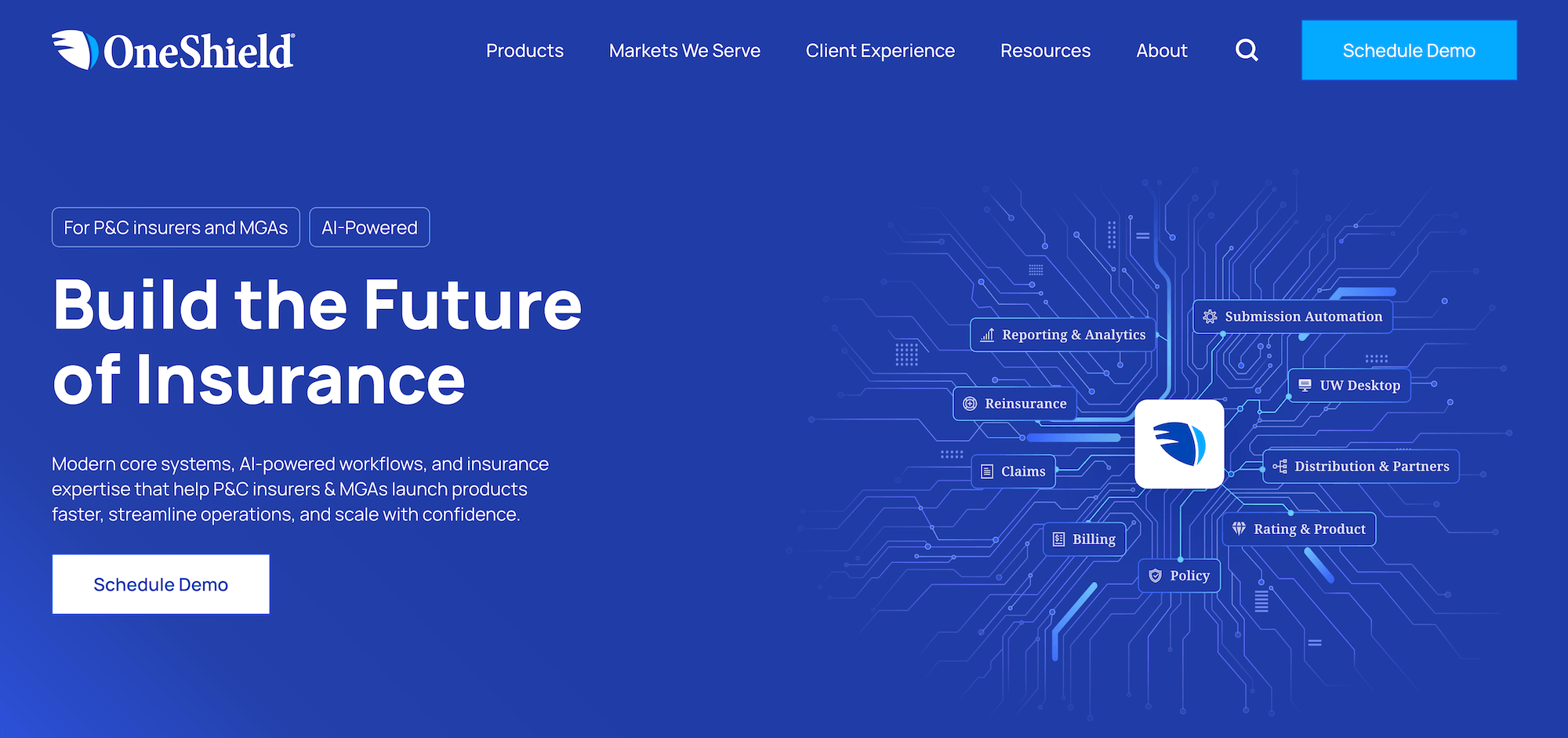
OneShield focuses on flexible delivery, letting insurers either run its core themselves or hand it to OneShield as a fully managed service. Its insurance software handles policy, rating, billing, and claims for commercial, personal, and specialty insurers, along with MGAs, MGUs, and program administrators. Its customers range from startups to multi-billion-dollar carriers, and its configurable cores can suit mid-market and specialty insurers that may find Duck Creek's full suite more than they need.
OneShield sells two core platforms. OneShield Enterprise includes modules for policy, rating, billing, claims, reinsurance, and relationship management. OneShield Market Solutions is a managed SaaS platform for MGAs, program administrators, and commercial and specialty carriers.
Key features:
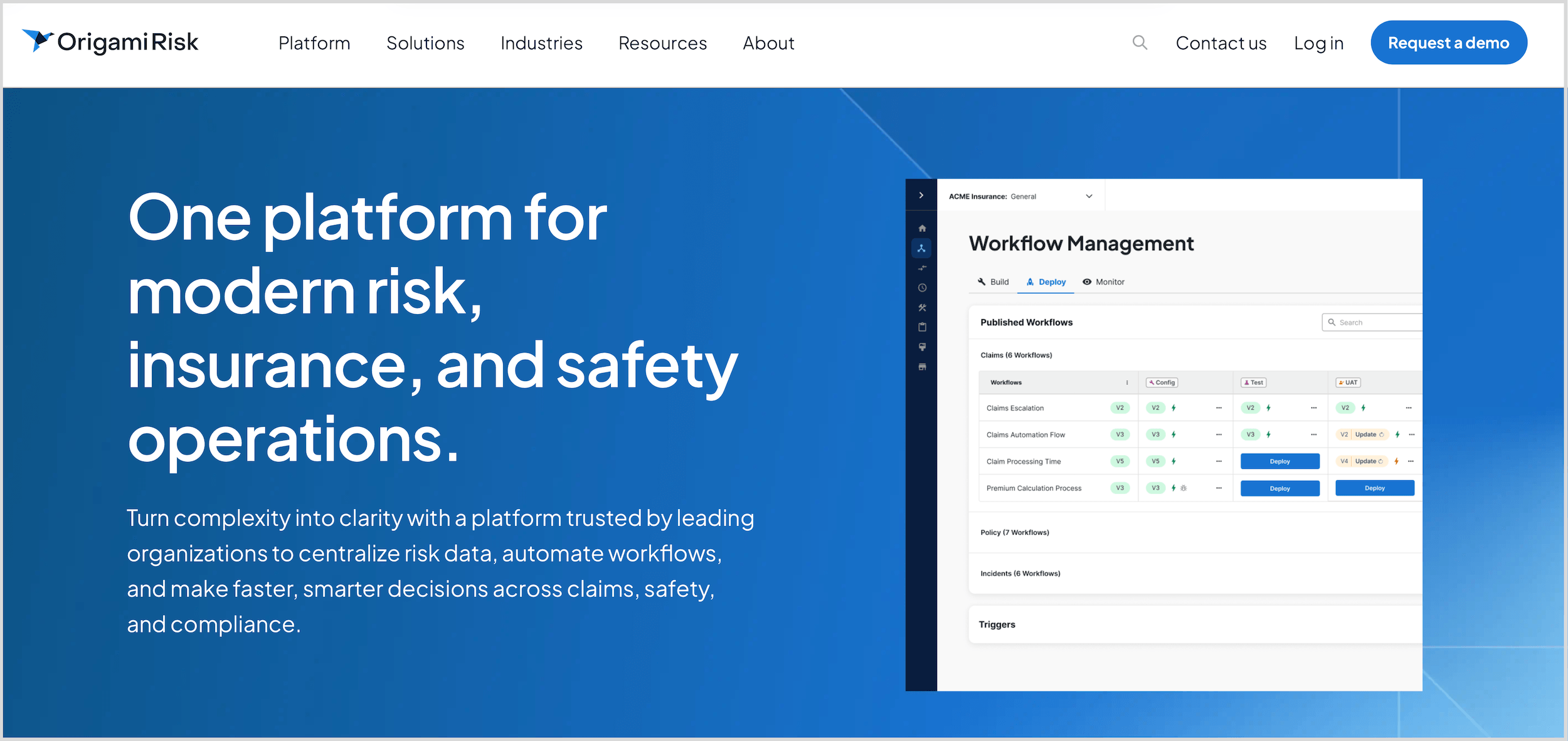
Origami Risk builds one platform for risk management, safety, compliance, and insurance, and its P&C core is one product on that platform. It sells the core to carriers, MGAs, risk pools, and third-party administrators (TPAs), and delivers it as multi-tenant SaaS on AWS, meaning one shared platform serves many customers.
Because the P&C core shares a platform with Origami's risk management, safety, and compliance products, insurers comparing it with Duck Creek Technologies, which focuses on P&C, may want to ask how much of Origami's roadmap goes to core insurance features.
Key features:

Sapiens builds its P&C suites around regional markets, with different core products for different parts of the world. It provides P&C core systems to insurers, MGAs, and brokers across personal and commercial lines, alongside a separate specialty business. Like Duck Creek, it covers policy, billing, and claims, with digital, data management, and analytics tools around the core.
CoreSuite for P&C serves several markets. TIA Enterprise, DIANASuite, and SCIPSuite complete the P&C lineup. Features and roadmaps can differ between products. Sapiens says CoreSuite customers can update forms, coverages, and business rules, so insurers should check what's included in the suite they’d use.
More recently, Sapiens announced SapiensAIP, which extends its existing core products with AI agents for work such as legacy data migration and configuration. Because the agents sit on top of those products, they work within the structure and data model of whichever Sapiens suite an insurer runs.
Key features:
Duck Creek implementations typically call for trained specialists and system integrator support. Whether that investment makes sense depends on an insurer’s size, in-house resources, and how quickly it needs to launch and change products.
Often the deciding question is how quickly a pricing or product decision becomes business your team can write.
Request a live demo to see how Federato's AI-native core can help your business grow premium while protecting margin.