Insurance
The agentic AI foundation: why bolt on fails and built in delivers
Federato

May 12, 2026
A year ago, Federato launched Orchestrate, a suite of tools meant to automate complex insurance workflows with agentic AI. In October 2025, that work led to a significant milestone:
This was more than a quick summary or a triaged list—it was end-to-end agentic underwriting that performed comprehensive, structured analysis, complete with auditable citations. Underwriters could interrogate and refine the output in natural language, staying in control while AI handled all of the busy work.
Since then, Federato has had over 350 conversations with carriers, MGAs and aggregators about agentic underwriting and policy administration. Insurance leaders around the globe across different lines of business have experienced an ‘aha’ moment when shown an AI solution that actually delivers the experience and outcomes they intuitively expect from it. The insurers we’re talking to are no longer asking how to apply AI, but what they need to change, fundamentally, to unlock the outcomes they now see are clearly within reach.
The last eighteen months have produced more AI announcements in insurance than the previous decade combined. As agentic AI gained traction, Old Core platforms rushed to respond. One vendor announced 13 new AI agents in a single release. Another acquired an AI startup for its IP and repackaged it as a “unified” platform. Meanwhile, a wave of startups assured the market they could make any existing stack “intelligent”— no migration required.
While these may sound like exciting advancements, they suffer from the same underlying, false assumption — that AI can be bolted onto foundations it was never built to work with.
AI technology is immensely powerful, but when bolted on instead of built in, it inherits problems from upstream systems:
Insurance data is a combination of large, unstructured documents and a comparatively small amount of relational data. A single building risk, for example, connects to locations, contractors, weather events, and prior losses, but only a fraction of these connections end up stored in a structured database. While experienced insurers know these connections instinctively, AI does not.
Unfortunately, simply dumping all of this data to the AI and saying “figure it out” has proven to be both costly and non-performant. Some carriers report spending north of a billion dollars and are still only performing basic triage. Countless others have engaged dozens of point solutions promised to work with their existing architectures only to ship a handful of brittle automations that need to be rewritten for each line-of-business.
AI uses tools to take actions and retrieve information from underlying systems. On the Old Core, those tools are brittle and spread across a patchwork of disconnected modules with different data structures and jerry-rigged APIs, making them poorly suited for supporting agentic AI.
Agentic AI also does not just operate in a single pass. It continuously replans, requests additional context, and re-invokes tools as it refines its output within a single task. Even a simple instruction like “re-rate this policy with a deductible change” can require up to 14 API calls across different rating engines. This iterative behavior overwhelms these tools, triggering timeouts and cascading failures that can escalate into a full outage.
Underlying both the context problem and the tools problem is a latency problem. With each tool call or context retrieval, underlying APIs and connectors move unnecessary amounts of data an unnecessary number of times between an unnecessary amount of systems. When each tool itself is underperformant, the compounding time delays can be staggering. If clicking a button in your Old Core system takes minutes to return a result, imagine what happens if an AI agent clicks that button several times in parallel.
While most vendors retrofit AI onto the Old Core, Federato cuts out your legacy PAS entirely, replacing it with an AI-native platform that spans the full policy lifecycle.
Migrating a PAS is no small feat, but Federato’s AI native architecture speeds up the process by automatically mapping and structuring your data into a consistent, opinionated schema. More importantly, the migration becomes an opportunity to recover and organize decades of institutional knowledge and operational logic that many assumed was lost when legacy system designers retired, making it actually usable for AI.
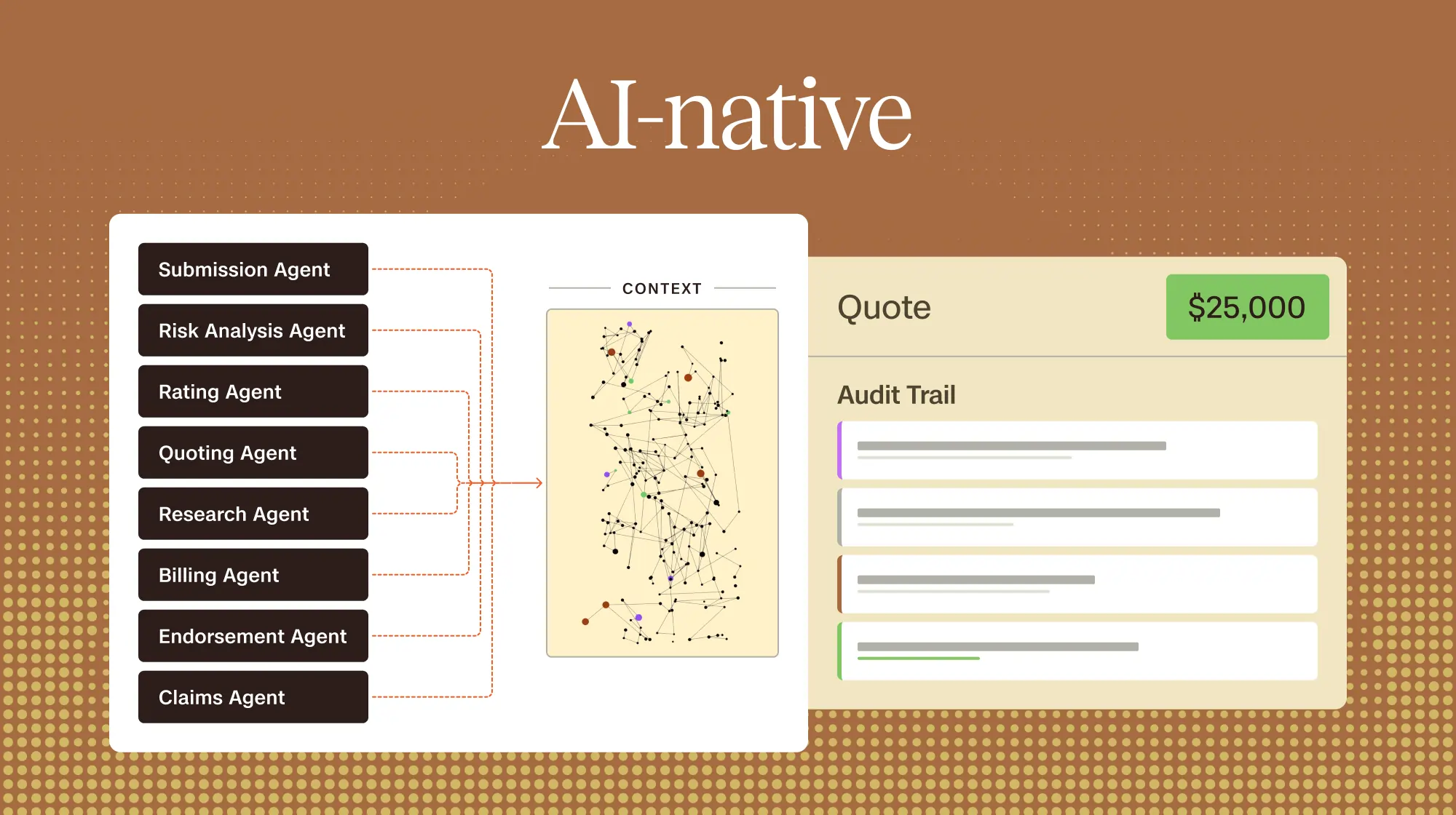
At the center of the platform is a Federated Context Graph: a living map of how guidelines, underwriting decisions, product definitions, claims histories, and billing insights in an insurer’s business fit together. This graph grows richer as new information is added over time. Because it is built on that structured foundation, Federato’s AI can navigate insurance context efficiently from the outset.
This matters more than it might seem. When relationships between data elements have to be pieced together from scratch every time an AI agent acts, speed and accuracy both suffer. The Federated Context Graph pre-maps relationships across insurer's data, so connections can be followed quickly to what matters for a given task. AI agents can then leverage that context to choose from a readily available set of tools and services within the platform to execute reliably, and provide a full audit trail of the information it used.
Here’s an example of what that looks like in practice:
This level of orchestration between context and dynamic tools is only possible with a built-in foundation, and it's exactly what makes a migration well worth it.
The impact of a strong AI foundation shows up in the numbers.
Take quoting as an example. Across carrier books today, less than 25% of bound risk aligns with an insurer’s own appetite, a reflection of how staggering the complexity in decision-making is. A single policy can involve 50 to 1,000 interconnected underwriting decisions, and small variances between decisions compound fast. Even two experienced underwriters reviewing the same submission will often land in different places.
When back-testing against real submissions and underwriting guidelines, Federato’s agentic quoting capabilities achieved 94% guideline adherence, far exceeding what humans achieve today, giving insurers a more consistent, auditable starting point.
If you are evaluating AI capabilities right now, one question cuts through the noise faster than any other: Is this a bolt-on AI feature, or is the entire architecture built to enable true AI transformation?
For Federato, that question is already answered. Over 350 demos in and climbing, several insurers have seen the difference. So the only question that remains is, have you?
Ready to see Federato’s agentic AI in action? Request a demo.