Insurance
P&C policy administration systems: 8 platforms compared (2026)
Federato

September 24, 2026
We've put together this guide for teams at P&C carriers and MGAs who are actively evaluating their insurance policy administration system (PAS) options. Because many readers are looking at this from the position of replacing or modernizing an existing system, we'll treat migration and integration as key evaluation criteria alongside the core features of each of the systems we evaluate.
This guide covers:
A PAS is the system of record for a policy from the moment it's quoted through every change made until the policy comes to an end. It holds the authoritative version of the policy's lifecycle, including what's covered, at what price, under what terms, what was changed, and when.
A PAS is essentially three things bundled together: a product engine, a system of record for compliance, and a connective layer to billing and claims.
The product engine is the rating, rules, and forms logic that determines what an insurance carrier or MGA can sell, at what price, and under what conditions. It covers:
A PAS has to track what terms applied to an insurance policy at any given point, who made each change, and when. Regulators, reinsurers, and parties to a dispute will all need access to that information later.
This is also where bureau content comes in. ISO, AAIS, and NCCI rate, rule, and form updates have to make it into the system and apply correctly across every affected policy, in every state a carrier writes in.
A PAS doesn't operate in isolation. Billing needs to reflect policy issuance and endorsements because those transactions can change the premium owed. Claims management needs to know what coverage was in force on the date of loss, including any earlier endorsements that changed it.
How tightly a PAS integrates with those systems determines whether that information moves automatically or has to be manually reconciled.
For a broader look at how these platforms fit into a carrier's wider technology stack, see our guide to insurance core systems.
When a system struggles, teams tend to see friction in all of these layers. To see a true change, the question isn't which piece to patch, but whether the PAS foundation can really provide the support the business needs.
The next section breaks down the specific criteria to evaluate that against.
P&C carriers and MGAs run into issues with their PAS in several specific areas. Understanding this can give you criteria to evaluate any PAS against, whether you're comparing vendors or assessing whether a current system is still workable.
A product owner who needs to adjust a deductible ahead of hurricane season, or an underwriter who wants to tighten a rating factor on a class of business should be able to make that change directly. On most legacy systems, they can't, because the change goes into an IT backlog behind whatever else is already queued up.
This hurdle is still commonplace in the industry. When we researched the Federato 2026 State of P&C Insurance Technology, we found that 64% of insurers depend fully or mostly on IT to implement operational changes.
Slower configuration means slower quotes, and slower quotes mean losing volume to faster competitors. To make matters worse, over time, that can skew a book toward adverse selection.
Here, the question is whether a system shares data with billing and claims as transactions happen, or only on a batch schedule or through manual reconciliation. A policy bound in the late afternoon should show up as premium owed in billing that same day, just as a claims adjuster investigating a loss should see the endorsement that changed a coverage limit before the date of loss.
When a PAS relies on batch processing, it creates a lag between when a policy transaction occurs and when the rest of the business can see it. That lag causes confusion for policyholders and internal reconciliation problems. In our report, we found that while 91% of leaders believed they had good or full visibility into their teams’ KPIs, only 27% of underwriters said they had full, real-time portfolio visibility. These findings point to a gap between leadership’s view of performance and the information available to underwriters as they work.
The problem also compounds with age. Carriers that have been on the same PAS for 15 or 20 years are often sitting on policy data in formats that don't translate cleanly to other systems. That data has to be pulled out, reformatted, and re-entered by hand before anyone else can use it, and every new integration requires the same manual step.
A robust, modern PAS should also perform a share of the routine servicing work—like endorsements, renewals, and data entry between systems—without manual intervention.
In our research, we also dug into the real operational costs of manual coordination. We found that on average, companies are losing five hours per employee per week, or roughly $10,145 per employee per year, to manual coordination work. For a 500-person operations team, that adds up to about $5.1 million annually.
Whereas legacy platforms tend to turn each new mandate into a one-off patch, a strong system absorbs new regulatory requirements as part of its design. A workers' comp rate change, or a new mandated policy form in a state that just updated its filing requirements, has to reach every affected insurance policy in every state a carrier writes in, correctly and on the effective date the regulator set.
The more patches accumulate, the harder it becomes to prove exactly what terms applied to a policy at a given point in time. And when a company has thin audit trails, it also raises the cost of capital, since reinsurers and other capacity providers price partly on how well a carrier can evidence its own underwriting discipline.
Not every PAS is built with the same buyer in mind. Some are designed around enterprise carrier operations, with a single underwriting hierarchy and one set of guidelines. Others are built around the multi-party, multi-program structures common at MGAs, where a single book of business might run under three different carriers' delegated authority agreements, each with its own limits and reporting terms. Putting an MGA's business on a PAS built for enterprise carriers, or vice versa, tends to leave gaps that force teams to come up with workarounds later.
This is why it's important to ask vendors who their platform was built for and how many customers of your size and structure they currently support.
Replacing a PAS means moving years, sometimes decades, of policy data into a new system. Much of that data sits in formats or field structures that don't map cleanly to a modern schema, and some of what matters most, like the judgment calls underwriters made on marginal risks, was never recorded as structured data in the first place. A migration that just moves data risks losing that institutional knowledge.
Industry-standard PAS migrations commonly run 12 to 15 months. That's long enough that many carriers choose to keep patching an aging system rather than absorb the disruption of a full replacement, even when they know the legacy system is costing them more every year.
Before writing off the idea of an entirely new PAS, it's worth asking about a vendor's track record on migration, finding out how long its recent projects really took, and whether the data came through intact, because migration doesn't have to be the multi-year ordeal carriers have come to expect.
Once you've weighed these criteria against what you know about your own operation, you can use them to evaluate the P&C PAS options below.
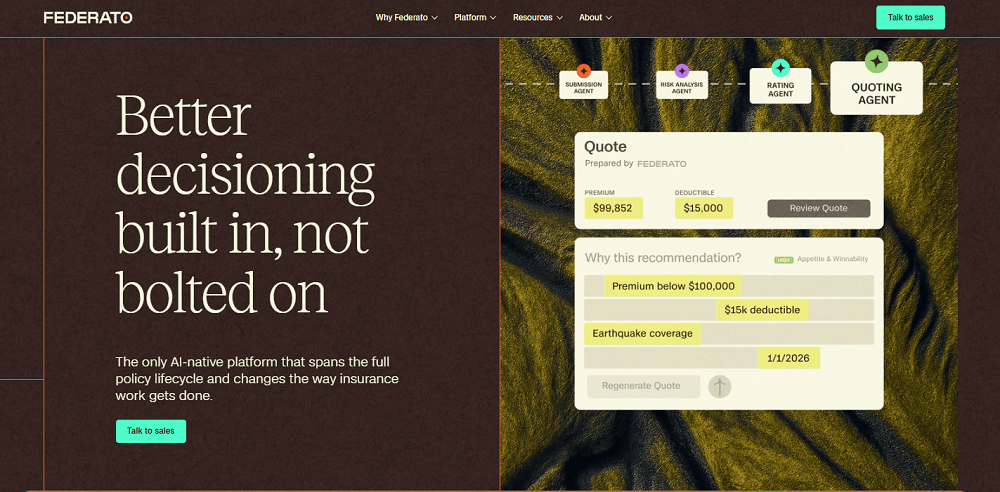
Federato is an AI-native core system for P&C and specialty carriers and MGAs, built so the policy record, the billing, and the claim all sit on one foundation. It runs the full policy lifecycle, from quoting and issuance through endorsements, renewals, and the end of a policy's term.
That foundation is what separates Federato from a traditional PAS. Rating, product definitions, policy data, and portfolio position all live in one system, so a change made in one place carries through the rest of the lifecycle automatically.
That unified core is also what lets Federato do more than just administer the policy. Most property and casualty insurance software stops at policy administration, but Federato's AI triages submissions, surfaces the highest-value business, and gives underwriting teams real-time feedback and portfolio-level visibility, all from the same system that issues and services the policy. For many carriers and MGAs, that's the centerpiece of a broader digital transformation effort.
With Federato, rating, forms, eligibility, coverages, deductibles, limits, and endorsements live in one structured product definition on a single schema, which enables us to carry a change through quoting, issuance, and servicing automatically. On most legacy systems, the same change means updating a separate rating engine, a separate forms library, and a separate underwriting rules table by hand.
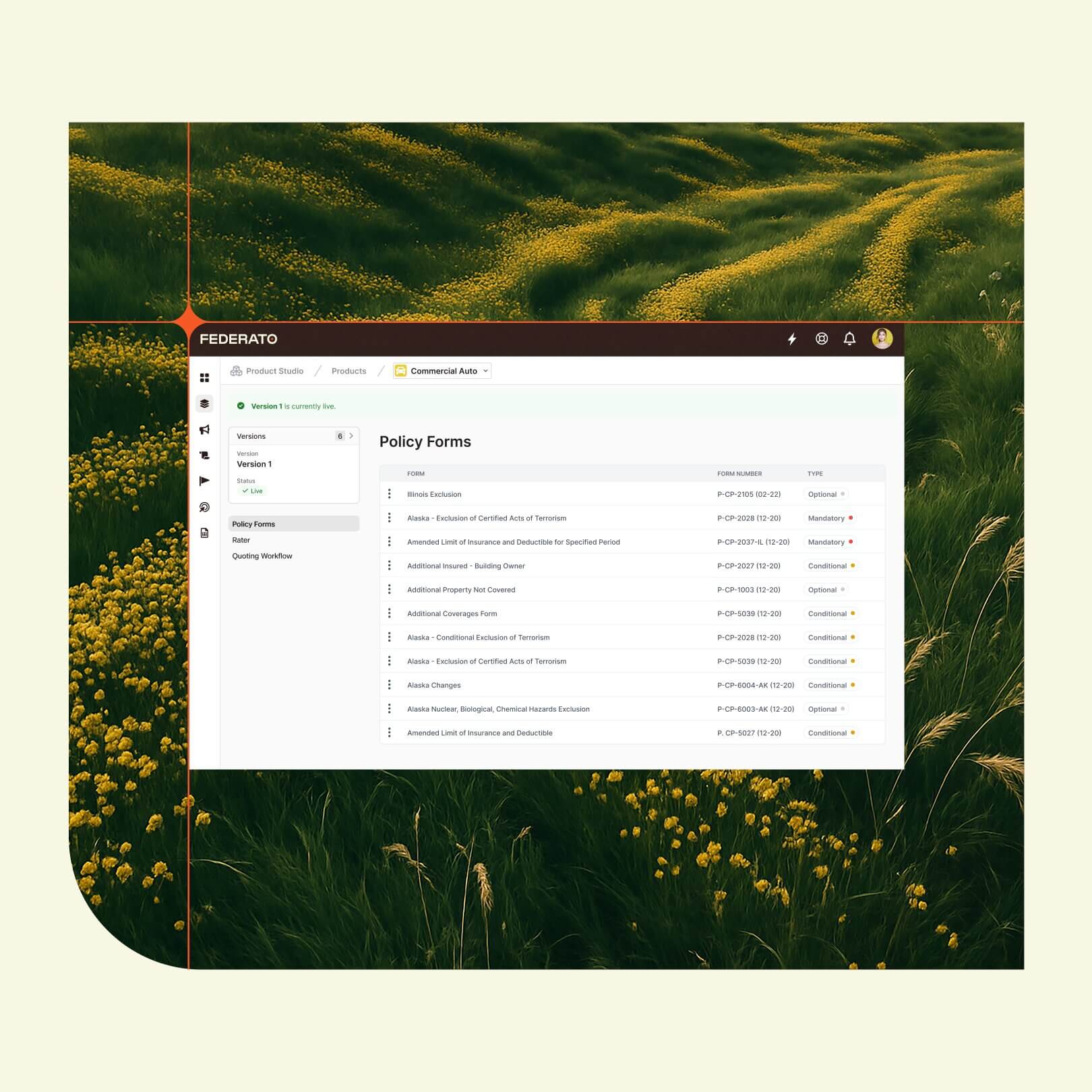
Issuance, endorsements, renewals, and the end-of-term process all draw on that same product definition used at quote, so a mid-term change applies consistently on the servicing side. Producers and policyholders can also initiate certain policy changes and service requests directly, with each update recorded against the same policy.
We call this system Product Studio, and it's the product configuration layer administrators use to manage every part of a product definition in one place.
Billing and payments run on the same foundation as policy administration, so rising delinquency in a segment or cancellations concentrated in one distribution channel become visible to underwriting directly. On most legacy stacks, the same pattern surfaces weeks later in a separate finance report, if it surfaces at all.
Claims data stays available while a claim is open, so a pattern in early loss severity can shape underwriting before it shows up in the loss ratio months down the line. Claims management and underwriting run on the same data foundation here, which is part of what makes the feedback loop fast. Policy history, including every endorsement and coverage change made during the term, carries forward into renewal automatically, so the renewal underwriter isn't reconstructing what happened over the prior 12 months from scratch.
Federato checks incoming submissions against an insurance carrier's own rules, appetite, and current portfolio position, and admins can configure it to automatically decline submissions that clearly fall outside appetite. For submissions that fit, Federato produces a first-draft quote within minutes, then underwriters stay in control to review, edit, and approve before anything goes out.
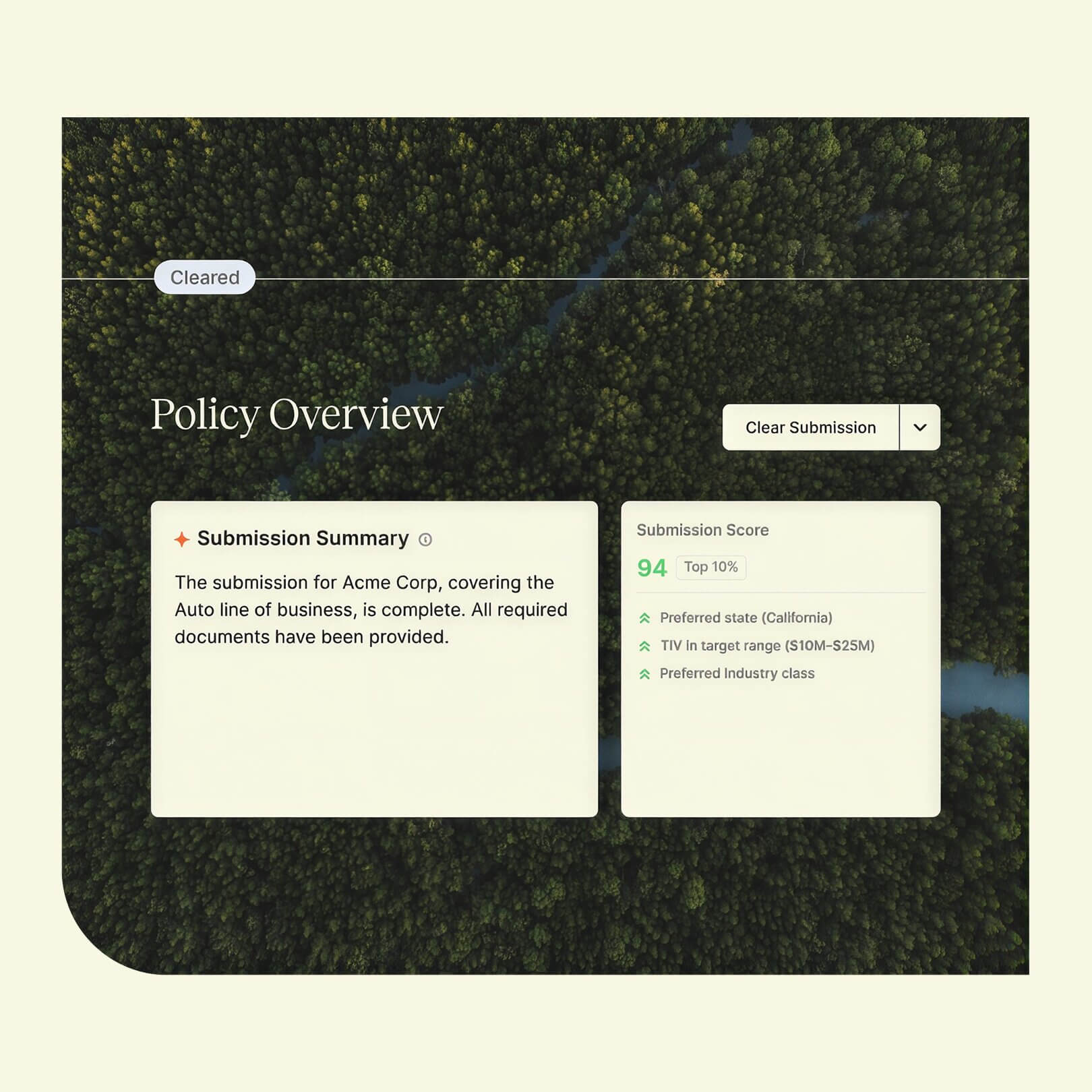
Winnability scoring draws on machine learning models trained on historical performance, referral patterns, and how brokers and agents have engaged on past submissions. Out-of-sequence endorsements, a routine headache on most legacy systems, are reconciled automatically, with affected changes reapplied and premium recalculated without manual cleanup.
Every version of a product definition ties to specific policy effective dates and records who made a change, when, and what the values were before and after. That's the level of detail a carrier needs on hand when a regulator or reinsurer asks what terms applied to a policy on a given date.
In Federato, a base product is defined once, with state-level overrides applied only where a state's rules require something different. A single product definition can cover all 50 states, so entering a new one doesn't mean rebuilding rating and forms logic from the ground up. Jurisdiction-specific taxes, fees, and regulatory charges get calculated in billing on the same foundation, with compliance logic built into the platform itself.
Most platforms treat a large enterprise carrier's underwriting operation and an MGA's delegated authority structure as two fundamentally different problems, which usually means building or buying separate systems for each. Federato takes a different approach. Instead of maintaining two products, it runs both on the same underlying schema, then configures the guardrails, hierarchy, and reporting to match how each business actually operates.
When guidelines, underwriting rules, product definitions, claims history, and billing data all live in separate systems, an underwriter, or an AI system acting on their behalf, has to move between them just to get through a single submission. A single, unified data model removes those boundaries, so the same platform can fit a 300-underwriter carrier's multi-line hierarchy or an MGA managing delegated authority across several carrier programs, without either one inheriting a system that was really built for the other.
For a closer look at how this plays out for MGAs specifically, see our guide to MGA insurance software.
The results speak for themselves. QBE, a large carrier, consolidated 14 tools into one across more than seven lines of business, five systems of record, and 300+ underwriters. HDVI, an MGA, cut the time to quote a small fleet submission from a week to half a day after consolidating nine separate systems into one. In both cases, the results came from configuring the same underlying platform to fit very different businesses.
Federato's platform automatically maps and structures existing policy data into a consistent schema during migration, rather than treating the move as a one-time export-and-reload job.
Our reusable product templates with configurable defaults shrink product setup from a multi-tool, multi-week process into a single guided workflow, and once a product is live, a single change carries through rating, workflows, forms, and servicing automatically instead of being rebuilt system by system.
Hill Country is the clearest evidence of what that speed looks like in practice. The carrier implemented in four months, against an industry standard of 12 to 15 months, and went from $0 to $10 million in written premium in under ten months. What's more, its underwriters' daily capacity more than doubled, from 2–3 accounts a day to 5–10.
Request a live demo to see how Federato unifies policy administration, underwriting, billing, and claims on one AI-native platform.
BriteCore is a cloud-native policy administration platform built on AWS, covering policy, billing, claims, and document management in one system. It offers a headless core deployment option, letting an insurer modernize core operations while keeping its own front-end applications.
Point and Click Editors let teams configure rating and underwriting rules directly, and persona-based executive dashboards and a library of standard reports give teams built-in analytics, with the option to build custom views on top. Automated cloud deployments let a team spin up a new pilot program and just as easily spin it down, with version control tracking changes along the way.
Key features:
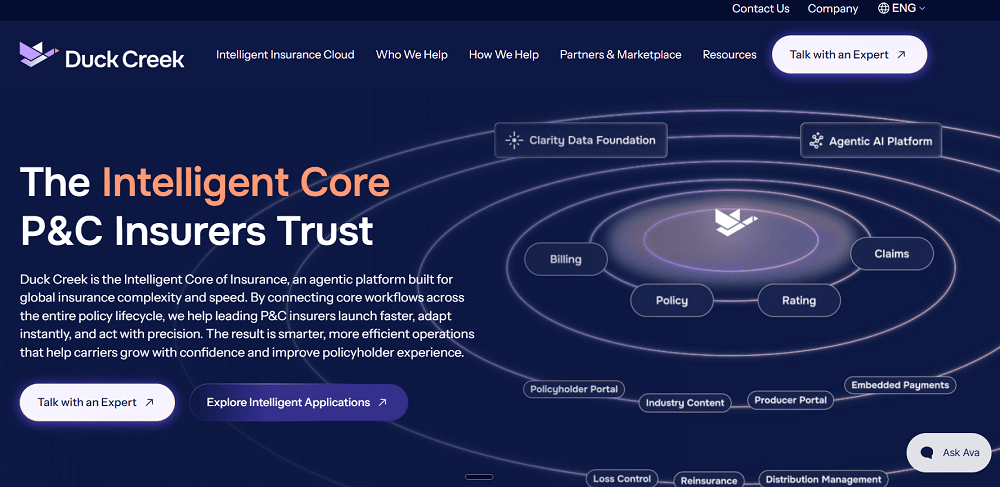
Duck Creek Policy is a low-code policy management product, sold standalone or paired with Duck Creek's billing, claims, and rating products.
A multi-level inheritance model supports flexible product design across admitted and specialty lines, and Duck Creek lists specific support for commercial auto with multi-state and multi-segment handling, personal auto, homeowners, workers' compensation, medical professional liability, and pet insurance. The platform connects to more than 2,600 APIs and over 100 pre-built partner integrations, covering things like geolocation, e-signature, and other third-party data services.
Key features:
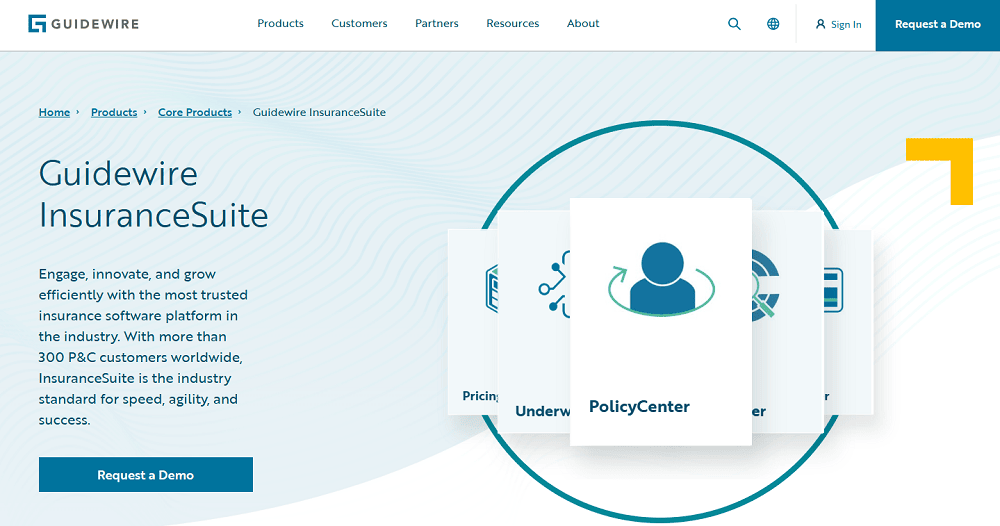
Guidewire PolicyCenter is the policy administration component of Guidewire InsuranceSuite, typically deployed alongside BillingCenter and ClaimCenter. It's available through Guidewire Cloud or as a self-managed deployment.
Guidewire software can also include InsuranceNow, a lighter, cloud-based platform positioned specifically for regional and super-regional U.S. carriers and MGAs, sitting beneath the flagship InsuranceSuite.
Key features:
Insurity offers two separate products: Policy Decisions for larger insurance carriers, and Pro Suite (formerly Sure MGA) for MGAs, specialty carriers, and other intermediaries.
Policy Decisions centers on what Insurity calls "Regulatory-as-a-Service," handling bureau monitoring and automated rate, rule, and form updates within the platform. Pro Suite is built for delegated and multi-carrier business, with browser-based, self-service product configuration aimed at reducing IT involvement in new product launches.
Key features:
Majesco Policy for P&C is part of the Majesco P&C Intelligent Core Suite and can run standalone or as part of that suite. It's available on-premises, hosted, or through Majesco's own cloud environment, CloudInsurer, and supports personal, commercial, workers' compensation, and specialty product lines.
Configuration runs through Dev Studio, where a unified worklist pulls tasks from policy, billing, and claims into one place, and a customizable landing page gives each user role-based views and widgets. Majesco also offers a Glovebox integration for consolidated policy and billing views, along with catastrophe management tools that surface AI-generated insights ahead of an event.
Key features:
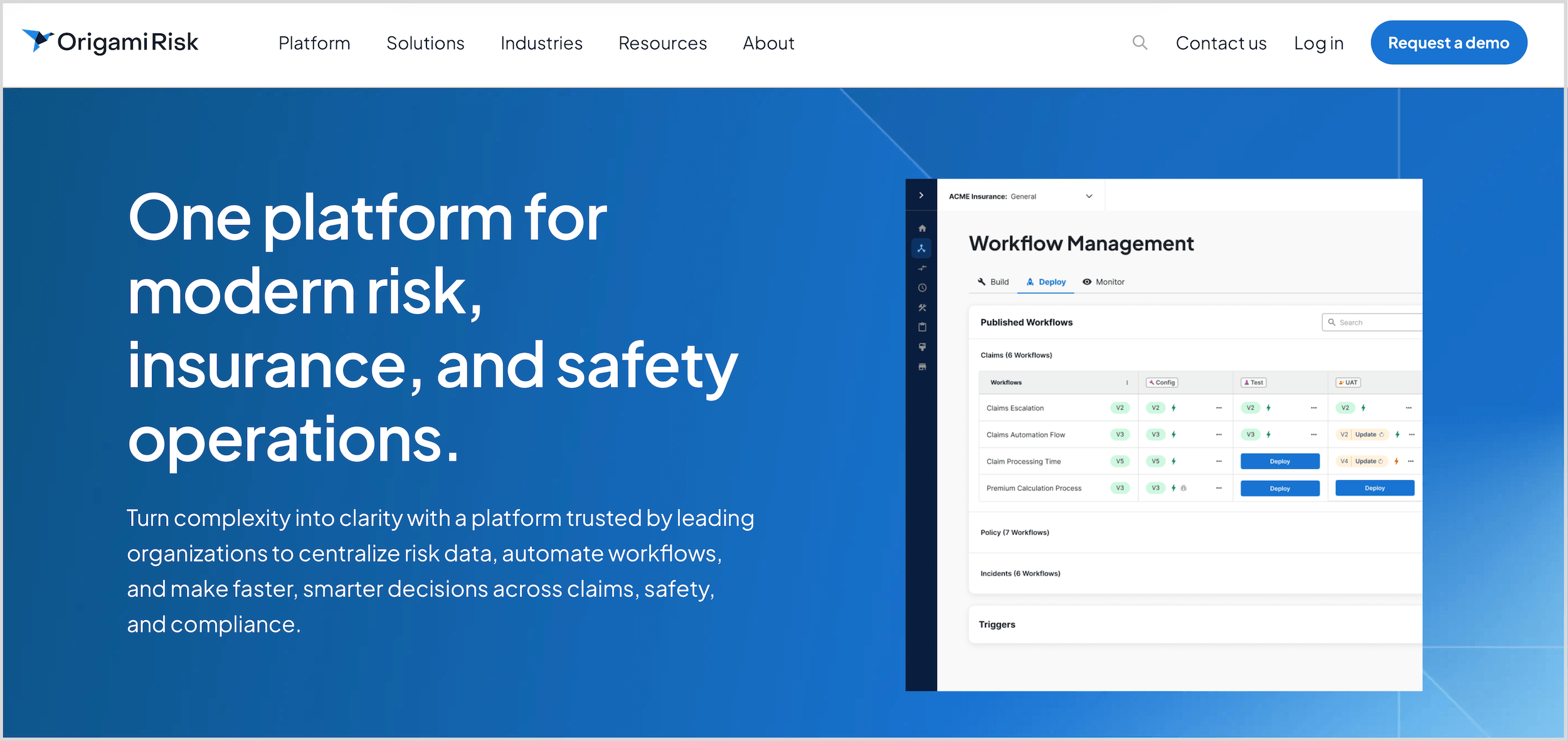
Origami Risk offers a cloud-native policy administration platform alongside billing and claims products in its broader P&C suite. It's built specifically for insurance carriers, MGAs, risk pools, and third-party administrators.
Agency Management Tools give carriers and MGAs direct control over agent and broker onboarding and distribution, alongside a modern buying experience for agents, insureds, and members. Native API integrations connect the platform to ecosystem partners, and rules-based reviews with exception controls support underwriting decisions across the policy lifecycle.
Key features:

Sapiens offers two P&C policy administration products: CoreSuite for Property & Casualty, aimed at the North American market, and IDITSuite, a more internationally oriented modular suite that offers multilingual and multicurrency support.
PolicyPro is the specific policy administration module within CoreSuite, handling quoting, issuance, and administration, alongside BillingPro and ClaimsPro.
Key features:
Every platform in this guide can run an insurance policy through its lifecycle. Where they differ is how well they hold up against the six criteria covered earlier: configurability, cross-system data, automation, P&C regulatory support, carrier or MGA fit, and ease of migration and integration.
While many platforms still treat administration as a loop that starts and ends with the policy record, the most robust platforms keep policy data connected to underwriting, billing, and claims as the work happens.
Federato administers the policy, and it uses the claims, billing, and renewal activity that feeds back into that policy in real time to help decide what should be written, at what price, and whether it fits the current portfolio.
Request a live demo to see how Federato brings policy administration and underwriting decisioning together on one platform.