Insurance
6 best property and casualty insurance software platforms (2026)
Federato

August 31, 2026

P&C insurance software covers a broad range of platforms, from core systems that support much of the policy lifecycle to point solutions for underwriting, submission intake, rating, and claims. Because these solutions vary so widely in scope, it can be hard to tell which problems a given system actually solves and how much of the insurance workflow it covers.
That’s important because optimizing one part of a workflow doesn’t always remove the work around it. An underwriting tool might help to prioritize incoming submissions, for example, while still leaving underwriters to check appetite, calculate rates, and build quotes themselves.
For insurers that already receive more submissions than their teams have time to pursue, a useful way to compare platforms is to look at how much manual work they remove and how well they connect data and decisions across the policy lifecycle.
When searching for a platform, we recommend considering three main factors:
Nearly every modern platform uses AI in some form, like extracting data from submissions and scoring risks. The real question is how far that automation goes.
A tool that reads, scores, and prioritizes submissions can improve triage, but if the underwriter still has to gather the remaining information, run the rate, test scenarios, and build the quote, much of the time-consuming work remains.
What’s less common is software that can carry a submission through to a priced, review-ready quote. By taking the submission further toward a final price, these platforms can help insurers quote a larger share of the opportunities they receive and get a credible price back to the broker or agent while the opportunity’s still available.
A software that completes more of the workflow also keeps a clearer record of how decisions are made and what the portfolio looked like at the time. In turn, it gives better evidence to reinsurers and capacity providers that underwriting decisions followed the insurer’s stated strategy and controls.
In practice, P&C insurers often rely on a mix of systems for different services like underwriting, rating, policy administration, billing, and claims, with many underwriters needing to work across six to ten applications just to evaluate and quote a submission.
The problem isn’t limited to software. Underwriting guidance also lives in PDFs, spreadsheets, or other static documents, compelling underwriters to hunt for information across disparate sources and to keep more context in their heads when making a decision. This means the rules for a risk are in one place, while the current portfolio context needed to apply those rules is somewhere else.
Consider an insurer that wants to keep its restaurant exposure below $50 million in a certain area and has already written $46 million. A new $10 million submission might still meet the insurer's appetite guidelines, but accepting the full risk would push the portfolio past its target. If the underwriter has to check a separate portfolio system to see that exposure, the written guidelines alone won’t tell the full story.
Bringing these functions together can solve much of the fragmentation. However, buyers should look beyond whether a vendor describes its product as a “single suite,” since the modules within that suite may still have been built separately and connected later.
In those cases, different modules may use separate data models and rely on APIs or integration layers to pass information between them. This means data may need to be mapped, translated, or reconciled as it moves through the system.
For buyers, the key question is what this architecture lets them do in practice. A platform with a shared data foundation can bring current appetite, portfolio exposure, and other relevant context directly into the underwriting workflow, so underwriters can make decisions using an up-to-date view of the book without assembling that view across separate systems.
Without a shared data foundation, AI may not have direct access to all the information needed to make decisions across the policy lifecycle. If submissions, rating, policy records, billing, and claims live in separately built systems, the AI has to pull that context together across integrations before it can act. When that context is incomplete, AI is limited to narrower tasks like reading documents, summarizing information, or flagging issues, rather than doing work that depends on data and rules from across the insurance operation.
That’s why buyers should look carefully at what a vendor means when it describes its platform as "AI-native." In some cases, the AI has been layered onto an older system or onto products that were built separately and connected later, which is why we refer to such systems as bolted-on AI.
A platform built from the ground up with AI in mind offers a broader and more accurate context to work from. Rather than treating the submission as an isolated file, it can better evaluate it in light of more factors like the insurer’s appetite, rating logic, policy wording, portfolio position, and past decisions.
With those criteria in mind, here’s how six leading P&C insurance software vendors compare:
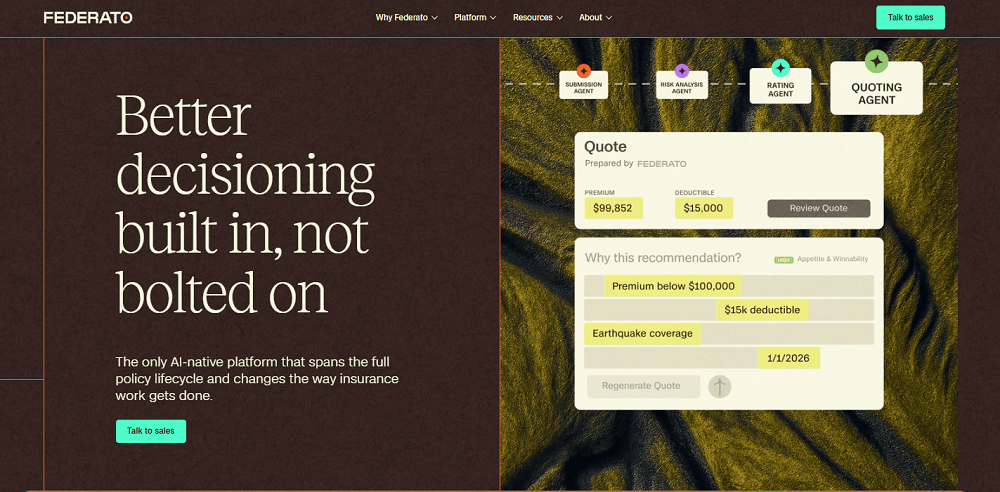
Federato supports the full policy lifecycle across underwriting, policy administration and servicing, billing, and claims, giving teams an accurate and up-to-date view of account, policy, and portfolio data at each stage.
That broader context allows the platform to automate more of the work around each decision, apply business rules consistently, and reduce the need for teams to gather or reconcile information across systems. For underwriters, that means the strongest submissions can arrive already prioritized and priced, so they spend less time building quotes from scratch and more time reviewing and acting on opportunities that fit the insurer’s appetite and goals.
Below, we show how that works in practice.
When a submission arrives, Federato reads the message and its attachments, then determines whether it contains a new submission or correspondence related to a deal already in progress.
It then checks the submission against the insurer’s rules, underwriting guidelines, historical data, and current portfolio position to determine whether the risk fits the insurer’s appetite at that point in time. Admins can configure the system to automatically decline submissions that don’t fit so underwriters don’t spend time reviewing business they would ultimately decline anyway.
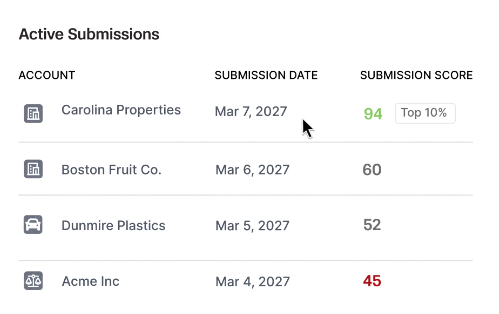
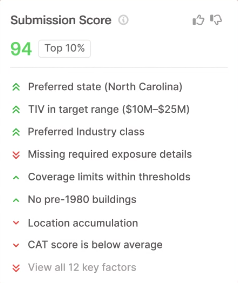
Only submissions that clear the appetite check are then scored for winnability, since scoring for winnability first could push easy-to-win deals to the top of the queue even if they’re a poor strategic fit.
Estimates of winnability are based on historical performance, referral behavior, and interaction data, including the outcomes of similar submissions that were previously quoted, won, or declined, as well as what individual brokers and agents have decided in past cases. The models also continue to learn from human feedback, incorporating institutional knowledge over time.
On the producer side, agents and brokers can check the Producer Portal to track an application’s progress, view outstanding requirements, and see next steps. The portal also displays balances, invoices, payment activity, and commissions, with commissions recalculating in real time as policies change and payments settle.
Producers can also initiate policy changes and service requests on behalf of policyholders. Because the portal operates on the same policy lifecycle as underwriting and billing, agents and brokers are always working from current information rather than a static view of the policy.
Once Federato has identified a strong opportunity, the platform drafts a quote using the insurer's own rates, policy wording, and current portfolio position.
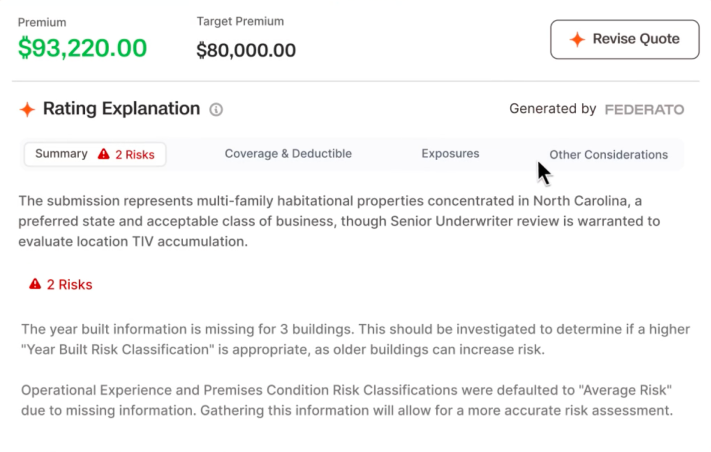
The underwriter can then make any necessary adjustments and approve or amend the price. The rating explanation appears alongside the quote, so the underwriter can see the premium and the logic behind it, including flagged risks, coverage, and deductible terms that influenced the price.
Each data point also includes context such as its source, a confidence score, and cited references. This allows the underwriter to trace a figure back to an attachment, integration, or external source without leaving the workflow.
Nina Chiapetta, VP of Business Development at Velocity Risk, describes the target her team set once quotes could be prepared before an underwriter opened the file: "We set a goal that by noon each day, each underwriter should have quoted the best three or four deals on their desk. To do that, they have to focus on what's in-appetite and winnable, rather than which brokers are most vocally calling for a quote.”
One of the biggest benefits of a unified insurance platform is that underwriters can see the company’s current appetite and existing portfolio exposure while they evaluate a submission, rather than relying on a (possibly outdated) guideline document or switching between separate systems to understand whether a risk still fits the company’s strategy.
Federato connects portfolio strategy directly to the underwriting workflow, so guidance changes as the portfolio changes. Below, we look at how the platform turns strategy into live guardrails and then feeds billing and claims information back into those decisions.
Control Tower turns portfolio strategy into live rules that operate inside the underwriting workflow. These rules stay connected to current portfolio data, so they can change as the book changes.
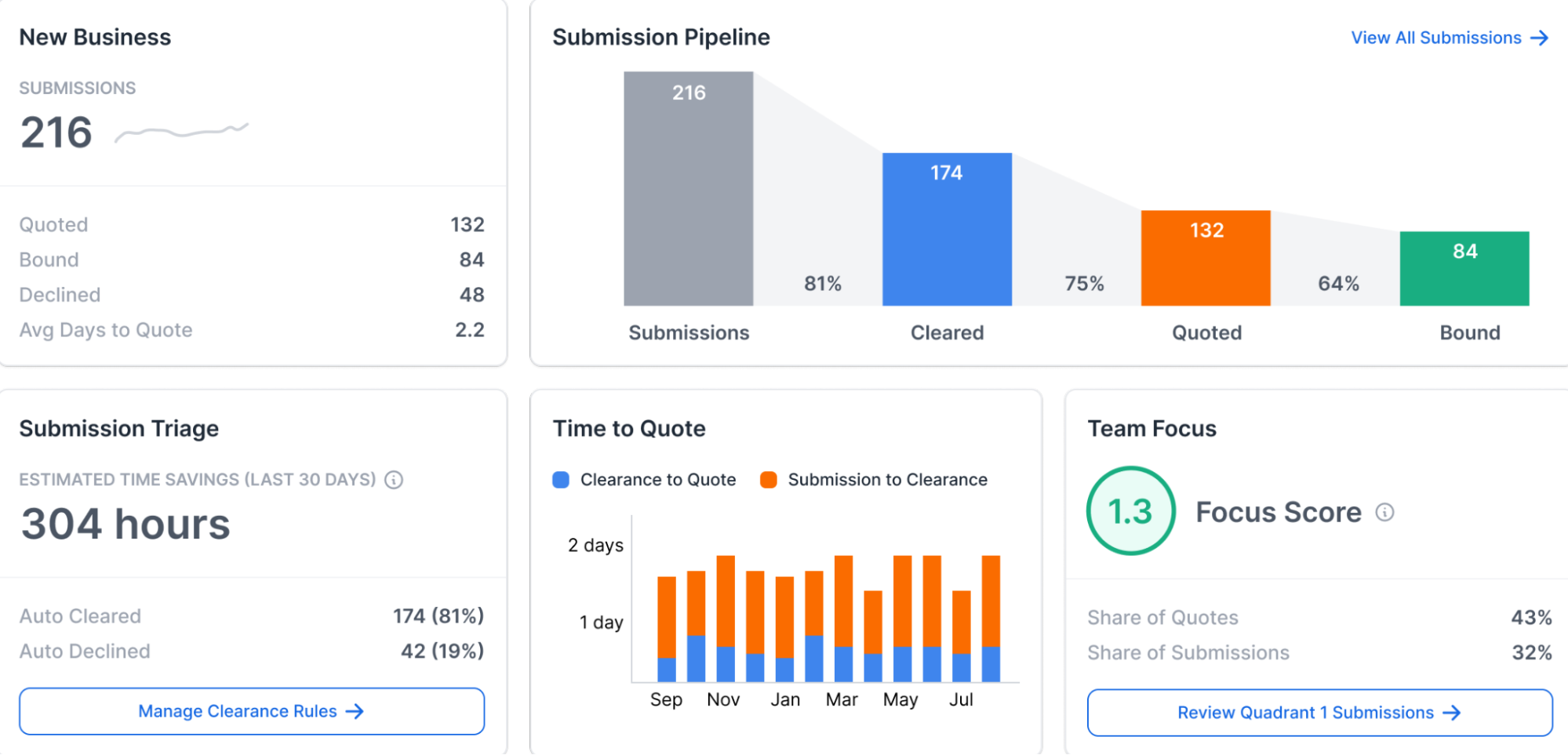
The system does this through three main components: Goals, Controls, and Insights.
Because these guardrails use live portfolio data, the guidance applied to new submissions can change as the book changes. If a segment starts approaching an exposure limit or market conditions shift, leadership can update the relevant rules and have them take effect immediately.
Federato continues to manage the policy after it’s bound, including issuance, endorsements, renewals, and cancellations. Those changes use the same product definitions that governed the original quote, so teams aren’t maintaining separate rules for quoting and servicing. Producers can also submit policy changes and service requests on behalf of clients, with each update recorded against the same policy record.
Billing and Payments uses the same data foundation as underwriting and policy administration, which gives leadership more context on how the book is performing after bind. Federato can surface which segments have higher delinquency rates or which distribution channels produce more cancellations, giving leadership a fuller picture of portfolio quality. After all, a segment that looks profitable when policies bind may look less attractive once payment and cancellation behavior are included.
Federato Claims adds another source of feedback by making claims information available while these are still open, rather than only after they close. By keeping policy wording, coverage decisions, and reserve changes together with their supporting context, the platform can help surface patterns sooner.
In many insurance platforms, pricing may live in a rating engine, forms in another tool, and eligibility or underwriting rules somewhere else. As a result, even a simple product change can require updates across several systems.
Changing one coverage option can therefore require matching updates to rating logic, eligibility rules, forms, and policy administration setup, usually with help from IT, because every connected system has to stay in sync.
Federato built Product Studio so administrators can manage rating, forms, eligibility, coverages, and other product rules in one place. Because these elements share the same underlying product definition, a change can carry through quoting, issuance, and other related parts of the policy lifecycle without teams having to update the same definition in several places.
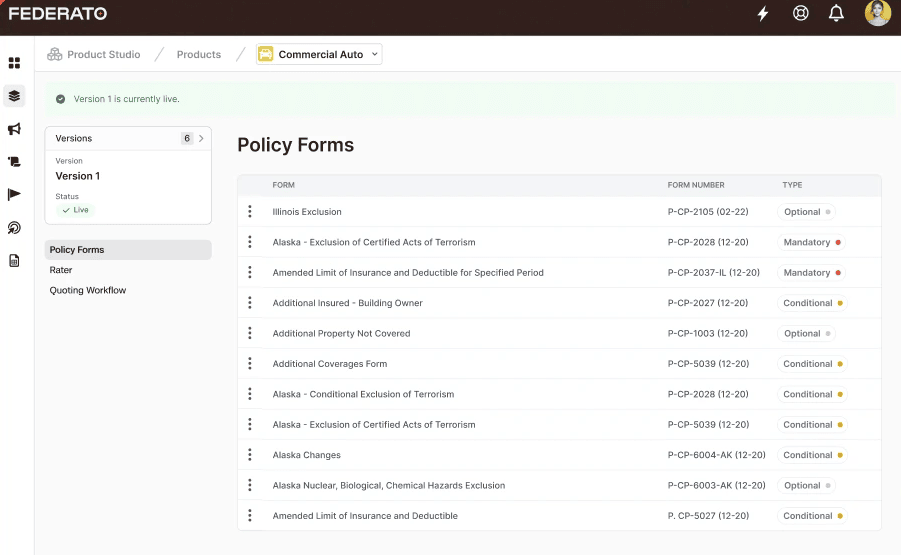
Product definitions are also versioned so that insurers can see what changed, when it changed, and which version applied to a policy at a particular point in time. Versions can be managed across states, programs, and business units, and are tied to policy effective dates so that mid-cycle changes don’t create confusion about which terms were in force. Each update records who made the change, when it was made, the values before and after, and the version it belonged to.
Adam Barnett, Chief Underwriting Officer at HDVI, describes the benefit: "Federato lets us test and iterate on rules and see how much of our pipeline they would apply to before deploying them, and develop rules based on aggregate conditions in our portfolio, which empowers our underwriters to work more deals that would otherwise require lots of back and forth with their manager to approve."
Federato works with carriers, MGAs, and other P&C insurers that want to bring underwriting, policy administration, billing, claims, and portfolio decision-making into one AI-native platform that shortens processing times and gives underwriters more time for higher-value work:
Request a live demo to learn more about how Federato helps underwriters quote more of the right business in less time.
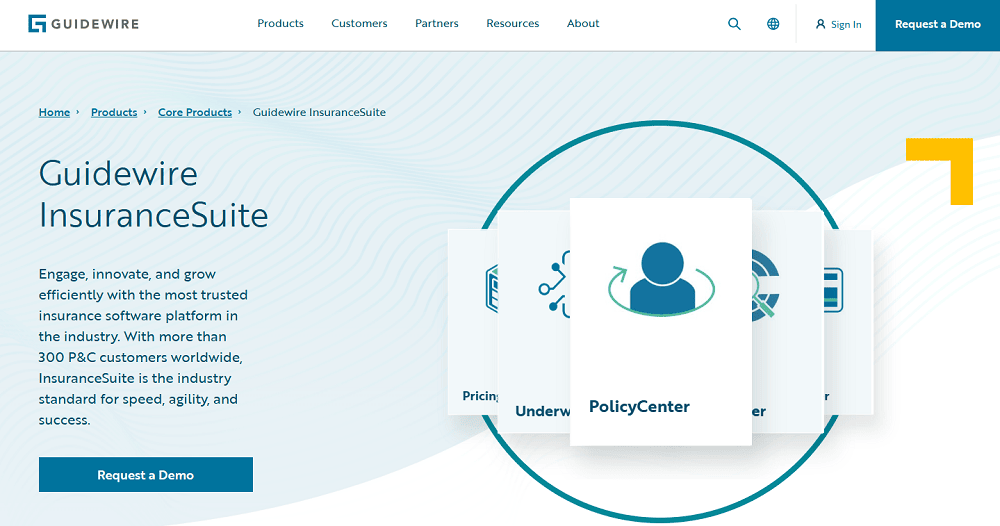
Guidewire is one of the better-known P&C insurance software vendors, helping carriers reduce disconnected systems, give staff a complete view of customers and policies, and improve the experience for policyholders, agents, underwriters, adjusters, and finance teams.
The platform is delivered through Guidewire Cloud or as a self-managed deployment and is designed for insurers that need configurable workflows and shared data across policy, claims, and billing teams.
Features
Guidewire’s central product, InsuranceSuite, includes three connected applications:
The platform also offers additional systems for underwriting and pricing, such as configurable rules, rating, product configuration, and risk data that can help teams assess submissions and price coverage consistently.
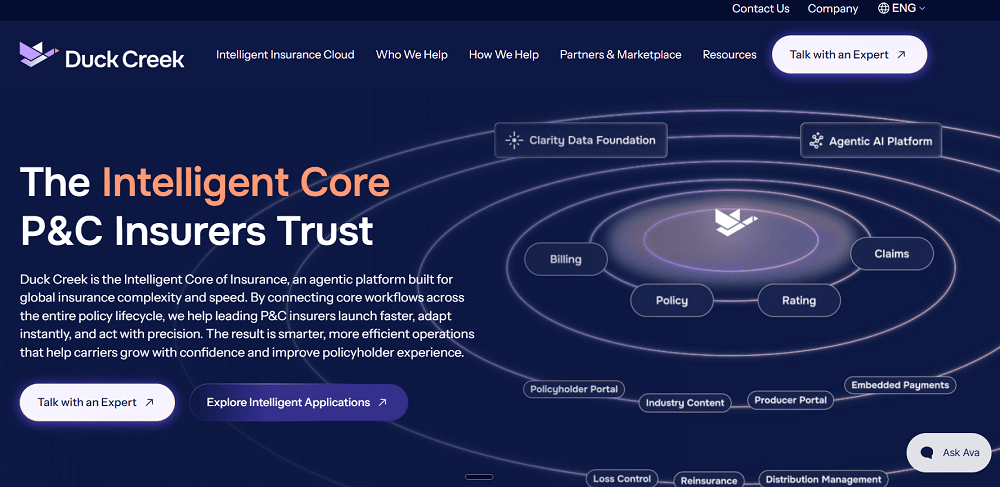
Duck Creek Technologies provides cloud-based core software that helps insurance carriers run the operational systems behind designing insurance products, quoting and issuing policies, calculating premiums, collecting payments, handling claims, and analyzing performance data.
They sell products individually or as an integrated suite through their SaaS delivery model, Duck Creek OnDemand. This model is designed for carriers that want continuously updated software rather than large, periodic system-upgrade projects.
Features
Duck Creek’s core offering connects several major insurance functions:
Duck Creek also allows business teams to adapt insurance products, rates, rules, forms, and workflows without rebuilding the core application for every change.

Sapiens supports the operational lifecycle of P&C insurance, from product configuration and quoting through underwriting, policy administration, billing, claims handling, CRM, and customer or agent service.
The company’s P&C insurance solutions center on modular suites like CoreSuite and IDITSuite. These combine core capabilities including policy administration, billing, claims management, digital engagement, workflow automation, data and analytics, and integrations with external insurance systems and partners.
Features
The platform includes portfolio-level oversight so managers can plan, monitor, and report on multiple innovation projects in one place, while automation nudges users at different stages to prevent bottlenecks.

Vertafore connects different participants in insurance distribution channels, streamlines workflows, and helps organizations manage the full lifecycle of P&C business, from submission, quoting, and underwriting through policy administration, billing, claims, renewals, and customer service.
Vertafore’s product ecosystem includes agency management systems, underwriting workbenches, carrier connectivity tools, rating solutions, document management and workflow automation, and CRM and customer-engagement applications.
Features
Vertafore includes business intelligence, reporting, and analytics across its products, from KPI dashboards and custom reports in AMS360 and QQCatalyst to portfolio analytics via RiskMatch for placement and portfolio management.
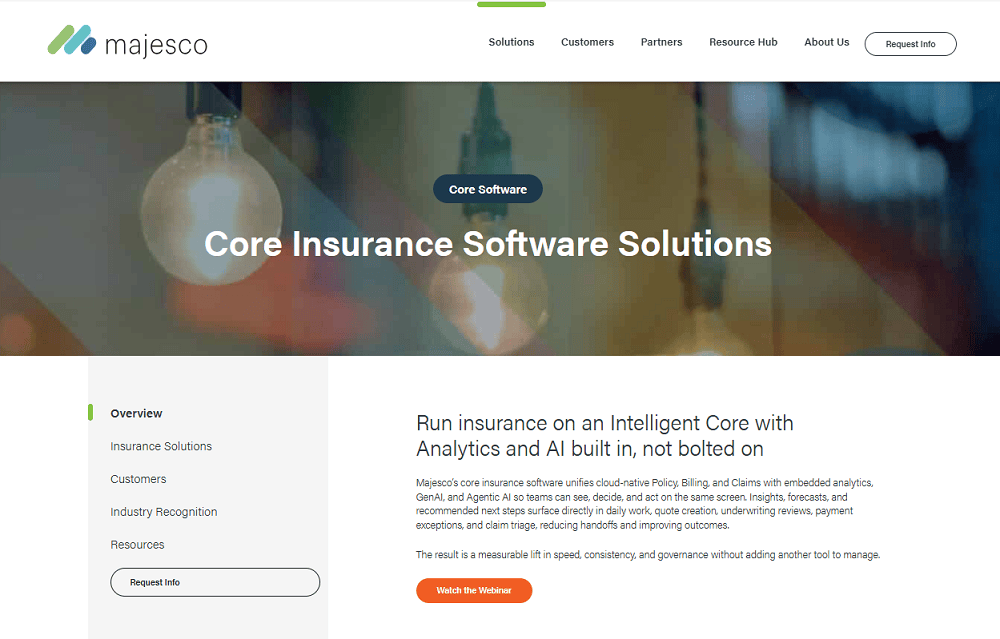
Majesco offers core systems and related P&C insurance solutions for property and casualty insurers. Its main offering, the Majesco P&C Intelligent Core Suite, brings policy administration, billing, and claims management together on a cloud-based platform.
The platform supports personal, commercial, workers' compensation, specialty, and newer insurance products. Majesco also provides preconfigured insurance content such as ISO-based rates, rules, and forms, along with APIs for connecting outside data and applications.
Features
Majesco’s digital products provide portals and experiences for agents, underwriters, customers, and claims adjusters working across P&C claims, while its Distribution Management offering covers areas such as producer onboarding, licensing, hierarchies, and compensation.
When evaluating P&C software, look beyond individual features and consider how much of the lifecycle runs on the same underlying data and product context.
Federato connects intake, quoting, policy administration and servicing, billing, claims, and renewal on one AI-native core. That means pricing, policy changes, billing activity, claims information, and portfolio decisions can all stay connected as the business moves through the lifecycle.
Request a demo to see how an AI native core can help your teams work from the same current context, automate most of the lifecycle, and drive better business outcomes.