Insurance
Why billions in insurance AI investment still haven’t transformed the work
Federato

September 18, 2026
Commercial P&C insurance companies have invested heavily in software and AI because they expect it to improve business results, but that promise has often fallen short.
While AI point solutions and bolted-on AI tools can do useful work, like reading submissions, extracting data, ranking opportunities, and recommending what should happen next, a person still has to turn that recommendation into an actual insurance action. This includes producing a quote, accepting or declining the submission against risk appetite and exposure, or making a change to a live policy so the premium, the documents, and the next invoice all reflect it.
We don't think the AI models are the main constraint. Today's models can carry an insurance workflow much further than they could two years ago, from recommendation into action. What prevents them from doing even more useful work is the operating foundation underneath.
That foundation, on most legacy insurance platforms, still runs critical functions across separate systems, while many processes also depend on documents and manual handoffs. To complete a task, AI may have to pull information from one system, extract it from a document, send instructions to another, wait for a response, and then record the result somewhere else. The more systems, integrations, documents, and manual steps involved, the more delays and opportunities there are for data to be incomplete or go missing.
So even when AI can identify the next step, it may not be able to complete the work quickly or reliably.
That’s why we built Federato. Most insurance AI is added to individual workflows and layered on top of an existing core system, which leaves the AI dependent on the same fragmented systems and integrations that already slow the work down. We took the opposite approach and designed a single, AI-native core foundation to let AI work from the same policy context, business rules, and data across the policy lifecycle.
In this article, we’ll explain why the operating foundation, rather than the model itself, determines how much of the work AI can do, and what changes for the book when that foundation is built for AI from the start.
Insurers have spent more on technology and AI in each of the past several years. Over the same period, several of the measures that describe how the work actually goes have moved the wrong way.
Our 2026 State of P&C Insurance Technology report surveyed 750 insurance professionals at carriers, MGAs, and MGA aggregators. It found that wasted effort, meaning time spent on work that never produces a successful outcome, rose from 26% in 2025 to 31% in 2026.
The same pattern showed up in risk selection. Submissions that fell outside appetite grew from 26% to 30%, and the problem concentrated at the extremes: the share of teams reporting severe appetite drift climbed from 18% to 39%.
For organizations running property and casualty insurance software across multiple systems, that fragmentation creates a growing coordination cost. Larger organizations reported losing more time to system fragmentation than smaller ones.
The same report found that underwriters navigate an average of 6.8 systems per submission, up from 6.4 the year before. A bigger technology budget hasn’t removed the fragmentation itself, and people are still the ones plugging the gaps.
That work includes copying information from one system into another, reconciling records that don't match, waiting for one system to return data to another, and finishing a transaction by hand when the workflow breaks.
The gap between what insurers spend and what they get back can be extreme. Some carriers report spending north of $1 billion on technology and AI and still only performing basic triage.
Insurers have tried several common approaches that made sense at the time. Below, we detail what each one fixed and what it didn’t.
Each of these efforts improves part of the technology stack. But the boundaries between insurance core systems remain, and rating, billing, claims, policy administration, and servicing still have to exchange data and coordinate work across them.
Those boundaries are why capable AI often stays stuck at basic assistance, and even that depends on the data being in good shape. Reading, summarizing, triaging, or recommending are only reliable if the underlying data is complete and well-organized for an agent to find. When information is scattered across systems or is conflicting, those basic tasks become difficult.
Take a commercial property submission: the workbench lists the building as masonry construction, but the policy administration system has it down as wood frame. The agent has no way to know which record is right, so instead of resolving the conflict, it pushes the decision back to a person.
Those boundaries are what we removed. Federato runs submission intake, underwriting, rating and quoting, policy administration, billing and payments, and claims on one foundation. All of it shares a single data schema, so an agent can finish a task without crossing a system boundary. It reads the guidelines, applies the rating, checks the portfolio position, and records the result in the same place.
At the center of that foundation sits our Federated Context Graph, a living map of how an insurer's guidelines, underwriting decisions, product definitions, claims histories, and billing insights connect to one another. Because those relationships are mapped ahead of time, an agent can follow them straight to what matters for the task in front of it instead of working them out again every time it acts.
Below, we look at how this changes decision making, how much manual work is left over, how information travels between teams, and how the business learns over time.
Federato scores every submission for appetite fit first, using the insurer's own rules, guidelines, historical underwriting data, and current portfolio position. Only the submissions that pass get scored for winnability, which is the likelihood that a submission will actually bind, estimated from data the underwriting process itself produces.
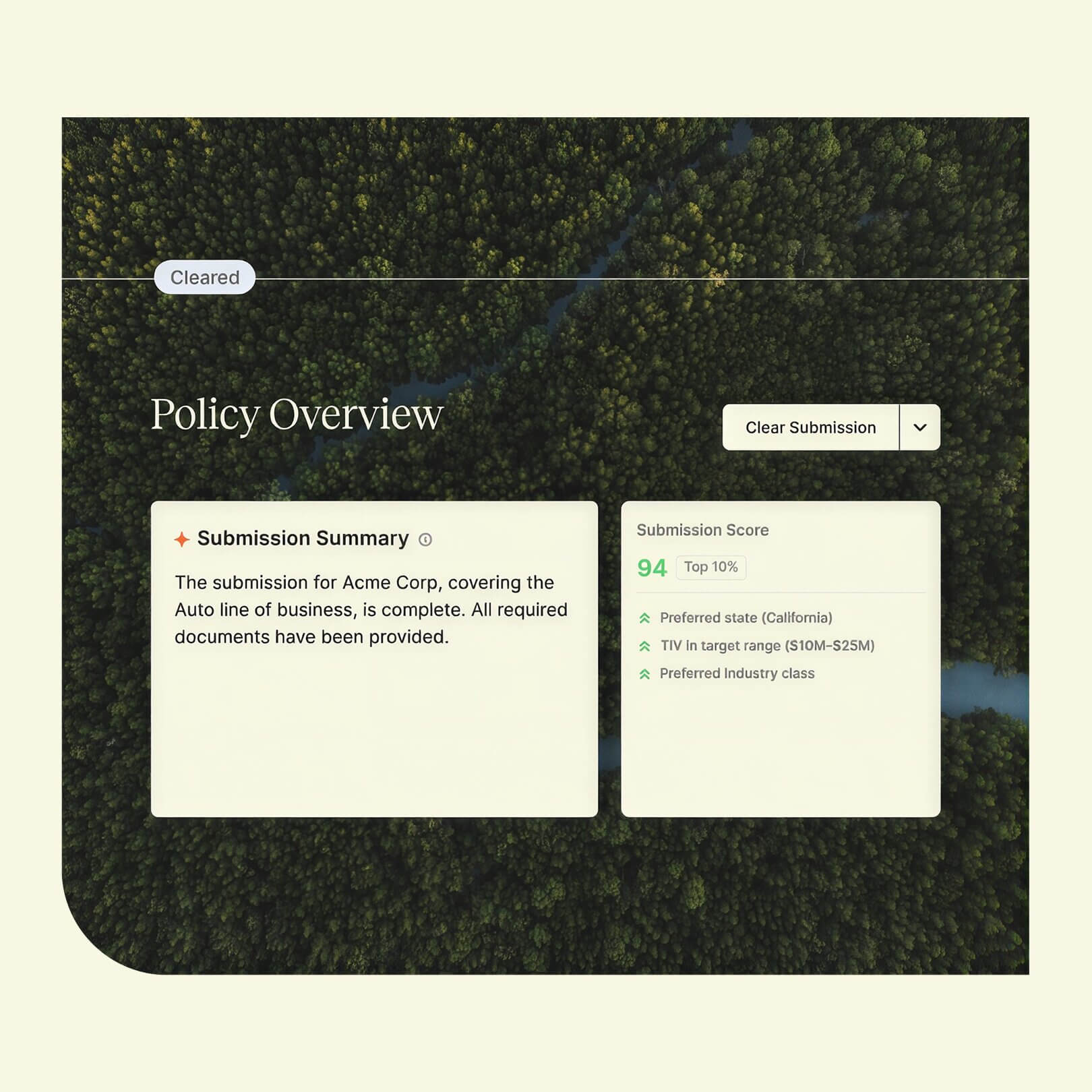
The order of those two checks is deliberate. Scoring winnability first would push easy wins to the top of the queue even when those deals are a poor strategic fit, and over time that makes a book of business worse rather than better. Submissions that clearly don't fit can be set to be declined automatically, so underwriters never spend time reviewing business they would have declined anyway.
For the best-fit deals, Federato then drafts a quote from the submission data, the appetite requirements, and the current portfolio position, and provides underwriters with the reasoning behind this, including the flagged risks and the coverage and deductible terms that moved the price.
Federato can do this because the rating engine, the product definition, the policy data, and the portfolio position all live inside the same platform. The AI agent doing the processing doesn’t need to wait on a chain of integrations between attempts.
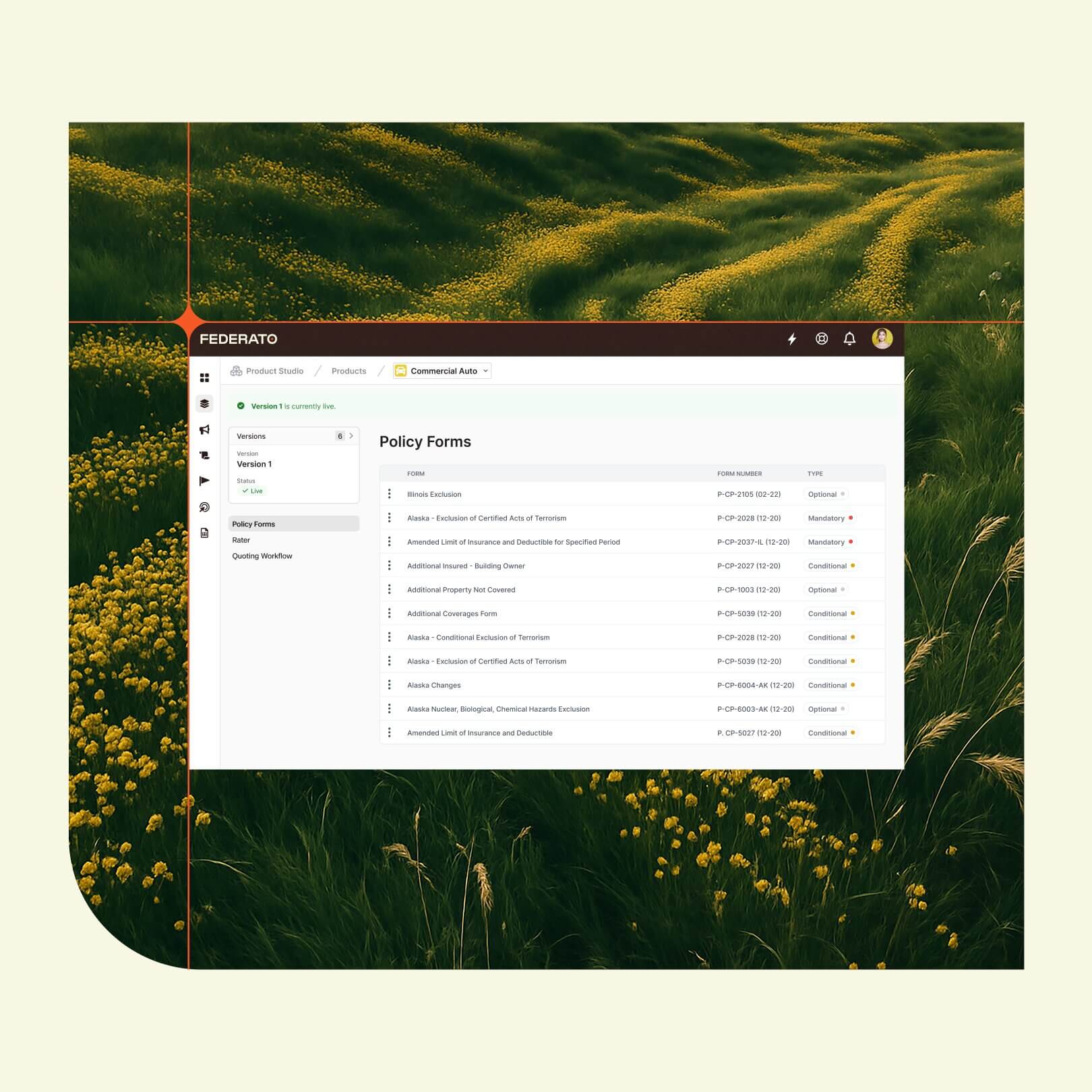
Product Studio holds rating, forms, eligibility, coverages, and rules in one structured product definition. One change carries through quoting, issuance, and servicing, and nobody has to update the same rule in several places.
It also versions every change across states, programs, and business units, ties each version to policy effective dates, and logs every update with the user, the timestamp, and the values before and after.
Billing and Payments runs on the same data schema as policy. Installment schedules, taxes for each jurisdiction, commissions, and minimum earned premium are defined once, and Federato applies them to live policies automatically.
That single foundation also lets endorsements and renewals update billing without anyone entering the same information twice. Cancellations calculate minimum earned premium and commission clawbacks, and every transaction is logged as it happens. Finance teams work from a real picture of the book instead of rebuilding one at month-end close.
When an adjuster makes a coverage call, Federato Claims records the specific policy clause involved and the reasoning behind the decision. It also records why claim reserves change as a loss develops.
Reserves reflect the insurer's current estimate of what a claim will cost, so repeated upward adjustments can reveal where losses are developing worse than expected. Those patterns can then reach product, pricing, and underwriting before more of the same business gets written or renewed.
For example, if a segment starts producing bigger losses than expected, underwriting can tighten appetite before that deterioration fully shows up in the loss ratio. If reserves keep coming in above estimate, pricing can raise the rate at the next renewal instead of absorbing the surprise a year later.
Billing feeds the same loop. If certain customer segments consistently pay late, or if business from a particular distribution channel cancels more often, underwriting leaders can see that the problem runs deeper than how the risk looked when it was first written.
They can use those patterns to decide which segments to pursue, how to structure future policies, and which distribution partners produce business that performs well across the policy lifecycle.
Control Tower keeps appetite guidance working after intake. Most appetite checks run once, when the submission arrives, and have nothing to say about the account after that. Control Tower ties an insurer's strategy documents and existing underwriting guidance to current performance and portfolio exposure, allowing it to steer new business as performance changes or targets are threatened.

Control Tower has three parts:
Together they show leaders how the book is developing while decisions are still being made. If the book starts to drift, leadership can change the guidance before more business binds, and the record of which rules were in force and how each decision was handled stays auditable.
The platform also keeps learning from the decisions and outcomes that build up over time, so past experience informs what it does next. For example, Federato builds winnability scores from each insurer's own historical performance, referral behavior, and interaction data, including how individual brokers and agents have behaved in similar cases.
Executives set goals about which business to pursue and how much risk to take. Those goals then have to survive thousands of individual decisions across underwriting, servicing, billing, claims, and renewal.
The usual way to keep teams aligned is to send out guidelines, appetite documents, and monthly reports as PDF files and spreadsheets. They go out of date within weeks, and static guidance can't answer the question an underwriter actually has, which is whether a particular submission still fits.
For example, a document can tell a team about its $50 million target for a class and region. It doesn’t necessarily tell them that $46 million is already written. A $10 million submission can still look in-appetite on paper, even though binding it would take the portfolio to $56 million.
Federato lets leaders steer the book in real time. They watch premium, loss, appetite, and portfolio mix as business is written and claims develop, then adjust targets, guardrails, or pricing before a pattern turns into a larger problem.
Running on one system also keeps a clear record of how each decision was made and what the portfolio looked like at the time. That record shows reinsurers and capacity providers that underwriting followed the insurer's stated strategy, and those relationships set the cost of capital.
One Federato customer, Velocity Risk, increased the percentage of bound policies that met its definition of high appetite 3.7-fold.
Rod Harden, President of Claims and Operations at Velocity Risk, described the effect as "further extending our leadership in the markets we serve while building trust with our capital providers, customers, wholesale partners and employees."
Setting strategy is only part of the job. The business also has to know what happens in claims, billing, and servicing, because that is what should shape the next decision.
Claims show which policy terms produce disputes. Billing shows which customers pay late and which channels produce the most cancellations. Servicing shows which accounts cause the same problems over and over, well before renewal.
When those functions run on separate systems that store data differently, none of those lessons reach the person or the model making the next decision. With Federato, data and decisions stay attached to the account, so a correction made in one workflow supports judgment in the others.
That shared context helps outside underwriting too. For example, when claims teams can see the policy reasoning and the coverage context behind a risk, coverage decisions become more consistent and unnecessary claim payments can fall, which helps the combined ratio.
Reid Spitz, Chief Executive Officer and Cofounder of HDVI, described what that shared context made measurable: "Federato has given us the ability to measure critical business metrics we simply couldn't track before, and really has enabled our fundamental business strategy of being a data-centric MGA."
The insurers getting the least out of AI are often constrained less by the models themselves than by the systems underneath them.
The four common approaches we described earlier each solved one constraint but inherited another, leaving important gaps between the information available, the decision itself, and the systems required to carry it out.
Because of Federato’s AI-native design, AI does the pricing work itself against live portfolio limits, and records how it reached each result. Since underwriting, policy administration, billing, and claims share one schema and one context graph, what the business learns in one place changes what it does in the next.
Also, because strategy runs as live guardrails at the point of decision instead of as documents sent around the company, the book follows the plan by design rather than waiting for corrections until after the quarter closes.
QBE North America consolidated 14 tools into one, bringing 7+ lines of business and 5 systems of record onto a single platform for more than 300 underwriters, and expects to pay back the investment in under 12 months.
Greg Puleo, Vice President of Digital Transformation at QBE North America, described the business case: "When you consider that we're putting out tens of millions of dollars' worth of limit, just one account with a better risk decisioning framework can pay for IT transformation for decades. Multiply that across a portfolio and the potential return on Federato's RiskOps platform becomes abundantly clear."
Federato runs the full policy lifecycle in one AI-native core platform, covering intake, quoting, policy administration, servicing, billing, claims, and renewal. Because all of it shares that core, a price, a policy change, or a claims decision travels to the rest of the account instead of stopping where it was made.
Request a demo to see what an agent can complete without handing the work back.