Insurance
Insurance core systems: in-depth comparison of 5 options
Federato

September 10, 2026
An insurance core system records and processes the policy lifecycle. It handles policy administration, billing, and claims, and connects to many of the other systems a carrier uses.
Over the past decade, property and casualty carriers have moved much of that software to the cloud. The move has reduced maintenance costs, made upgrades easier, and cut technical debt.
But these systems are still mainly built to record decisions, not to prepare them by pulling together the data, rules, and context they depend on.
The limitation continues after the decision is made. An underwriter might explain a call in a text note attached to a policy or a claim, and the system will store that note. What it won't do is turn the reasoning into data that underwriting, claims, billing, or another team can use later.
That makes it harder for one part of the business to learn from another. Claims may uncover a pattern that should change how a risk is underwritten. Billing may show that certain customers or channels cancel more often. When those signals stay inside separate records or separate systems, they don't shape the next decision.
Carriers have closed that gap by adding AI on top of the core. These tools summarize files, extract information, and sort submission queues, making individual tasks faster.
But reading is easier than acting. To price a risk, AI has to gather submission data, check the underwriting rules, run the rating engine, and record why it chose a particular structure. If the information and actions sit across separate systems with different data structures, the AI has to piece that process together through integrations. That path is often too slow, too incomplete, or too unreliable for the AI to finish the workflow on its own, so a person steps in to complete it.
Federato was built around the opposite approach. AI and a single data model sit at the center of the platform, and the full policy lifecycle runs on the same foundation.
The platform can bring together the information a decision needs, act on it, and keep the reasoning behind what happened. Instead of only summarizing a submission, for example, it can draft a priced quote for an underwriter to review. And because the reasoning stays connected to the rest of the lifecycle, later decisions can use what the business has already learned.
In this article, we compare five modern insurance core platforms, starting with Federato, followed by Guidewire, Duck Creek, Insurity, and BriteCore. We also explain the main types of core system and where each platform fits within that framework.
Below, we explain three kinds of insurance platforms and what to watch for when you're qualifying them.
Many established vendor platforms were built over decades and carry years of regulatory content, broad line-of-business coverage, and implementation experience that newer vendors haven't accumulated yet.
But many also grew partly through acquisition. A common pattern is for a vendor to acquire a solution, bolt it on, call the result unified, and sell it under one brand. What the buyer gets is a set of modules that were built separately and connected later.
Each module generally has its own schema with its own way of storing and labeling data, which means it must be translated whenever it moves between modules. That translation requires a communication layer, and someone has to build and maintain that layer so the modules can request and read data from each other.
Such layers cover most details but not every one. When a field in one module has no equivalent in another, or when the two disagree, a person has to step in and decide what the right answer is.
A cloud-native core insurance system is usually more coherent than an older suite because its modules were designed from the ground up to work together rather than joined together after the fact.
Also, most cloud-native cores are built as a set of services rather than as one large application, which gives a carrier several practical benefits:
That architecture makes cloud-native cores easier to change, scale, and integrate, but they’re still systems of record first. AI was added later to a platform designed mainly to store and process transactions, so it tends to handle narrower tasks within workflows.
Such tasks help a person reach a decision faster, but they generally don’t assemble the full context needed to price a risk or retain the reasoning behind that decision for the rest of the business to use.
An AI-native core platform is built with a focus on AI and unified data from the start rather than adding those capabilities later to a traditional core insurance system. This platform runs intake, underwriting, rating, quoting, and other functions on one foundation and one schema.
This means the platform stores and labels data the same way everywhere. No translation layer sits between functions, and nobody reconciles two versions of the same field. These platforms also keep working after a policy binds, through issuance, endorsements, billing, claims, renewal, and cancellation, using the same product definitions that governed the original quote.
Because the rating engine, the product definition, the policy data, and the portfolio position all sit inside the same platform, an AI agent can test one deductible, limit, and set of terms after another against live portfolio limits. It doesn't wait on a chain of integrations to fetch and return the data each attempt needs.
Every stage runs on the same foundation, so what one part of the business learns is available to the next decision rather than sitting in a report that arrives a quarter later. The guardrails read live portfolio data, which means the guidance applied to new business changes as the book changes. Leadership updates a rule once, and every submission after that is measured against it.
The AI in this category completes work rather than preparing it. It gathers what a decision needs, applies the insurer's own rules, and produces a result a person reviews and approves.
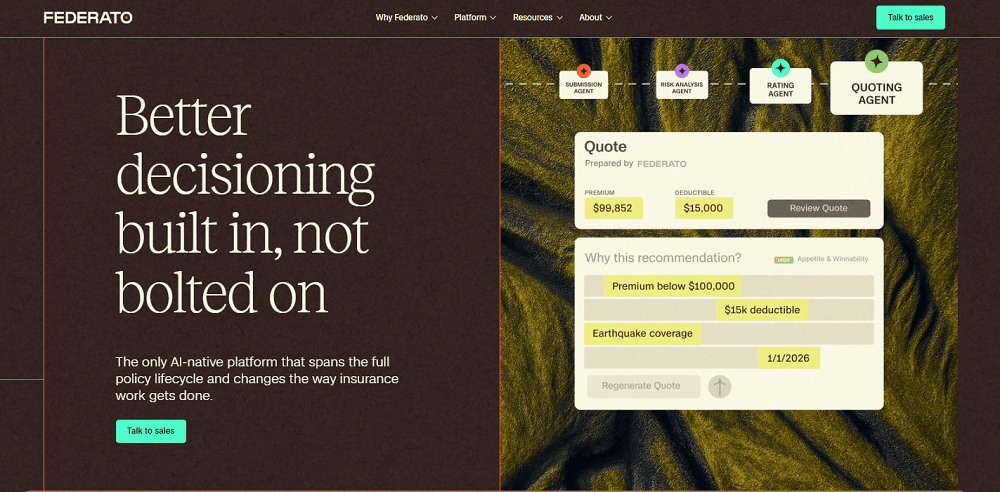
Federato is the only AI-native core system that spans the full policy lifecycle, with intake, underwriting, rating and quoting, policy servicing, billing and payments, claims, and renewal all running on a single foundation.
At the center of that foundation sits the Federated Context Graph, a living map of how an insurer's guidelines, underwriting decisions, product definitions, claims histories, and billing insights connect to each other. Because those relationships are mapped in advance, an AI agent can follow them straight to what matters for the task instead of working them out again every time it acts.
When a submission arrives, Federato reads the message and its attachments and determines whether it contains a new submission or correspondence about a deal already in progress.
It then checks the submission against the insurer's rules, underwriting guidelines, historical data, and current portfolio position to decide whether the risk fits the insurer's appetite at that moment. Administrators can configure the platform to automatically decline the submissions that clearly don't fit, so underwriters never spend time reviewing business they would have declined anyway.
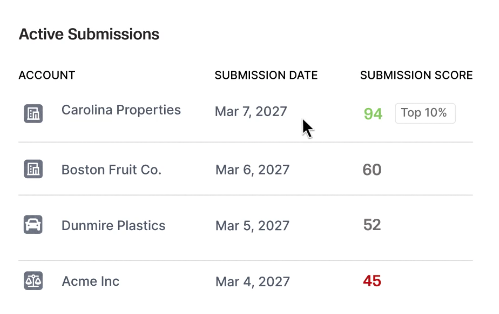
Only the submissions that clear the appetite check are scored for winnability, which is how likely the insurer is to win the deal. This is a better way of prioritizing submissions, since scoring winnability first would push easy wins to the top of the queue even when those deals are a poor strategic fit.
Winnability scores are built from each insurer's own historical performance, referral behavior, and interaction data, including how individual brokers and agents have behaved in past cases. The models also learn from human feedback.
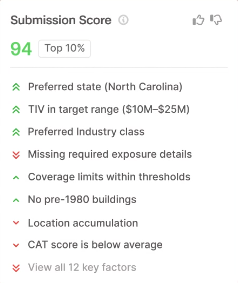
For the best-fit deals, Federato drafts a priced quote from the submission data, the appetite requirements, the insurer's own rates and policy wording, and the current portfolio position.
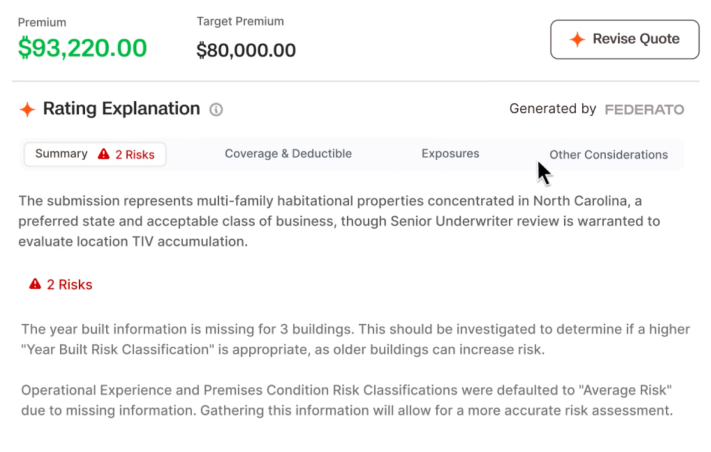
The rating explanation sits next to the drafted quote, so the underwriter sees the premium and the reasoning behind it, including the flagged risks, the coverage, and the deductible terms that moved the price. The underwriter can then update this quote as necessary before issuing it.
Control Tower turns strategy documents and existing underwriting guidance into live guardrails tied to current performance and current exposure.
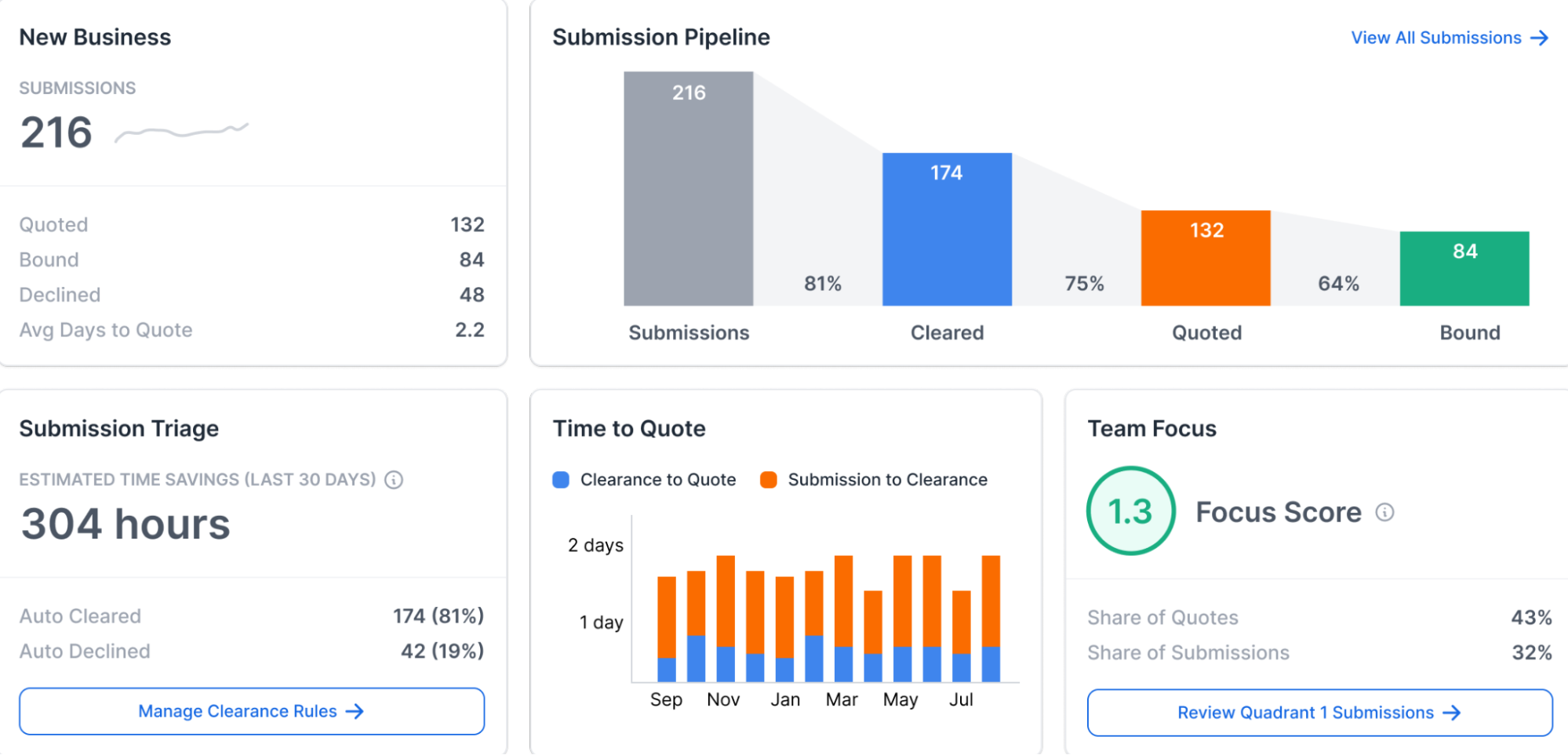
Control Tower offers three levels of guardrail:
Because the guardrails use live portfolio data, the guidance applied to new submissions changes as the book changes. When a segment approaches an exposure limit, leadership can update the rule and have it take effect immediately.
The guardrails also stay active after intake, with appetite guidance adjusting as targets are met. This makes every AI decision explainable, auditable, and traceable back to the insurer's own guidelines, and the work itself creates an audit trail.
Federato continues to support the policy after it binds, including issuance, endorsements, renewals, and cancellations, using the same product definitions that governed the original quote.
Billing and Payments runs on the same schema as underwriting and policy servicing. Installment schedules, taxes for each jurisdiction, commissions, and minimum earned premium are defined once, and Federato applies them to live policies automatically.
Endorsements and renewals update billing without anyone entering the same information again. Cancellations calculate minimum earned premium and commission clawbacks, and every transaction is logged in real time, so finance teams work from a current picture rather than rebuilding one at month-end close.
Billing data also feeds back into underwriting as a risk signal, showing which segments carry higher delinquency rates and which distribution channels produce the most cancellations.
Federato Claims runs on the same platform and the same context graph as underwriting, product, and billing. When an adjuster makes a coverage call, Federato records the specific policy clause and the reasoning behind the decision, and it structures reserve changes with their supporting context. The reasoning becomes data the business can use rather than a note buried in a file.
Because claims runs on the same platform, no separate data project sits between a claims decision and an underwriting one, allowing information to move more directly across the insurance value chain.
If one clause keeps causing disputes, the product team can rewrite the form before the company writes more policies on it. If a segment starts producing larger losses than expected, underwriting can tighten appetite before those losses reach the loss ratio.
Product Studio holds rating, forms, eligibility, coverages, and product rules in a single structured definition, so one change carries through quoting, issuance, and servicing.
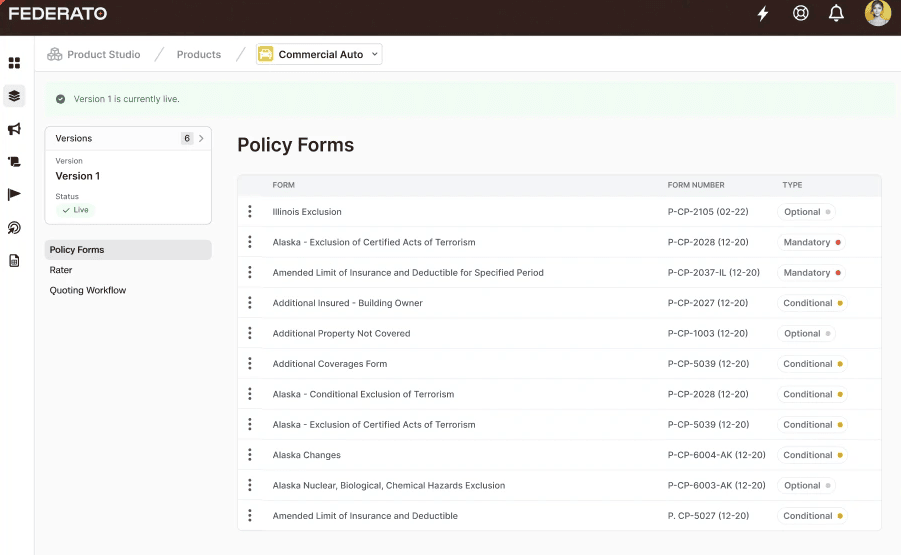
It versions every change across states, programs, and business units, and it ties each version to policy effective dates, so a mid-cycle change doesn't create confusion about which terms were in force. Every update records the user, the timestamp, the values before and after, and the version it belonged to.
Velocity Risk reduced the time from modeling complete to quote issuance from 21 days and 11 hours to 2 days and 8 hours within two months, an 89% reduction, and increased the share of bound policies that meet its own high-appetite definition by 5.5 times.
Nina Chiapetta, Vice President of Business Development, describes the target her team set once quotes could be prepared before an underwriter opened the file: "We set a goal that by noon each day, each underwriter should have quoted the best three or four deals on their desk. To do that, they have to focus on what's in-appetite and winnable, rather than which brokers are most vocally calling for a quote."
QBE North America consolidated 14 tools into one, unified 7 lines of business and 5 systems of record into a single view for more than 300 underwriters, and projects a payback period of under 12 months.
Greg Puleo, Vice President of Digital Transformation, describes the business case: "When you consider that we're putting out tens of millions of dollars' worth of limit, just one account with a better risk decisioning framework can pay for IT transformation for decades. Multiply that across a portfolio and the potential return on Federato's platform becomes abundantly clear."
HDVI reduced the time to quote a small fleet submission from one week to half a day, and programmed more than 30 rules that automate 95% of its referrals.
Adam Barnett, Chief Underwriting Officer, described the change: "Prior to Federato, we had nine different systems throughout a submission process; we've consolidated that down to one."
Request a live demo to see how Federato brings core functions onto one platform.
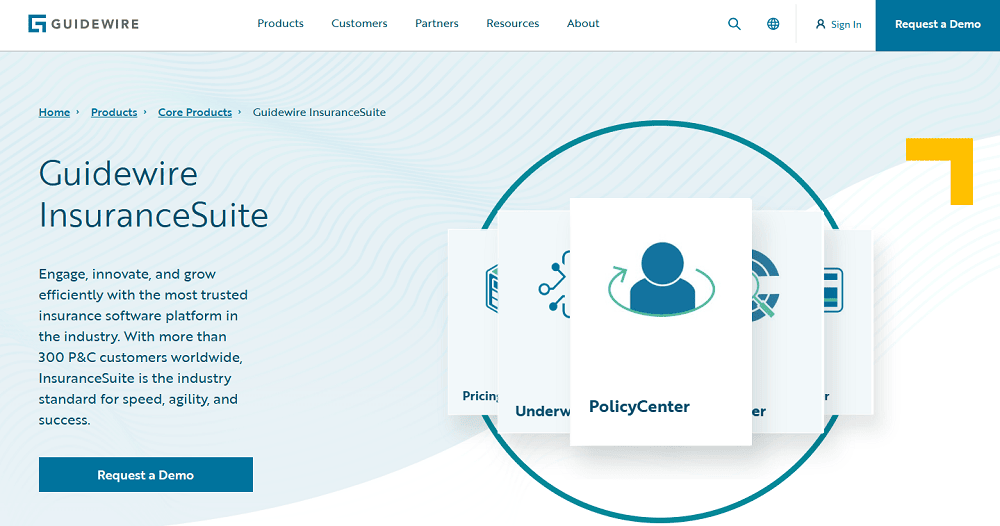
Guidewire is a property and casualty core system vendor that sits in the modernized incumbent suite category. Its applications are sold under one brand and delivered on the Guidewire Cloud Platform or as a self-managed deployment.
Key features
Guidewire also publishes Cloud APIs and an architectural blueprint that lets an insurer or a partner build an agentic quote-and-buy journey on top of PolicyCenter.
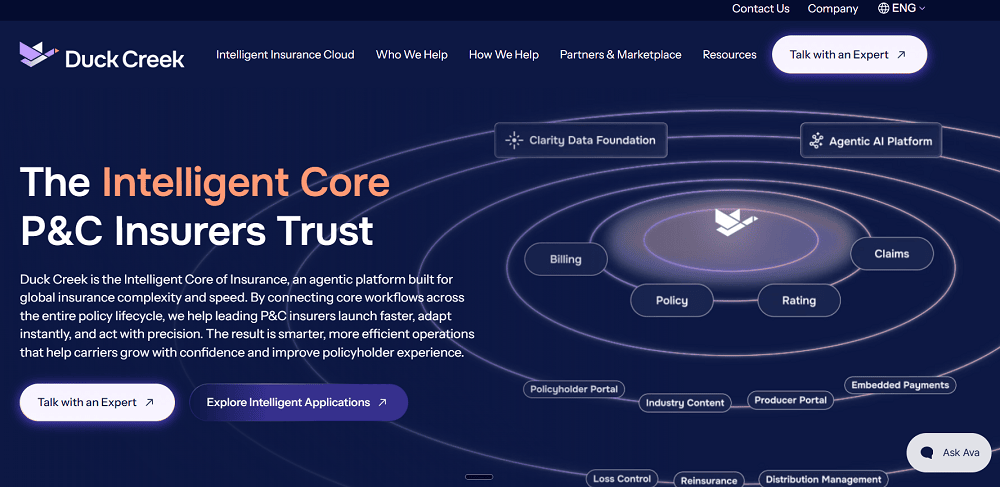
Duck Creek Technologies provides a core system of record that carriers use to design insurance products, quote and issue policies, calculate premiums, collect payments, handle claims, and analyze performance data across the insurance value chain.
Duck Creek is in the modernized incumbent suite category, and its products are sold individually or as an integrated suite. It continues to add capabilities through acquisition.
Key features
The platform keeps an insurer's business logic separate from the core platform code, which is intended to reduce the upgrade disruption often associated with heavily customized legacy systems.
Insurity provides core systems and analytics for P&C insurance carriers, managing general agents, and program business.
Insurity is in the modernized incumbent suite category and has expanded its core, analytics, geospatial, personal lines, and MGA capabilities through multiple acquisitions over time.
Key features
Insurity offers a combination of P&C core processing with embedded regulatory intelligence, geospatial risk analytics, and purpose-built suites designed to improve operational efficiency and support risk and reinsurance decisions for carriers, MGAs, specialty programs, and personal lines.
BriteCore covers policy administration, claims, billing, and analytics across key stages of the P&C insurance lifecycle. It’s a cloud-native core insurance system and was built by one vendor rather than assembled from acquisitions, which distinguishes its architecture from many legacy systems. It also runs on Amazon Web Services.
Key features
BriteCore is a collection of cloud-based services that communicate with one another through defined interfaces. This allows the platform to connect functions such as policy administration, billing, claims management, and product configuration without relying on one large, tightly coupled application.
Federato runs intake, underwriting, rating and quoting, policy servicing, billing, and claims on one foundation, carrying context across the lifecycle so every decision informs what happens next and drives better business outcomes.
Request a demo to see the difference between a platform that records a decision, and one that learns from and acts on it.