Insurance
Why P&C leaders and their teams don't see portfolio visibility and AI the same way
Federato

August 13, 2026
Ask a leadership team how well their organization understands what's happening in the portfolio right now, and most will say the visibility is there. Ask the underwriters doing the work, and the answer changes.
This is the second post in a series on Federato's 2026 State of P&C Insurance Technology report, which surveyed 750 P&C insurance professionals across carriers, MGAs, and MGA aggregators. The first post covered the coordination tax: the hours and dollars fragmented systems cost insurers, and the strategy drift that grows alongside it. That drift doesn't stay hidden inside the workflow. It shows up as a gap between what leadership believes is happening and what their teams experience, and that gap is where today's post picks up.
Leaders and underwriters aren't looking at the same picture. 91% of leaders report good or full visibility into their KPIs. Only 27% of underwriters say they have the full real-time visibility required to see and respond to portfolio performance as it happens, rather than relying on periodic or static reports. That's a 64-point gap between confidence at the top and insight on the ground.
The disconnect repeats across nearly every survey question we asked both leaders and underwriters:
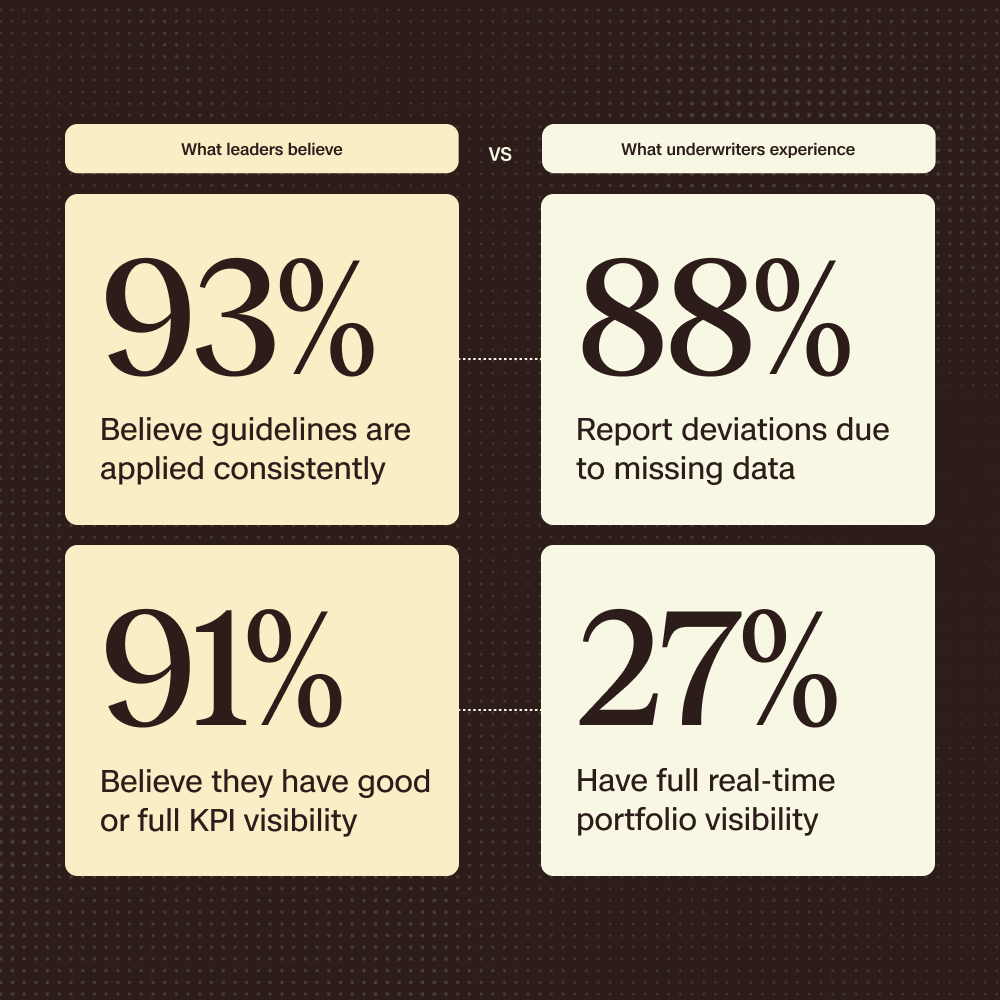
As one manager at a midsize carrier put it, "sometimes we rely on informal knowledge or past experience because systems do not provide full context." When systems fall short, people substitute judgment and memory for information the system should have provided. Leadership sees the KPI dashboard, but not the individual underwriter cross-checking guidelines by hand because the workflow gave them no other option.
"Sometimes we rely on informal knowledge or past experience because systems do not provide full context."
— Manager, Carrier, $250M–$999M GWP
If integrated systems would close the visibility gap, AI should be helping close it too. The results are mixed. Adoption keeps climbing: 43% of respondents say AI now automates parts of their workflows, and 27% say it's used broadly. But adoption isn't the same as impact. Fewer than one in three individual contributors report improved decision quality or reduced manual effort from AI.
The gap shows up by seniority as well. 40% of C-suite executives say AI has improved decision quality and accuracy, and 35% say it's reduced manual effort. Individual contributors, the people actually running AI-assisted workflows all day, are more skeptical on both counts.
Ask people what's holding AI readiness back, and the report doesn't turn up one clear answer. 14% point to data quality or availability. 13% cite organizational resistance to change. 12% blame legacy system complexity, and 10% point to a lack of management understanding. C-suite leaders are somewhat more likely than individual contributors to name legacy systems as the primary barrier, at 15% compared with 10%.
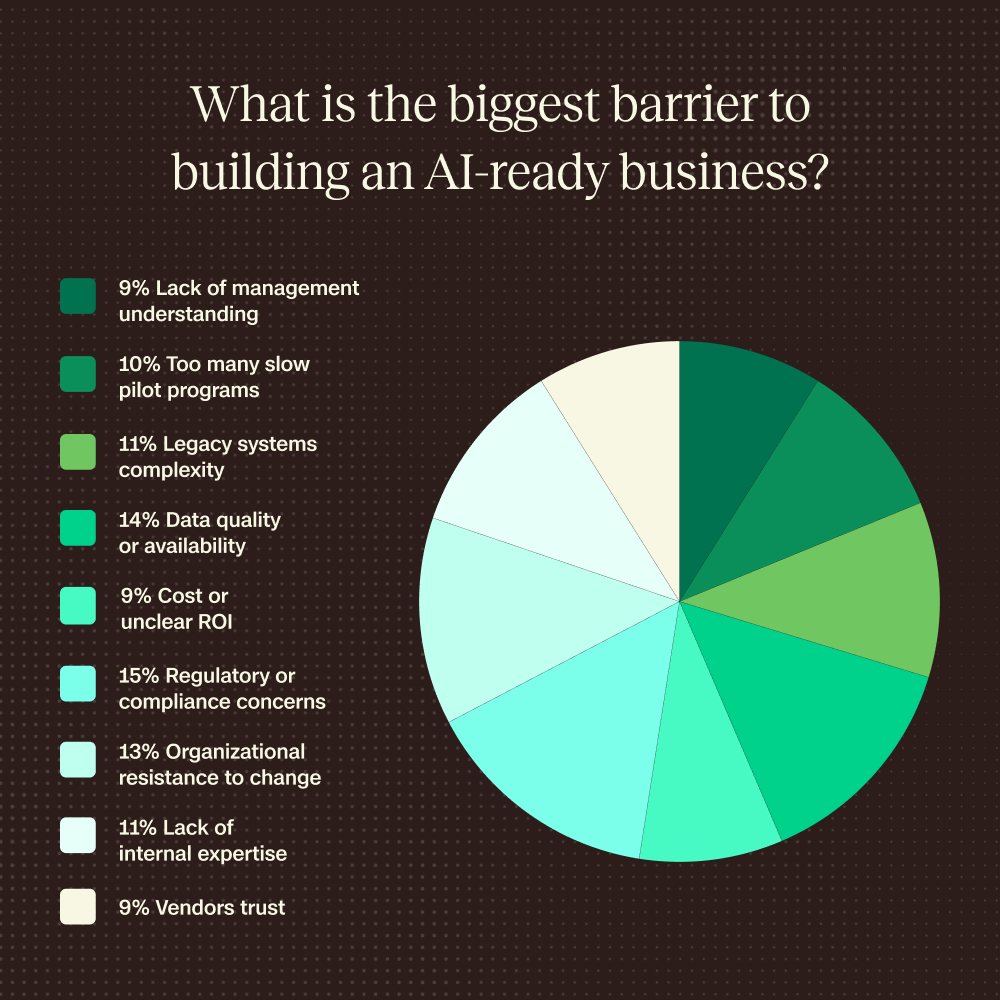
That lack of consensus is itself a finding. When an organization can point to one blocker, it can fix it. When the barriers are spread across data, systems, culture, and understanding in roughly equal measure, no single initiative closes the gap. It takes AI that's built into the workflow from the start, not layered on top of the same fragmented systems described in the first post in this series.
The full report goes further into how AI maturity affects both the visibility gap and decision quality, including which stage of adoption most insurers are actually in and what separates the organizations seeing real returns from the ones still waiting for AI to pay off.
Stay tuned for the next post in this series, which will look at what's actually driving results for the insurers pulling ahead.