Insurance
MGA insurance software: what to look for, plus 7 platforms to compare
Federato

September 28, 2026
MGA insurance platforms can look similar on the surface, but they can cover different parts of the business. Some focus on certain tasks of the workflow, while others aim to run most of an MGA’s operation in one system.
The right choice depends on how your MGA operates, which carriers you work with, the products you sell, and how quickly you need to launch and scale. It also depends on how well the software handles carrier rules, reporting, integrations, and the manual work that comes with each.
In this article, we compare seven leading MGA platforms, starting with Federato, our AI-native core that runs the full MGA workflow on a single foundation, followed by Guidewire, Duck Creek, Vertafore, Insly, BindHQ, and Novidea.
Some MGA software is built to do one job well, like a rating engine, a bordereau reporting tool, or a document manager, and relies on integrations to connect to everything else in the stack.
Other platforms try to cover the full policy lifecycle in one place. Often, though, the provider built the system by acquiring one solution after another and bolting each onto what it already had. That leaves blind spots between modules that were never designed to talk to each other, bridged by a communication layer that's complex to build and expensive to maintain.
The strongest platforms are built from the ground up to run the full range of MGA functions, including underwriting, claims, compliance, and finance, on a single foundation.
That single foundation is what enables the following four capabilities.
MGAs underwrite the business, but carriers take the financial risk. That means every renewal and capacity decision ultimately comes down to one thing: Does the carrier trust how the MGA has been underwriting?
That's why MGA insurance software should include:
Without these capabilities, an MGA is always reacting to what a carrier has already found. Delegated authority depends on the carrier trusting the MGA to stay within its agreed limits without constant oversight.
More collected premium isn't automatically good news. If an MGA's growth causes it to drift outside the classes, geographies, or risk types a carrier agrees to, it actually erodes the relationship rather than strengthening it.
The best tools set four requirements:
If an MGA takes too long to respond, the deal can be placed elsewhere before its quote is even considered, no matter how competitive the eventual price might have been. Speed earns an MGA the chance to compete, which means the software behind it needs to do more than move submissions through a queue.
Underwriting isn't the only work an MGA may take on for a carrier. Depending on the program, an MGA may also bill and collect premiums, pay broker commissions, and handle claims within an agreed settlement authority. When it does, the carrier judges that work on speed and accuracy too: how quickly and correctly premium is billed, collected, and remitted, and how quickly and correctly claims are handled and paid.
For MGAs that take on this work, the software should include:
Late remittances and inconsistent claims decisions erode a carrier's confidence as quickly as business written outside appetite. For an MGA that handles this work, turnaround after the bind belongs in the same case it makes to carriers for renewed capacity.
With these criteria in mind, below are the top 7 MGA insurance software platforms:
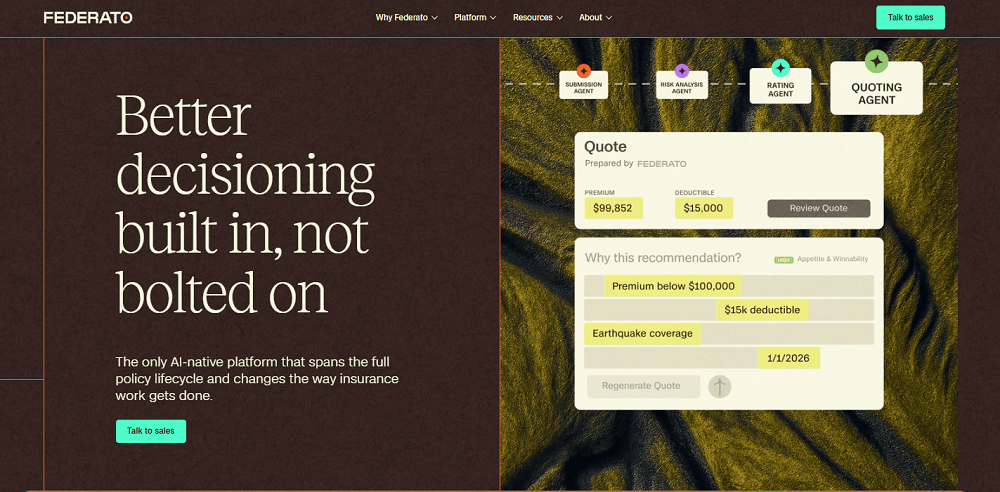
Federato is an AI-native core that runs the full MGA workflow, including submission intake and triage, appetite screening, quoting, billing, and claims, on a single foundation.
Because every stage reads from and writes to the same record, each carrier’s constraints can be enforced as a risk is underwritten, before out-of-bounds business makes it onto the books.
For an MGA, there’s another benefit: the same system used to underwrite and manage the business also keeps a clear record of whether each decision followed the carrier’s rules. That means the MGA doesn’t have to piece together separate reports later to prove it stayed within its authority.
Below, we look at how that plays out across the parts of the platform MGAs use most.
Control Tower turns carrier constraints and program strategy into live rules that run inside the workflow, rather than sitting in a delegated authority agreement that's only checked at renewal.
With Federato, guardrails can be set differently for each program while rolling up into one consolidated view of the portfolio, so a blanket appetite setting doesn't stand in for what was actually agreed with each capacity provider.
This runs through three components:

Because guardrails run on live portfolio data, guidance updates the moment a carrier's constraints change or a segment nears its limit. If a program is approaching its aggregate limit in a specific class of business mid-quarter, the relevant Control can tighten immediately, catching drift before it affects loss ratios.
Federato supports different appetite guardrails for each carrier or program. An MGA running a professional liability program for one carrier and a general liability program for another can hold both sets of underwriting rules and referral thresholds separately, even where the two overlap in the classes of business they write. This is especially valuable for MGAs relying on property and casualty insurance software, since it keeps carrier-specific rules distinct even as the underlying classes of business converge.
At the same time, Federato rolls that activity into one consolidated view of the total portfolio, with real-time exposure monitoring and performance traceability across the insurance lifecycle.
That means leadership can spot patterns that only show up at the whole-book level, such as a class of business that looks fine individually across two programs but represents a much larger combined exposure than either carrier realizes on its own. This is what makes it possible for an MGA pursuing growth to show a partner exactly how a new program would sit alongside what's already being written.
When a submission arrives, Federato puts it through an AI-powered triage process. It reads the message and its attachments, works out whether it's new or correspondence on an existing deal, and classifies each attachment by type. It then runs a different extraction process for each type, since the data that needs to be pulled from a statement of values, for example, isn't the same as what matters in a narrative loss run.
Federato then checks the submission against the program's guidelines, historical data, and current portfolio position to determine appetite fit at that precise moment. Clear non-fits can be auto-declined, so underwriting time isn't spent on business that was never going to be written, and carriers get a fast, clear answer. Submissions that clear appetite are then scored for winnability using:
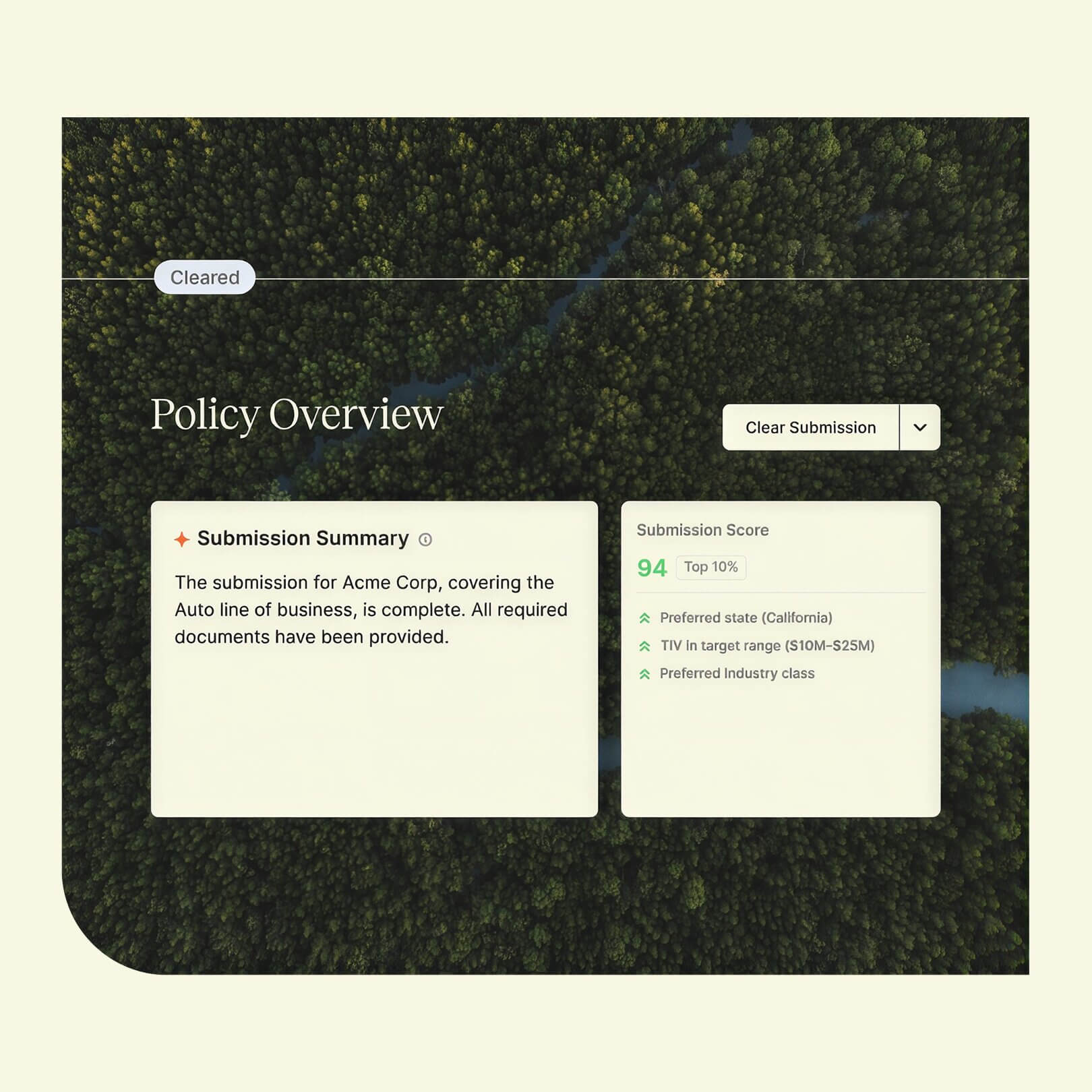
For the best-fit deals, Federato then drafts a priced quote from the program's own rates, wording, and current portfolio position, showing its reasoning alongside the draft so an underwriter can see how the number was reached. This compresses the time between a submission landing and a quote going back out, without asking underwriters to trust a number they can't trace back to its source.
Nina Chiapetta, VP of Business Development at Velocity Risk (a hybrid MGA/carrier), described the effect once quotes could be prepared in advance:
"We set a goal that by noon each day, each underwriter should have quoted the best three or four deals on their desk. To do that, they have to focus on what's in-appetite and winnable, rather than which brokers are most vocally calling for a quote. That puts the power in their hands to be more selective and write the best business quickly, and to spend more time on the deals and relationships where their particular skills can come into play."
Velocity Risk also reported an 89% decrease in its average time to quote, from 21 days and 11 hours to 2 days and 8 hours once a submission is modeling-complete, and a 3.7x increase in the share of its bound policies that meet its own definition of high appetite.
Most brokers don’t need to change how they submit business to work with Federato. MGAs can give brokers a dedicated email address for submissions, and Federato reads the incoming message and attachments, extracts the relevant information, and brings it into the underwriting workflow automatically.
For MGAs that want to give brokers and wholesale partners more direct visibility, Federato’s Producer Portal lets them track submission progress, see outstanding requirements, and check policy status without chasing the MGA for an update.
The portal also shows balances, invoices, and billing and payment activity, with commissions recalculating as policies change and payments settle.

Producers can also initiate policy changes and service requests on behalf of policyholders, moving routine work, such as adding a vehicle to a fleet policy, out of the MGA’s service team and into the hands of the producer managing the relationship.
Because submission, underwriting, policy, and billing data stay connected, brokers can continue using familiar channels like email while the MGA gets structured data inside Federato and can offer self-service visibility where it makes sense.
Federato built billing and claims on the same foundation as underwriting and policy administration, rather than acquiring them and bolting them on. That means the work an MGA does after the bind doesn't depend on passing data between systems.
Endorsements and renewals update billing automatically, and cancellations calculate minimum earned premium and commission clawbacks. Every transaction is logged in real time in purpose-built sub-ledgers, so finance teams work from a live picture of what's owed instead of reconstructing one at month-end close. Automated notifications alert policyholders and the MGA to missed payments, helping prevent cancellations, and delinquency and cancellation patterns by segment feed back to underwriting leadership.
Federato supports both direct bill and agency bill. For an MGA collecting premium on a carrier's behalf, that means premium remittance to the carrier and commission payments to brokers run from the same system that manages the policy, without separate reconciliation. Commissions are calculated and allocated with funds available promptly.
For MGAs with claims authority, Federato Claims keeps first notice of loss (FNOL), documents, notes, reserves, and payments in one claim record on the same platform as the policy. An AI agent guides FNOL intake and structures the claim for the adjuster. As new facts come in, Federato checks them against the applicable policy language and flags missing information or conflicts before the claim is paid, while brokers and policyholders can check a claim's stage and outstanding items in their portals without calling the adjuster.
Every coverage decision is documented with the specific policy clause and the reasoning behind it, which gives the MGA the same kind of record for claims that it keeps for underwriting. Claims data can feed back into underwriting while claims are still being handled, giving underwriters earlier insight into loss trends that can inform pricing and appetite decisions.
Product Studio holds rating, forms, eligibility, coverages, deductibles, and limits for an MGA's insurance products in one structured definition, on a single data model that stays consistent across every line of business, including specialty insurance programs. That structured foundation gives Product Studio the capabilities MGAs typically look for in insurance core systems, while keeping every program on Federato tied to the same underlying data model.
A single change carries through automatically:
For MGAs and program administrators launching new programs or adjusting delegated authority terms, this replaces work that has traditionally required IT involvement to keep every connected system in sync. With Federato, product teams can update pricing and rules directly, shortening speed to market for a new program from months to weeks.
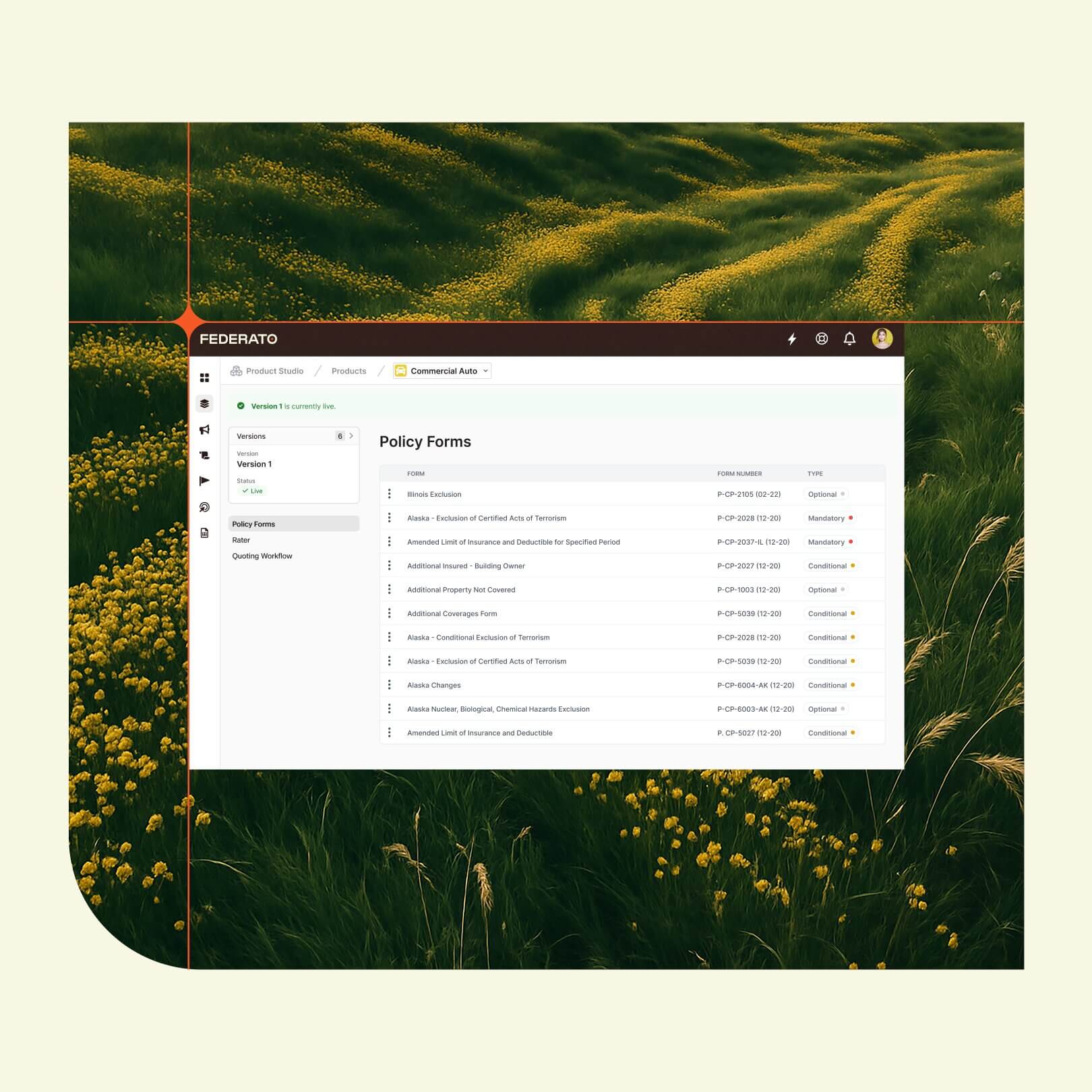
Product definitions are also versioned, with full traceability of what was in force and when, and forms are version-locked so a global update can't change a version that's already live. This means a carrier reviewing how a policy was written can be shown the exact rules that applied at the time, rather than the MGA reconstructing what the guidelines said after the fact, which is essential for MGAs specifically given how directly their authority depends on that kind of proof.
Request a live demo to see how Federato helps MGAs prove discipline while writing more of the business they want.
Guidewire is a cloud-based P&C insurance platform covering policy administration, billing, claims, underwriting, and related insurance operations. Its core offering, InsuranceSuite, combines PolicyCenter, BillingCenter, and ClaimCenter, while InsuranceNow provides a more packaged cloud core for insurers looking for a faster implementation path.
For MGAs, Guidewire offers a broad set of core capabilities rather than a narrowly MGA-specific system. Its strength is the depth and scale of the platform, although that breadth can also make it a heavier option than smaller or more specialized MGA platforms.
Key features:
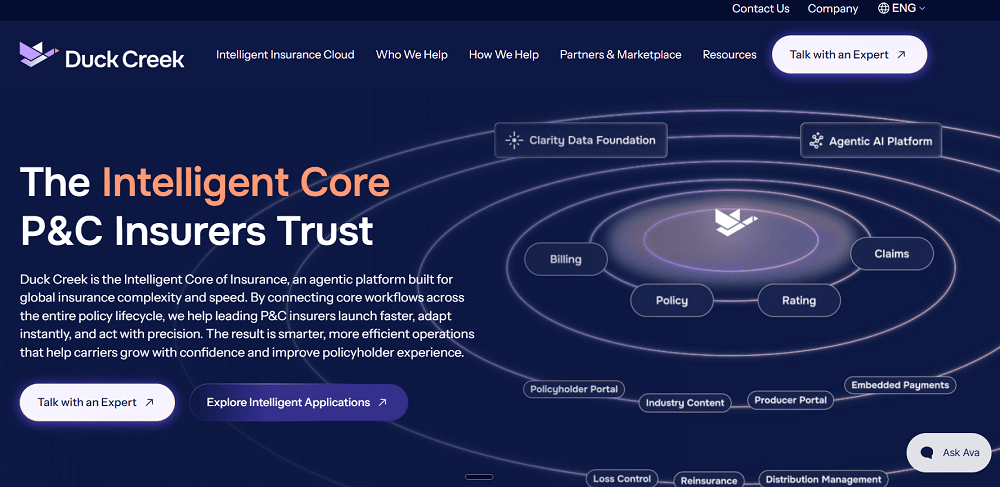
Duck Creek is a cloud-based core system covering policy, rating, billing, and claims, sold standalone or as a suite. Its specialty insurance line is the part of the platform most relevant to MGA-style business, aimed at carriers and MGAs writing complex, evolving risks that need more configurable rating and coverage than standard commercial lines.
Duck Creek recently acquired Send, an underwriting orchestration engine, and now positions the combined platform as covering commercial, specialty, MGA, delegated authority, reinsurance, and London Market operating models specifically. That acquisition brings the connective layer between submission intake, data, and underwriting decision-making into the same platform as the core policy, billing, and claims system.
Key features:

Vertafore is a long-established insurance technology provider with a dedicated section of its site for MGAs, built from several named products rather than a single unified system. The platform lists AIM for underwriting, accounting, and claims, MGA Systems for policy administration, NetRate for ISO-based rating, and Surefyre, an AI-driven underwriting workbench and agent portal, alongside ImageRight for document generation and document management.
Vertafore also offers a knowledge database aimed at underwriting research, and a set of AI agents layered on top of these products, including agents aimed at submission intake and processing.
Key features:
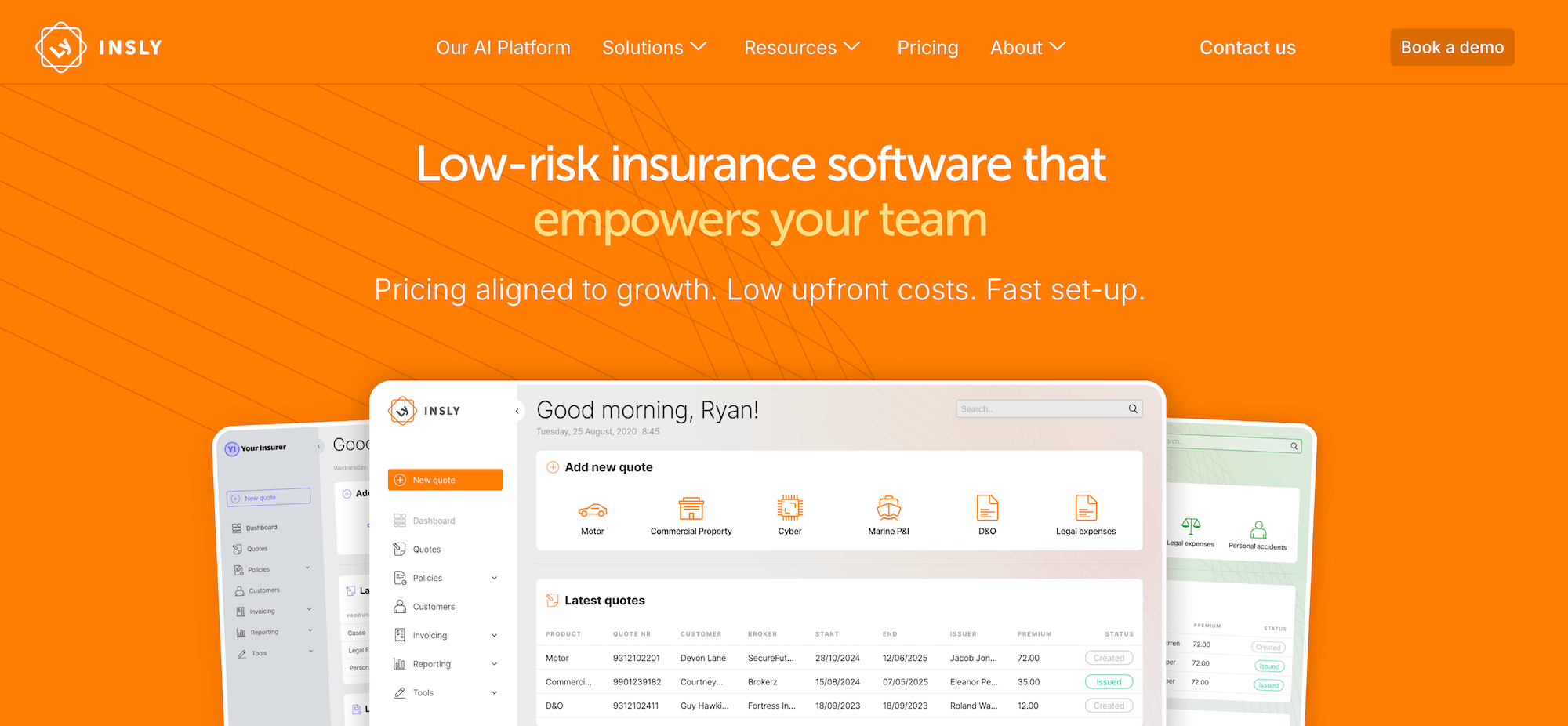
Insly is a modular insurance software platform for MGAs, insurers, and brokers. Its products cover insurance product configuration, distribution, accounting and reporting, and claims management, allowing MGAs to use individual modules or combine them into a broader operating platform.
Its Product Builder supports low-code product configuration, while open APIs connect the platform with distribution partners, capacity providers, and external data sources. Insly also offers AI capabilities for tasks such as document data extraction, broker follow-up, underwriting guideline lookup, and submission triage.
Key features:
BindHQ is an insurance operations platform built for MGAs, MGUs, and wholesale brokers. It covers submissions, quoting, policy issuance, endorsements, accounting, document management, and reporting in a single workflow, combining functions that would otherwise sit across separate AMS, PAS, and back-office systems.
For delegated-authority business, BindHQ can enforce carrier-specific limits, line sizes, and territory restrictions at the point of bind, automate carrier-ready bordereaux, and maintain an audit trail of quotes, binds, endorsements, and cancellations.
The platform also includes prebuilt templates for lines such as general liability, property, homeowners, and dwelling fire, while supporting custom products with their own rules, rating logic, forms, and workflows.
Key features:

Novidea is a cloud-based insurance management platform built on Salesforce for brokers, MGAs, MGUs, and coverholders. It brings front-, middle-, and back-office functions into one system, covering workflows from quote to bind as well as policy administration, bordereaux management, and reporting.
For MGA and delegated-authority operations, Novidea supports risk, premium, and claims bordereaux in Lloyd’s 5.2 format, along with multilingual and multi-currency capabilities for businesses operating across multiple territories.
Because the platform is built on Salesforce, it uses Salesforce’s workflow, automation, and low-code configuration capabilities for processes such as referrals, peer reviews, authority approvals, CRM, and distribution management.
Key features:
Four things separate the MGA insurance software platforms worth shortlisting from the rest:
Federato does all four on one data foundation, driven by AI that acts and advises. It's the only AI-native core platform that spans the full policy lifecycle. Federato's Federated Context Graph maps how guidelines, underwriting decisions, product definitions, claims histories, and billing insights fit together, so an AI agent working on a renewal can draw on the account's claims and billing history and the program's live exposure, not just the submission in front of it.
AI added on top of separate modules can only work with the context each module happens to capture, which makes the system a little faster without making it any smarter. With Federato, what the business learns in claims and billing feeds back into appetite and pricing, so every decision improves the next one. The result is less time spent gathering data and reconciling systems, and a stronger case to carriers that the business is run with discipline.
Request a live demo to see how Federato can work for your MGA.