Insurance
Specialty insurance software: factors to consider, plus 6 platforms to compare
Federato

October 22, 2026

Specialty insurance covers complex or unusual risks that standard insurance policies may not address, such as cyber threats, marine cargo, and professional liability. Coverage and pricing are often tailored to each risk, so carriers and MGAs need to consider not just whether a risk makes sense on its own, but how it fits into their broader business strategy.
However, many specialty insurers rely on separate systems to manage different stages of the policy lifecycle. This makes it harder to share information, apply guidelines consistently, and track how new business affects the overall portfolio. By the time leaders spot a problem, they may have already taken on more risk than intended, affecting profitability and relationships with capacity providers.
Federato addresses these challenges with a unified, AI-native platform built on a single data foundation. It connects workflows across the policy lifecycle, gives teams real-time visibility into portfolio performance, and helps them make faster, more consistent decisions that stay aligned with strategy.
In this article, we explain what to look for in specialty insurance software and compare six platforms across two categories: P&C insurance platforms that support specialty lines and platforms built specifically for specialty and program business.
In specialty lines, risk exposure can become concentrated in one area, such as a single stretch of coastline or a single class of business. To manage that risk, specialty leaders need to set targets for specific parts of their portfolios. For example, they might limit exposure in one region, set a rate change target for a line of business, or define the desired mix of business within a single program or broker relationship.
Most teams still set and share those targets through strategy documents, underwriting guidelines, and monthly reports that circulate as PDFs and spreadsheets. Those files tend to go out of date within weeks. As a result, leaders sometimes spot a problem only after they review the next portfolio performance report. By then, they may find they've been writing too much of one type of risk, relying too heavily on one broker, or seeing losses rise in a single segment. Until the updated guidelines reach everyone, some teams keep making decisions based on targets and risk limits that no longer apply.
When evaluating specialty insurance software, look for a platform that tracks premium, losses, risk appetite, and business mix against portfolio targets in real time. As new policies are written and claims develop, teams should be able to see how the portfolio is performing and use that information to guide their decisions. When leadership changes a target, the guidance changes for everyone at the same moment.
Specialty risks are priced one at a time, often from data that doesn't fit a standard form. For example, an underwriter may need to work from a property schedule that lists hundreds of locations, a fleet's telematics data, or a company's financial statements.
Excess and surplus (E&S) business also tends to reach several insurers at once through wholesale brokers. The insurer that returns a credible price first has the best chance of winning the deal.
Most submission tools now read documents, extract the data, check basic rules, and rank the queue, which is a real improvement. But the underwriter still has to pull the rate, run the pricing scenarios, check the result against what the portfolio can absorb, and build the quote. Ranking helps an underwriter decide which submission to work on next, but it doesn't reduce the work needed to produce each quote.
A strong specialty platform takes the best-fit submissions all the way to a priced quote, with the reasoning attached, for an underwriter to review. It should also check each quote against the live portfolio as well as the written guidelines. For example, a team may know it has a $50 million target for one class of business in a region, but not that $46 million is already written. A $10 million submission that meets every guideline would still push the book past its target.
Specialty insurance involves a lot of judgment calls, from setting prices and coverage terms to handling claims. Different people may reach different conclusions in similar situations, making it important to understand how each decision was made.
For example, most P&C policy administration systems record final policy decisions, such as the premium and policy terms, but not necessarily the reasoning behind them. When someone reviews the account later, they can see what was decided without knowing why.
That missing context matters to carriers and reinsurers, too. Carriers need to know that MGAs are staying within their agreed authority, while reinsurers want to see whether the risks being written match the insurer's stated appetite. They also want to understand how often referrals occur, how delegated authority is being used, and whether risk is becoming too concentrated in certain areas.
Look for specialty insurance software that keeps a record of the rules in effect, the portfolio's position at the time, and the reasoning behind each quote and coverage decision. It should also track product changes, so teams can explain past decisions to carriers and reinsurers without having to piece together information from separate systems.
Specialty billing is rarely standard and often involves minimum earned premium, installment plans, broker commissions, and taxes that differ by jurisdiction. Some policies also carry adjustable premiums that are settled by an audit after the policy term ends.
When billing runs separately from the policy administration system, the gaps show up after bind. For example, after a mid-term change such as an endorsement, the billing system can end up working from outdated policy data. That leads to invoice and commission errors that can build up over time. Late commissions and remittances between carriers, MGAs, and brokers wear down confidence in the numbers first, and then in the relationships that depend on them.
Specialty claims are harder too. Custom policy wording makes coverage calls less routine, and liability losses can take years to fully develop. The same coverage question can also get different answers from different people. For instance, one adjuster may treat late notice as a coverage issue, while another treats it as a procedural one.
Billing and claims data also shows how business performs after it's written. It reveals how customers pay, which policy wording leads to disputes, and where losses are developing worse than expected. On most platforms, that information reaches the people who set prices and appetite through reports, often after more of the same business has already been written.
The most capable specialty platforms run billing and claims on the same foundation as the policy. A policy change updates billing automatically, and coverage decisions are checked against the policy's own wording. Information from billing and claims also helps teams identify problems early and adjust rates, risk appetite, and policy wording before those problems become more costly.
Specialty insurance often involves more parties than standard lines. MGAs write policies on behalf of carriers, reinsurers take on part of the risk, and several insurers may share coverage for the same account.
Each of these parties needs something different from the software. MGA insurance software needs to provide separate guardrails for each carrier program, along with a way for the MGA to demonstrate that it stayed within them. A carrier needs to see how each MGA and broker is performing, so it can direct capacity to the partners producing the best results.
Look for specialty software that handles both views on one platform. The guardrails an MGA works within and the reporting a carrier relies on then come from the same data.
The three platforms below are insurance core systems that cover the P&C insurance policy lifecycle and run specialty lines alongside other property and casualty business.
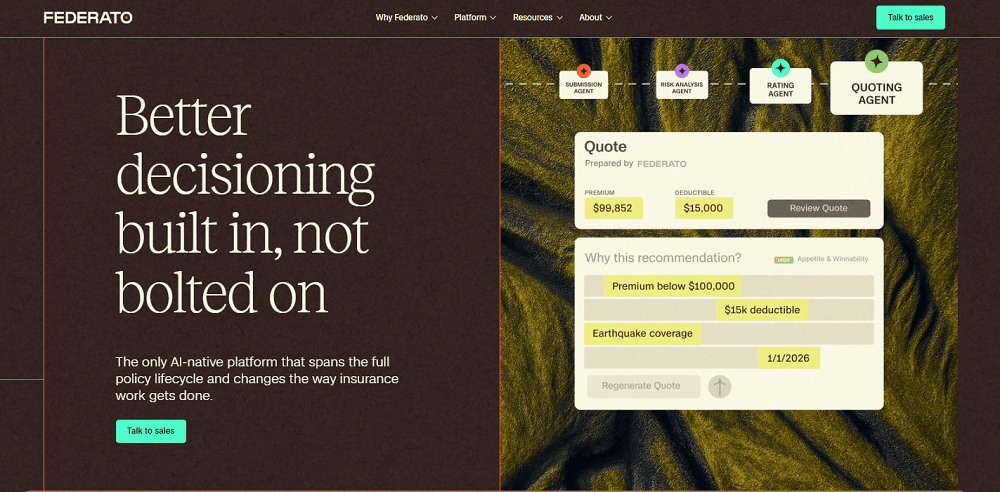
Federato is an AI-native platform for specialty and E&S carriers, MGAs, and MGA aggregators. It’s the only platform that spans the full policy lifecycle, connecting submission intake, underwriting, rating and quoting, policy administration, billing, and claims on a single data foundation.
At its center is the Federated Context Graph, a context layer built on a single data model. It maps how an insurer's guidelines, product definitions, business decisions, billing activity, and claims history relate to each other.
Every part of the platform uses the same data model, so our AI can access the full account history, business guidelines, policy details, and portfolio context without gathering and reconciling information from separate systems.
This architecture is especially useful when a workflow moves from pricing a quote to issuing a policy or handling a claim. This is because each step can draw on everything that happened in the steps before it.
Control Tower connects portfolio strategy to the decisions teams make as business is written. It helps leaders set measurable targets, apply appetite rules, and monitor performance in real time through three components:

Together, Goals, Rules, and Insights tie each portfolio target to the submissions it affects. When leadership updates its guidance, the change applies to new decisions right away, without waiting for revised documents to reach the teams responsible for them. For example, as a region approaches its exposure limit, new submissions from that region can be flagged for closer review.
Velocity Risk, a commercial E&S property insurer, increased the share of its bound policies that met its definition of high appetite by 3.7 times. Rod Harden, President of Claims and Operations at Velocity Risk, described the impact as "further extending our leadership in the markets we serve while building trust with our capital providers, customers, wholesale partners and employees."
Federato's Policy Administration automatically evaluates each incoming submission against the insurer's risk appetite, underwriting guidelines, and current portfolio position. Submissions that meet those requirements are then scored for winnability, which is how likely the insurer is to win the deal. Submissions that clearly fall outside appetite can be declined automatically.
For the best-fit submissions, Federato generates a rated, first-draft quote within minutes, using the insurer's own rates, policy wording, and current portfolio data. Teams then review, edit, and approve the quote before it goes to the broker.
Each quote includes an explanation of how the price was calculated, with citations that trace every input back to its original source. This means underwriters review a prepared price instead of gathering inputs and running every rating scenario by hand.
HDVI, a commercial trucking MGA, uses live data from devices installed in the trucks it insures to assess driving behavior and price each fleet. That data runs through six analytical models, which makes HDVI's pricing process more complex than most.
For its small-fleets business, HDVI programmed more than 30 underwriting rules into Federato. Much of each submission's analysis is now done before an underwriter sees it, and each deal goes to a team with the authority to write it. That cut the typical time to quote a small-fleet submission from one week to half a day, while keeping HDVI's pricing precise.
Adam Barnett, Chief Executive Officer at HDVI, said, "We used to print and hand off 50 pages of guidelines to an underwriter. Now, each time a rule is triggered within Federato, it probably saves an underwriter 10-15 minutes they would otherwise spend flipping through that stack of paper, and guarantees accuracy so the rule doesn't get missed."
Federato records each decision along with the reasoning behind it, across every stage of the policy lifecycle. A reviewer can also reconstruct the rules and approval history that applied when the decision was made.
For example, during claims handling, Federato records the relevant policy clause and the reasoning behind each coverage decision, so it's easier to understand how and why a claim was handled. At the portfolio level, Control Tower tracks referrals and exposure trends to support later reviews. Reinsurers can use that record to examine guideline exceptions and exposure limits.
Propeller Bonds, a surety MGA, grew its production volume from 12 bonds per month to 400 per day. It was later acquired by Arch, its primary capacity provider.
Chris Kolger, Co-CEO of Propeller Bonds, explained how Federato helped the company build trust with its partners: "It all goes back to the trust we've built with both our capacity partners and our agency partners. We wouldn't have that trust if we didn't have a foundation in place that we can rely on to power our growth, keep us moving quickly and make it easy to do business, and Federato provides that foundation."
Billing and Payments runs on the same data foundation as policy administration. Insurers define installment schedules, jurisdiction-specific taxes, commissions, and minimum earned premiums once, and Federato applies those rules to active policies automatically. The platform supports both direct billing and agency or broker billing.

Billing also stays in step with policy management activities. Endorsements and renewals trigger billing adjustments, and cancellations account for minimum earned premium and any commissions that must be returned.
Leaders can also see which business segments have higher rates of late payment and which distribution partners generate more cancellations. These patterns may reveal weaknesses that premium figures alone would miss.
For claims handling, Federato uses AI to guide the first report of a loss based on the type of claim. As new information comes in, the platform checks it against the policy's coverage terms. It also records each change to a claim's reserves, along with the reason for it, which helps leaders spot patterns across claims.
Claims information feeds back into submissions, pricing, and product decisions while claims are still open, so teams can respond to emerging problems before they become more costly. For example, if claim reserves for a segment keep exceeding initial estimates, pricing teams can adjust rates for that segment at renewal.
And if certain policy wording keeps leading to coverage disputes, product teams can update the relevant forms before more policies go out with the same language. They make that change in Product Studio, where rating, forms, and eligibility rules are managed.
Federato lets MGAs apply different business guidelines and risk appetite limits to each carrier program while keeping a single view of their entire portfolio. The platform tracks how closely the MGA follows each carrier's requirements in real time, which helps MGAs demonstrate compliance and build confidence with their capacity providers.
Carriers, in turn, can monitor performance across their MGAs, agents, and brokers. They can see which programs, partners, and business segments are producing the strongest results and decide where to allocate capacity based on that record.
Product Studio lets insurers manage rating, policy forms, and eligibility rules in one place. Changes carry through quoting and policy management workflows, including issuance and servicing, automatically, so teams don't have to update the same information across multiple legacy systems.
Policy forms live in a shared library and can be reused across products. State-specific requirements can be managed as variations within the same product instead of as separate product builds.

A first deployment of Federato takes 12 to 16 weeks, depending on how complex the program is. After launch, insurers can add more lines of business in as few as eight weeks.
Carriers can also move data, workflows, and core operations to Federato one line of business at a time. Schema Sense speeds up this process by automatically mapping up to 84% of an insurer's existing data schema, including data from legacy systems, to Federato. Our own engineers handle implementation, rather than third-party systems integrators.
QBE North America was able to reduce 14 separate tools to a single platform, bringing together seven lines of business and five systems of record for more than 300 underwriters and staff.
Greg Puleo, Vice President of Digital Transformation at QBE North America, explained why better business decisions carry so much value: "When you consider that we're putting out tens of millions of dollars' worth of limit, just one account with a better risk decisioning framework can pay for IT transformation for decades."
Federato is built for specialty and E&S carriers, MGAs, and MGA aggregators that want to manage submission intake, quoting, policy administration, billing, claims, and portfolio oversight on one AI-native platform.
Request a live demo to see a specialty program run on Federato, from setting portfolio targets and drafting quotes to handling billing and claims, while keeping a record of the reasoning behind each decision.
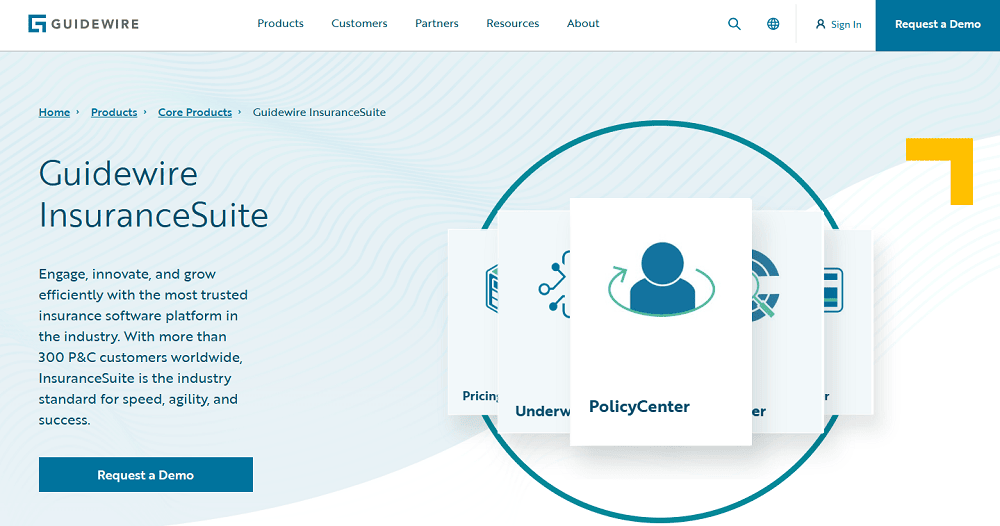
Guidewire builds core software for P&C insurance companies, including those that write specialty lines. Its InsuranceSuite includes applications for policy administration, billing, and claims management, which insurers can buy individually or as a bundle. Guidewire also offers InsuranceNow, a separate cloud-based core platform for regional insurers and MGAs, along with solutions for E&S insurance.
Features
Guidewire's analytics and risk data products include HazardHub for property risk assessment and Cyence for cyber risk modeling.
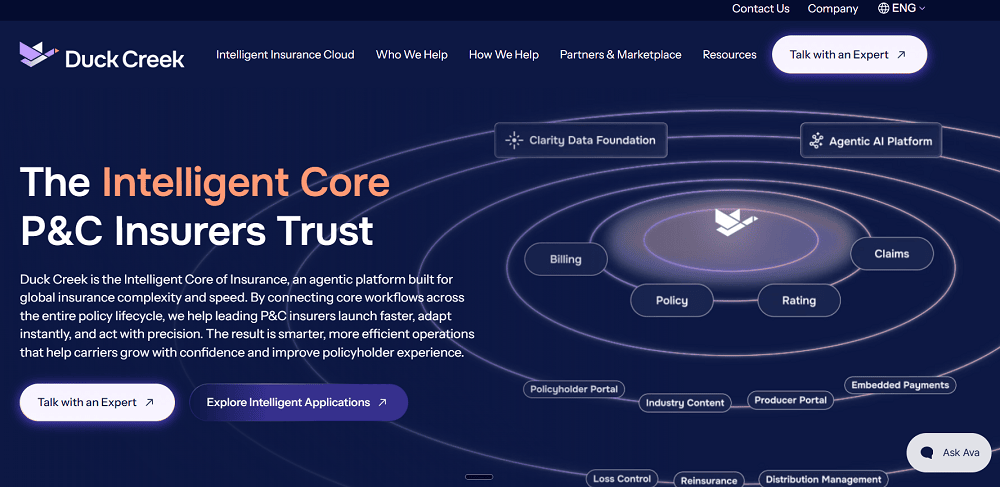
Duck Creek Technologies offers modular, cloud-based core software for P&C insurance carriers, including specialty insurers. Insurers can buy its applications separately or together through Duck Creek OnDemand.
The company also sells distribution management, reinsurance, loss control, and analytics tools. It acquired Send Technology, an underwriting platform for commercial and specialty insurers, MGAs, and reinsurers.
Features
Duck Creek also offers Agentic Product Configurator, which uses AI to help turn insurance product requirements into system configurations. Its first capabilities are available on a limited basis through Duck Creek Professional Services.
The next three platforms were designed with specialty, E&S, and program business in mind, and focus on flexible product configuration and launching new products quickly.

Socotra offers Socotra Connected Core, a multi-tenant SaaS platform for specialty and E&S insurers, including insurers that write cyber and mergers and acquisitions coverage.
Socotra also provides billing, reporting, and data management tools. Its product configuration model supports variations across customer segments, geographic markets, and distribution channels.
Features
Cogitate offers DigitalEdge to carriers, MGAs, and program administrators that write commercial and specialty insurance, including cyber, professional, and management liability. Insurers can use its modules separately or as a suite.
Features
Cogitate also provides distribution management, reporting, and analytics solutions, plus integrations with external risk data and insurance services.
SpeedBuilder Systems offers BindExpress, a cloud-based suite for P&C carriers and MGAs that write specialty programs. The platform supports marine, parametric, cyber liability, and professional liability risks.
Features
BindExpress modules can work together or connect to existing systems and third-party applications.
In specialty insurance, every quote, coverage call, and billing adjustment changes how the portfolio performs. That's why the book needs to be checked against its targets while business is being written, instead of after the quarter closes.
Federato connects pricing, policy administration, billing, and claims, so teams can make decisions using information from across the business. Insurers use it to prioritize and price the right risks, track portfolio performance in real time, and keep each decision tied to their strategy.
Request a live demo to see how Federato keeps specialty insurers on strategy across the policy lifecycle.