Insurance
Guidewire competitors: 8 alternative core systems
Federato

October 22, 2026

Guidewire is one of the most established core system vendors in P&C insurance software, particularly among large carriers. Its InsuranceSuite lets carriers build custom workflows across policy, billing, and claims.
But setting up and maintaining Guidewire can be a major undertaking, particularly for insurers looking for a nimble platform that can deliver ROI quickly. There are three areas worth considering:
For existing Guidewire customers running the platform on their own servers, a potential migration to Guidewire Cloud is another reason to reassess their options. Since migration is a significant project in itself, it's also an opportunity to consider whether Guidewire remains the best fit or an alternative would better meet their needs.
In this article, we compare eight leading Guidewire competitors, starting with Federato, and examine how they differ in architecture, implementation requirements, configuration flexibility, and AI capabilities.
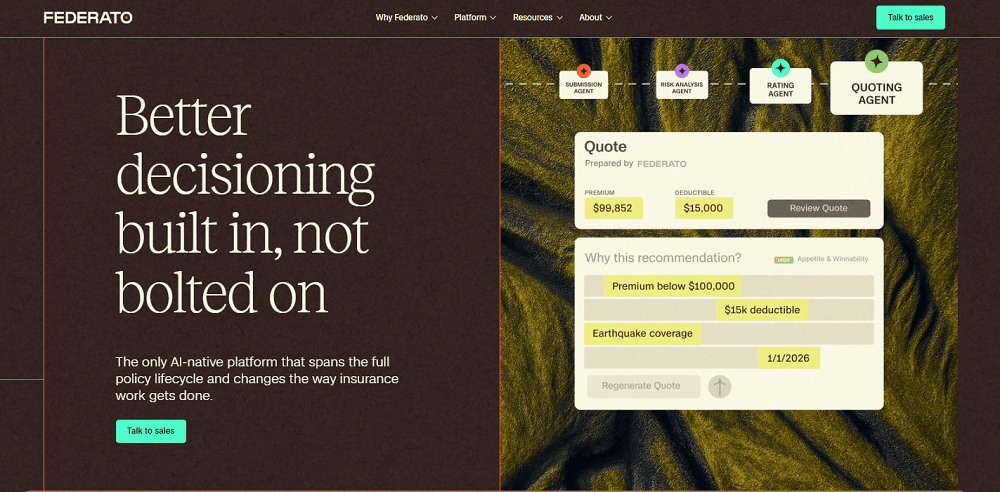
Federato gives AI direct access to the data, business rules, and workflows it needs to make decisions and reliably carry out tasks, which sets it apart from traditional insurance core systems.
Policy data, product definitions, billing activity, and claims history all live in one data model, so a change made in one place carries through the rest of the lifecycle. Billing and claims data also feed back into underwriting and pricing, so leaders can steer the book as results come in rather than correct it after the fact.
Teams can configure rates, forms, and rules without code and start from reusable product templates, so launching a line doesn't depend on custom development. A first implementation typically takes 17 weeks, and each additional line of business takes about eight weeks after that. Insurers also avoid the system integrator costs that often balloon on legacy implementations.
One MGA, for example, set up 30 underwriting rules during its initial configuration, and those rules now handle 95% of its referrals automatically (submissions that would otherwise go to a manager for approval). It also reworked several workflows partway through implementation with minimal impact on its timeline.
Moving to a new core system also means transferring existing policy data. Federato's Schema Sense can automatically map up to 84% of an existing system's data schema to the platform, so insurers can bring their records across without rebuilding their data from scratch.
When AI is added to an older core, it inherits that system's limits. An agent can only work through the integrations that connect the core's separate applications, and it can't reliably work around records that those applications don't agree on. Too often, the result is a stalled workflow or an error that an underwriter has to spend additional time troubleshooting.
Federato avoids those limits by replacing legacy P&C policy administration systems with a platform designed around AI from the start.
Its AI agents, which can carry out multi-step tasks rather than just answer questions or prioritize tasks, work from one data foundation at every stage of the lifecycle. At the center of the platform, the Federated Context Graph maps how guidelines, underwriting decisions, product definitions, claims histories, and billing insights fit together. The agents use that context to find and apply the right information so they can quickly and reliably complete the work requested.
That design lets Federato's AI draft quotes itself, not just triage the best submissions.
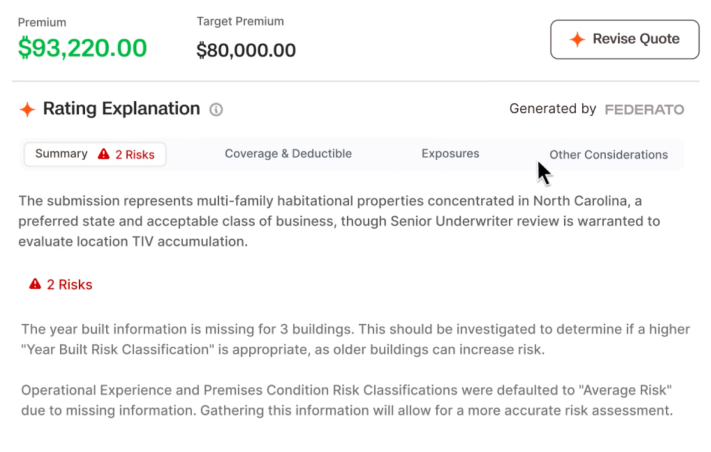
Federato checks each submission against the insurer's appetite and scores those that pass based on how likely the insurer is to win the deal.
For the best-fit submissions, it then drafts a priced quote using the insurer's own rates and policy wording and shows the underwriter the reasoning behind the premium. Every output also includes citations to the information it used, so whoever is reviewing it can see how a recommendation was reached and refine it before acting on it. Because the audit trail builds up as the work happens, leaders and compliance teams get a record of each decision without asking anyone to document it separately.
At Velocity Risk, improvements to its underwriting workflow using Federato helped increase the share of bound policies meeting its definition of high appetite by 3.7 times.
Many established property and casualty insurance software platforms have grown through acquisitions, connecting products that were originally built as separate applications. Because these applications often use different data models, they rely on integrations to share information — which can introduce delays, data inconsistencies, and gaps in context, making it harder for both humans and AI to complete work reliably across the policy lifecycle.
Even within a single vendor's suite, a midterm coverage increase may trigger updates across policy administration, rating, documents, and billing. If those applications don't stay in sync, staff can end up reconciling conflicting records or completing the change manually.
Here's how Federato handles these workflows in practice:
Information also flows back in the other direction.
Each billing event becomes a signal for underwriting, and trends in coverage decisions, reserve changes, disputes, and overrides reach underwriting, pricing, and product teams while claims are still open.
Control Tower, Federato's portfolio oversight tool, shows leaders how the portfolio is tracking against their objectives as submissions come in. When conditions shift, they can promptly update targets and guardrails before a segment drifts off course.

In Federato's 2026 State of P&C Insurance Technology report, 64% of insurers said they depend fully or mostly on IT to implement operational changes. For product and pricing teams, that dependence turns every new product, rate change, and rule update into a request that waits in a development queue. By the time a change reaches the market, the conditions that prompted it may already have changed.
Federato's Product Studio keeps that work within the teams that own the products.
Product teams set pricing at the product level, so rates reflect how the product is structured. They also define forms, endorsements, and the rules that govern when each one applies. They can update pricing, coverage, and rules directly, without code changes or coordination across multiple systems.
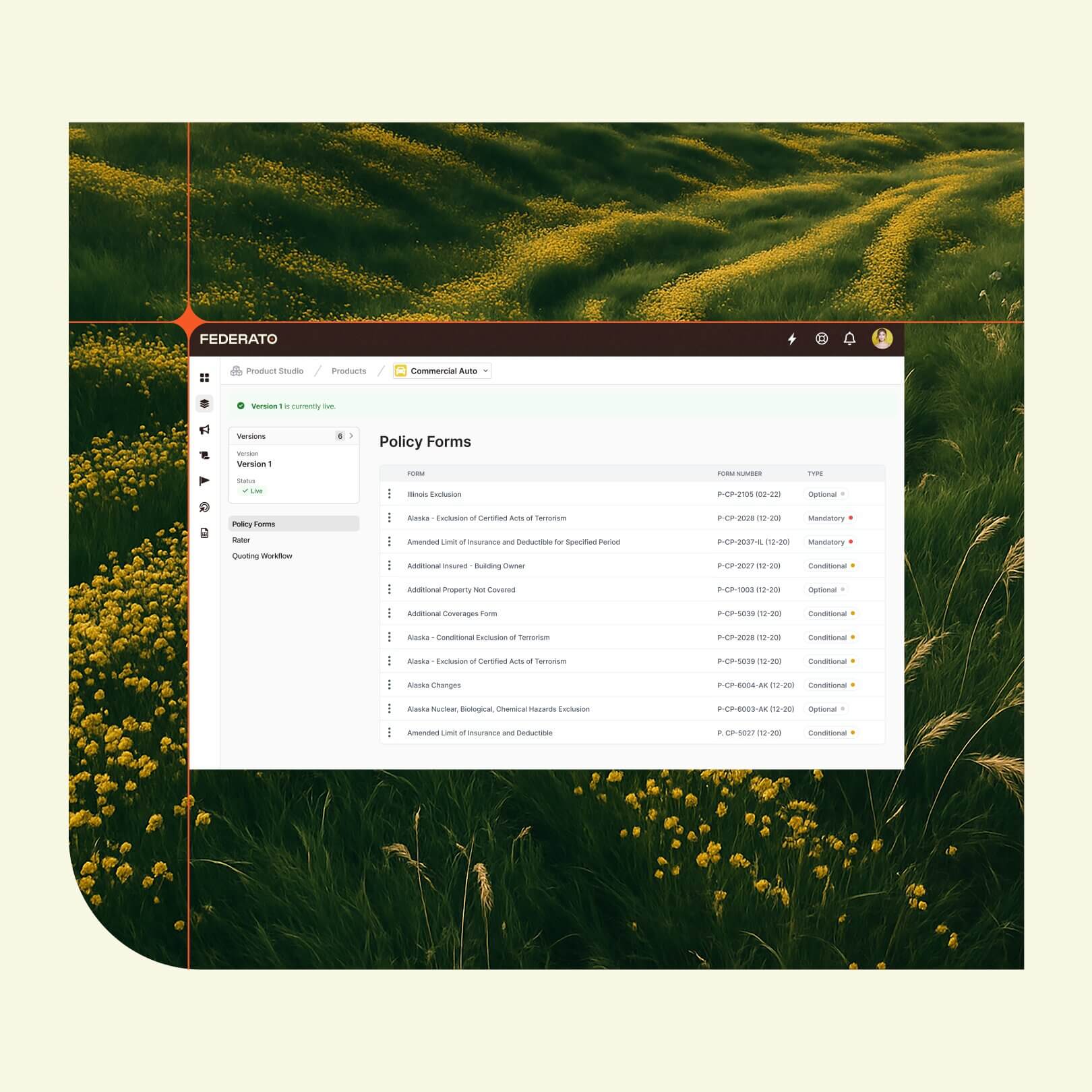
Every version of a product definition ties to specific policy effective dates, and every change is logged with a full audit history. When a regulator or an internal reviewer asks what was in force on a given date, the answer is already on record.
Every line of business works from a single data schema, so teams can expand into new programs or states without rebuilding product definitions from scratch.
Federato customers have consolidated multiple systems into one platform and reduced the time it takes to complete key insurance workflows. The results show improvements in both operational efficiency and the ability to handle growing volumes of business.
Request a live demo to see how Federato turns a unified AI-native core into faster decisions, more efficient operations, and better business outcomes.
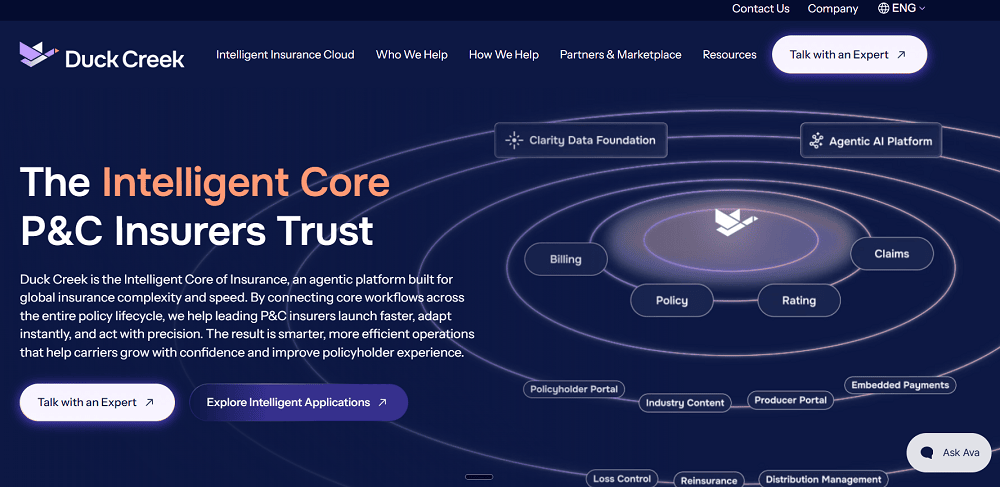
Duck Creek offers core applications for policy, rating, billing, and claims across personal, commercial, and specialty lines. Its cloud-based software runs on Microsoft Azure, with several delivery models available. These include Duck Creek OnDemand, which serves as a transitional cloud environment for existing customers migrating from on-premises systems, and Active Delivery, which offers a more standardized SaaS operating model.
Duck Creek claims a 90-day implementation, but configuring it is specialist work that’ll extend implementation timelines. The company runs Duck Creek University, with certifications at Configurator, Technical, and Technical Architect levels, so insurers should plan for trained specialists on their own team or a partner's.
Its Agentic AI Platform builds AI agents on top of its existing core products, using shared data and APIs to connect them to policy, billing, and claims systems. Rather than rebuilding those products as a new system, the platform adds new layers of orchestration, governance, and insurance-specific models over the data and integrations already in place.
Key features:

Sapiens sells P&C core systems to insurers around the world, and its IDITSuite serves P&C insurers, MGAs, and brokers in personal, commercial, and specialty lines. Sapiens offers different core products depending on where an insurer operates. Insurers comparing Sapiens with Guidewire should check which core product applies to their region and how much of the newer tooling they can use today.
Sapiens' API Conductor (ACE) gives insurers an open API layer for connecting third-party systems, which suits carriers that want to replace legacy systems gradually. Sapiens recently announced SapiensAIP, focused on data migration and system configuration.
Key features:
EIS is built for insurers running core digital transformation programs, the kind of enterprise buyer that would otherwise tend to default to Guidewire.
Its main product, EIS OneSuite, follows a microservices, API-first, cloud-native architecture, so carriers can adopt the parts they need and connect them to systems they already run. BillingCore, for example, works with PolicyCore or a third-party policy administration system.
That modular design shapes how EIS is rolled out. EIS recommends a phased approach to modernization, and like Guidewire, it works with large implementation partners.
Key features:
Insurity serves carriers, MGAs, and program administrators across commercial, personal, and specialty lines, including marine and workers' comp. For specialty and commercial insurers that want core systems and analytics from the same vendor, it can be an alternative to Guidewire.
Rather than one suite, Insurity offers several policy products aimed at different parts of the market. Ratio Policy AI is its newest, API-first policy administration system for commercial insurance. Pro Suite is a modular core for MGAs and specialty carriers working under delegated authority and program administrator models. Separate suites cover workers' comp and marine, so buyers need to work out which combination fits their business.
Much of that range came from acquisitions, including Valen Analytics, SpatialKey, and Instec. Insurity runs its cloud deployments on both AWS and Azure, and it works with system integrator partners for implementation and configuration.
Key features:
Majesco offers cloud-native insurance software, and its P&C suite supports personal, commercial, workers' comp, and specialty lines. It serves both carriers and MGAs, with a separate core product for each.
CoreConnect is Majesco's MGA insurance software offering, built for MGAs, MGUs, and growth-market insurers. It's based on the platform Majesco gained when it acquired DRC. CoreConnect starts from preconfigured setups built for MGA use cases and includes portals for agents, brokers, and insurers. This split mirrors Guidewire's own division between InsuranceSuite and InsuranceNow.
Majesco also sells specialized products alongside its cores, including Enterprise Rating and Intelligent Underwriting, so the final scope depends on which pieces an insurer adds. In 2025, it added AI agents to its existing P&C products for claims triage, billing, and payments.
Key features:
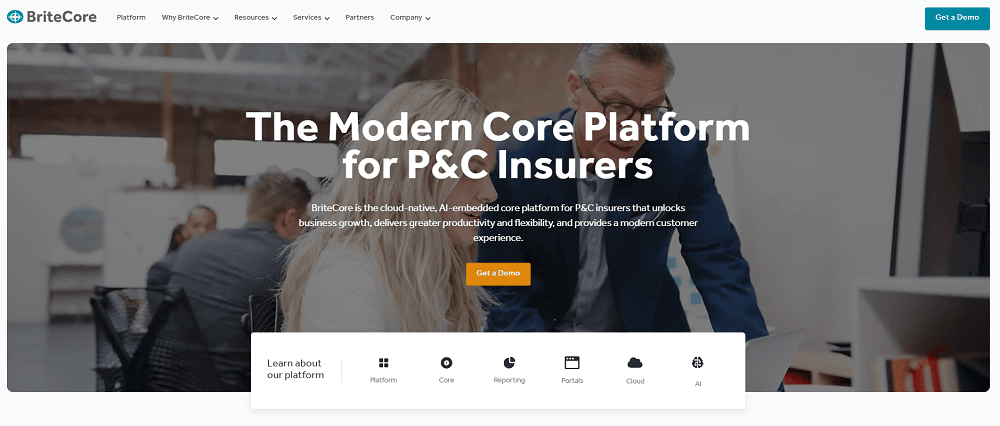
BriteCore focuses on mid-size carriers and fast-growing MGAs in North America, a segment Guidewire serves with InsuranceNow rather than InsuranceSuite.
BriteCore sells one platform covering policy, billing, and claims, and it runs on AWS. Product definition and rating are handled through a point-and-click interface for products, coverages, rates, and fees.
BriteCore recently added a headless deployment option, which lets insurers keep their own underwriting tools, rating engines, or customer-facing applications and connect them to BriteCore as the transactional system of record. It has also introduced its first AI copilots and an Underwriting Workbench.
Key features:

Socotra is a core platform for insurers and MGAs that want to build and launch their own products. Where Guidewire offers a full suite to buy, Socotra appeals to insurers with engineering teams that want to build around a flexible core.
Products are configured graphically or with JSON, and Socotra says any software developer can configure and implement it. This means insurers can implement Socotra with their own team, a partner, or Socotra's professional services. That gives insurers with technical teams a lot of control.
Socotra covers policy, billing, rating, and portals. For claims, its documentation covers first notice of loss, and full claims handling comes through partner companies. Insurers that want a complete lifecycle should factor those integrations into their evaluation.
Key features:
The right core system depends on an insurer’s size, budget, in-house IT resources, and how quickly it needs to launch and change products.
If you're facing a move to Guidewire Cloud, or your teams are tired of waiting on a development queue, it's worth weighing the cost of staying against the cost of moving.
Federato’s AI-native core system drives business outcomes by running policy, billing, claims, and portfolio management on one foundation, so your teams can launch products faster, change them without waiting on IT, and pursue premium growth while protecting margin.
Request a live demo to see how Federato puts AI to work to improve operational efficiency and accelerate decision-making.