Insurance
89% of P&C insurance employees use shadow AI
Federato

August 21, 2026
Right now, 9 out of 10 employees at your company are using unsanctioned AI tools because the approved tools don’t move fast enough.
This is the third post in a series on Federato's 2026 State of P&C Insurance Technology report, which surveyed 750 P&C insurance professionals across carriers, MGAs, and MGA aggregators. The first post covered the coordination tax fragmented systems impose on every employee's week. The second covered the gap between what leaders believe is happening and what underwriters actually experience. Today’s post covers what employees do about that gap when nobody's watching.
Shadow AI refers to AI tools used outside a company's approved systems, policies, or workflows. In P&C insurance, where a submission can carry client PII, loss history, and proprietary underwriting logic, it's a live data governance problem. The research shows it's endemic, and that leadership already knows.
When Federato asked what employees rely on when their organization's own tools aren't enough, general-purpose AI tools such as ChatGPT, Copilot, Gemini, and Claude topped the list at 53%, ahead of personal spreadsheets, informal Slack threads, outside data sources, and manual workarounds across systems. Manual workarounds, the option that requires the most effort and produces the least value, came in last at 39%.
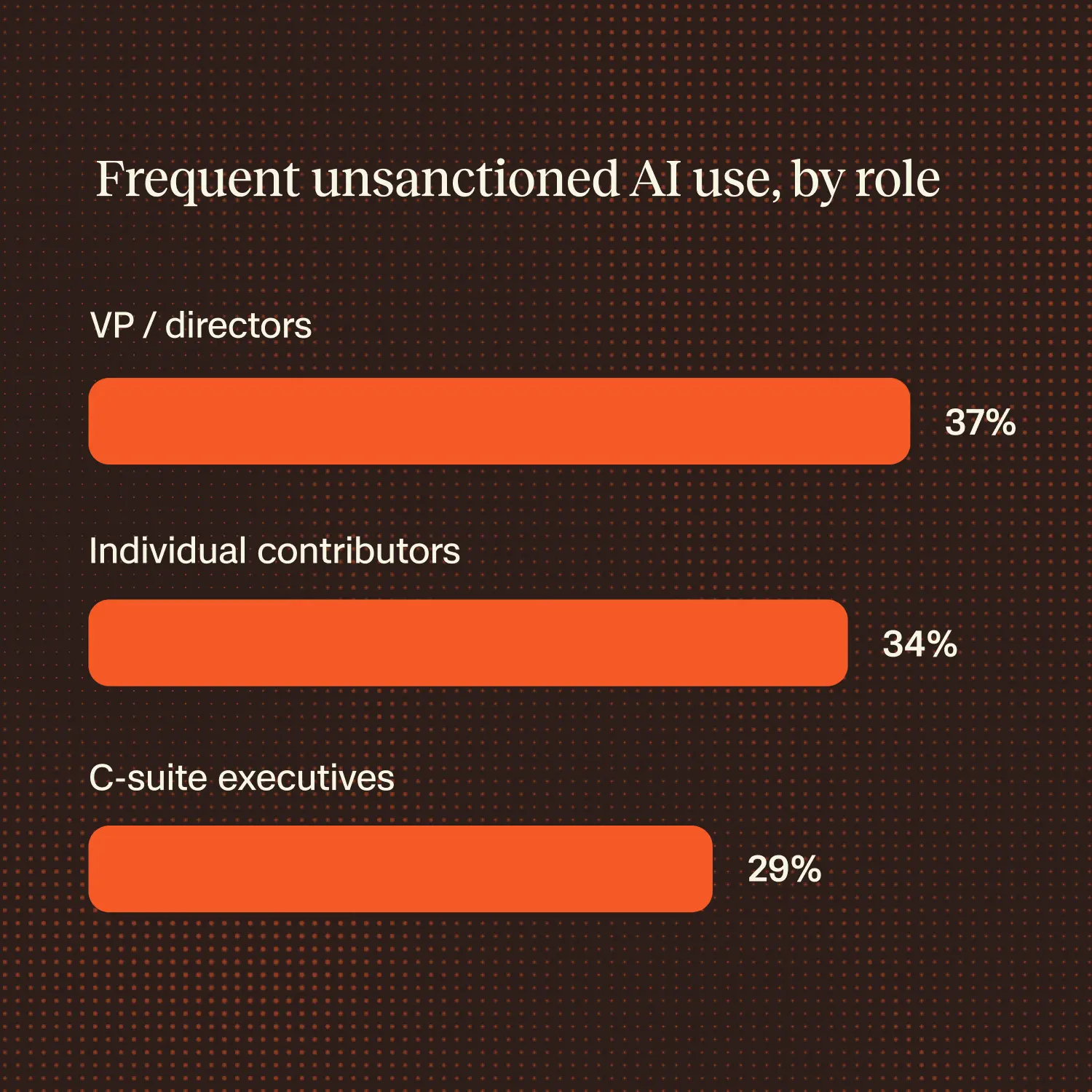
Asked directly how often they personally use AI tools that aren't approved or sanctioned by their organization, 89% of employees said at least occasionally, and 36% said frequently. The behavior isn't concentrated at the bottom of the org chart, either. VPs and directors report the highest rate of frequent shadow AI use, at 37%, ahead of individual contributors at 34% and C-suite executives at 29%. The people closest to deadlines and furthest from the tooling budget are the ones most likely to route around it.
It would be convenient to file this under "leadership doesn't know what's happening on the front line." But the data tells a different story. 89% of directors and above say unsanctioned AI use is common in their organization, with 40% calling it very common.
Among the leaders who describe shadow AI as very common, 40% also admit to using unsanctioned AI tools themselves frequently, a higher rate than leaders who call it merely somewhat common or rare. The people with the clearest view of how widespread this is are disproportionately the ones doing it.
The data shows that shadow AI use isn’t a symptom of falling behind. Frequent unsanctioned AI use rises alongside operational maturity: 29% among the least integrated organizations, 33% among those in transition, and 43% among the most integrated.
That's counterintuitive, until you think about who's doing the using. Employees at more advanced organizations are more comfortable with AI generally, more likely to already have a workflow built around it, and more likely to reach for a faster tool the moment their approved system can't keep pace.
Two respondents captured the tradeoff plainly. An individual contributor at an MGA aggregator described the hidden cost as "fact-checking AI answers, because they can sound right but still be wrong." A vice president at an MGA put it in terms of time: "managing time when AI saves you work but still needs a lot of supervision." Shadow AI doesn't remove the friction, it just removes oversight.
That's the real exposure. When underwriting data, claims details, or portfolio information gets pasted into a consumer AI product, that information can leave the organization's control entirely, with no privacy safeguard and no record that it happened. In an industry where regulators expect a clear account of how every decision got made, a workforce quietly routing sensitive data through unapproved tools is a governance gap that compounds every time it happens. The research shows it's happening at nearly every level of the organization, every day.
Employees go looking for other tools when their approved systems can’t keep up with the pace of the work in front of them. Blocking access to outside tools without addressing that gap just removes the workaround and leaves the underlying friction in place.
The insurers seeing better results are embedding AI directly into the underwriting workspace, so employees get speed and context from the system they're supposed to be using, instead of a browser tab no one can audit. When guidance, portfolio context, and AI assistance live inside the workflow, there's less reason to go find it somewhere else.
The report breaks down how AI maturity connects to governance confidence and real-time decision guidance, and where the biggest gaps between adoption and integration still sit.
Read the full 2026 State of P&C Insurance Technology report for the complete findings. And stay tuned for our next post in this series, on realizing the value of fully integrated AI.
Ready to see how Federato brings AI inside the workflow? Book a demo.