Insurance
7 agentic AI use cases in insurance that go beyond automation
Federato

November 18, 2026

Many commercial insurers and MGAs already use generative AI to read submissions, summarize claims files, and answer brokers' questions. AI agents promise to take this a step further. Instead of helping employees with one task at a time, an agent can carry out an entire workflow, freeing employees to focus on decisions that require human judgment.
But faster prioritization of submissions and more effective claims processing mean little if the decisions behind them don't improve. If an insurer accepts the wrong risks or overlooks the exposure already in its portfolio, greater efficiency may simply mean writing more unprofitable business. The most impactful agentic AI use cases are the ones that help insurers grow premium in target segments, reduce operating costs, and improve loss performance.
The bigger opportunity is to use the information an insurer gathers to make better decisions about which risks to insure and how to manage the portfolio as conditions change. To do that, AI agents need access to current account and portfolio data, the insurer's business rules, and the reasons behind past decisions. A shared data foundation makes that context available wherever agents need it, reducing the delays and gaps in information that can arise when they rely on integrations between separate systems.
Below, we explain what agentic AI is and examine seven use cases across the commercial P&C insurance lifecycle. We look at what agents can automate, how access to connected account and portfolio data can help improve decisions, and what it takes to put those capabilities to work. We also cover whether existing insurance systems can support agents, how to keep agents within defined limits, and where insurers should start measuring results.
"Agentic" describes AI that acts on its own. An AI agent is given a business goal, such as preparing a submission for underwriting or repricing a renewal, and it works through the steps needed to reach that goal. It gathers the data it needs, applies the insurer's guidelines, makes decisions within limits the insurer sets, and completes the work in the policy, billing, or claims system. People review the decisions that require human judgment.
The easiest way to understand what an AI agent does is to compare it with two other types of automation: rule-based automation and AI assistants.
An AI agent can carry out a multi-step task autonomously. It decides which actions to take and adapts as new information becomes available, while operating within rules and limits the insurer has defined in advance.
Suppose a policyholder requests an endorsement to change their coverage mid-term. Here’s how each approach would handle the request:
Task automation speeds up one step, and workflow automation completes a sequence of steps. Agents can deliver both of those efficiency gains, and because they can also work from current account and portfolio context, they can influence which actions the insurer takes next.
That gives insurers two kinds of benefit. The immediate one is handing agents high-volume, routine work across the policy lifecycle, so people can focus on the judgment calls and relationships only they can handle. The more significant benefit comes from using the data and insights gathered during those workflows to improve future risk assessment, pricing, and portfolio decisions, within the appetite and authority the insurer defines.
Below, we look at seven agentic AI use cases and the results each one can deliver.
Before an insurer can draft a quote, it typically has to gather information from many sources, including the broker's emails and attachments, its own internal systems, and third-party data providers. These inputs include the submission application, the schedule of locations or vehicles, and loss runs, and they're spread across documents, carrier systems, and third-party feeds.
Our 2026 State of P&C Insurance Technology report, which surveyed 750 insurance professionals across carriers, MGAs, and MGA aggregators, found that underwriters use an average of 6.8 systems to work a single submission.
Once the information is gathered together, an underwriter assesses factors like the applicant's business operations, property values and locations, exposure to natural disasters, past claims, and requested coverage limits. The underwriter also has to account for the insurer's own guidelines and the exposure already in its portfolio. The insurer then has to run clearance checks, triage the submission against appetite, and price it.
In Federato, AI agents in Policy Administration turn submissions from a broker's email into draft quotes for the best-fit deals, rather than simply triaging and prioritizing such deals. When a submission lands in the inbox, the agent identifies it and its attachments, separates submissions for different lines of business that arrive in the same email, and extracts the data from each document. That includes details such as the locations in a statement of values or the losses in a loss run.
The agent fills gaps with third-party data, such as a property's wind and hail exposure or a contractor's safety citations, and automatically asks the broker for anything that's still missing. It also runs the insurer’s clearance rules, which check for duplicate submissions, broker licensing, and sanctions.
Next, the agent scores each submission for appetite fit against the insurer's guidelines and current portfolio targets, and for winnability, meaning how likely the insurer is to win the deal. Winnability is based on the insurer's own past results, its referral behavior, and how each broker has engaged on past submissions. The agent combines these measures into one priority score. Based on rules that leadership sets, the agent declines submissions that clearly fall outside appetite and refers those that need senior sign-off.
The agent rates the best-fit, most winnable risks using the rater the insurer has configured in Federato and the insurer's guidelines. It then drafts a quote that cites the guideline and data behind every term. An underwriter reviews, edits, and approves the draft quote before it goes to the broker.
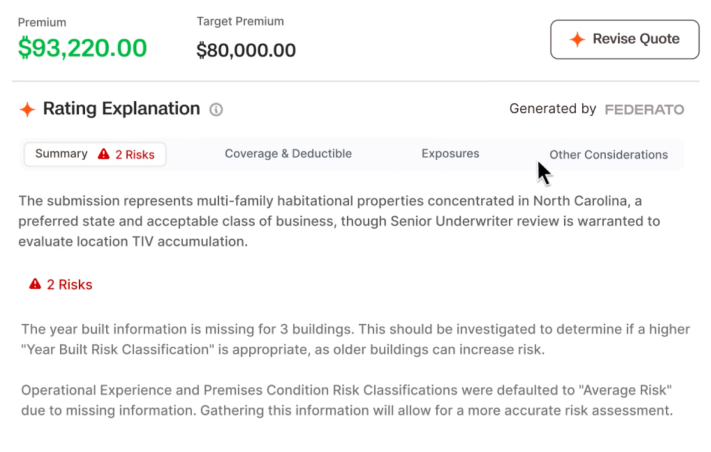
As a result, the team starts each day from a ranked queue and a set of draft quotes, instead of raw submissions worked first in, first out, and users’ time goes to the business the insurer most wants to write.
Keeping a portfolio aligned with the insurer's strategy means monitoring the business being written and adjusting course when necessary. But when portfolio leaders rely on monthly or quarterly reports, a segment may drift off target well before anyone notices.
An AI agent can monitor premium and exposure as policies bind, comparing them against the insurer's appetite, accumulation limits, and growth targets. When a segment approaches a limit or falls behind target, the agent alerts portfolio leaders and identifies the policies driving the change.
The agent can also apply rules approved by leadership to adjust how pending submissions are handled. For example, it can prioritize business in under-target segments or refer risks that would breach an accumulation limit.
In Federato, for example, portfolio leaders use Control Tower to set goals by line of business, geographic program, or broker as accumulation, mix, or rate targets. Each goal updates against live data as business comes in. Leaders also set the appetite rules that new submissions are scored against, see how often each rule fires, and adjust each rule's weighting as conditions change.

When leaders change these targets or rules, AI agents that triage and price new submissions start using the new versions right away, so each new submission is weighed against the current plan.
As a result, the insurer can catch a drifting segment and bring it back on plan before more business binds in it, instead of finding the problem in next quarter's report. This protects both the loss ratio and the cost of reinsurance.
Once a policy is bound, policyholders can ask for changes during the term, such as adding a location, vehicle, driver, or additional insured. Each request has to be checked against the insurer's guidelines and existing policy terms, priced, and reflected in updated policy documents and billing records.
Today, service teams handle most routine endorsements as part of their customer engagement responsibilities and refer unusual requests to the underwriter. The person then has to review the original decisions to understand why certain terms or exceptions were approved. In many specialty insurance software platforms, the final premium and policy terms are recorded, but the reasoning behind those decisions remains in notes or emails.
As a result, a change may comply with the insurer's guidelines but still conflict with the conditions under which the risk was originally accepted.
An AI agent can process endorsements while also checking them against the conditions and reasoning behind the original underwriting decision. First, it can compare each request with current appetite and guidelines, and with any conditions or exceptions recorded when the account was written. For changes within its authority, it can recalculate the premium and update the policy documents and the next invoice. It can also refer anything outside its authority for human review, along with the reason for the referral.
For an agent to consider the reasoning behind past underwriting decisions, that information has to be accessible in the servicing workflow. The original underwriting rationale, including any conditions or exceptions, must be recorded and connected to the current policy information. A shared data foundation makes this possible, allowing the agent to evaluate proposed changes against the reasons the risk was originally accepted.
Today, billing teams send reminders and cancellation notices on a fixed schedule, and patterns in late payments by segment or broker rarely influence decisions elsewhere in the business. On most systems, billing runs separately from policy administration. As a result, a rise in late payments in one segment shows up weeks later in a finance report, if it shows up at all. Meanwhile, every policy that's canceled for non-payment takes the premium for the rest of its term off the books.
An AI agent can automate payment matching and collections while also identifying patterns in payment behavior that can inform decisions elsewhere in the policy lifecycle. It can match each payment to the right policy and installment and resolve mismatches, such as a broker remittance that covers several policies. It can also track late payments and non-payment cancellations by segment, program, and broker, and flag concerning patterns for portfolio leaders to review.
Automated collections may prevent avoidable cancellations and help the insurer keep premium on the books. Outside the billing workflow, the same payment and cancellation patterns can help underwriting teams decide which segments and broker channels to pursue, and on what terms.
This second benefit also depends on the data foundation beneath the agent. A shared foundation connects payment activity with policy, account, and portfolio data, which lets the agent identify patterns and pass them to the people responsible for acting on them. If billing runs in a separate system, the agent may see that an installment is late without knowing which program, class, or broker the policy belongs to, unless integrations supply that context.
In Federato, for example, Billing and Payments shares a data schema with Policy Administration. When a policy is endorsed or canceled, agents can recalculate the affected amounts, including taxes, commissions, and minimum earned premium, without reconciling records across systems. Because every payment is recorded against the same policy data used to evaluate submissions, delinquency and cancellation patterns by segment and broker channel can reach underwriters before more business is written on the same terms.
At many insurers, adjusters receive first notices of loss (FNOL) by phone or email and manually check coverage against the policy. The details of each loss and the reasoning behind claims decisions often remain scattered across notes and systems. As a result, portfolio leaders may see losses rising in a segment without understanding what's driving the increase.
For example, when handling a routine storm claim, an adjuster may have to piece together information from several sources: notes in the claims system, an inspection report buried in an email thread, and photos stored on a shared drive. Before making a coverage decision, the adjuster must gather and review all that information to understand the full picture.
In Federato Claims, for example, an AI agent runs FNOL as a chat in the policyholder or broker portal. This approach to customer engagement lets the agent guide the conversation based on the type of loss and adapt its questions in real time as the policyholder or broker answers. It captures what's said and structures it into a record for the adjuster, with any missing information identified, so no one has to repeat themselves.
Structured FNOL intake mainly improves efficiency. The adjuster begins with organized facts and identified gaps, so there's no need to transcribe every report or chase basic details.
Federato Claims also supports an initial coverage review by comparing the reported facts with the policy in force on the date of loss, including any endorsements made during the term. Before a claim proceeds toward settlement, the agent flags missing information, conflicting facts, or ambiguous policy wording for the adjuster and cites the relevant policy provisions. This helps the adjuster resolve coverage questions that could otherwise delay claims settlement.
As adjusters make coverage decisions, Federato records the supporting evidence, reasoning, disputes, and overrides as structured data rather than leaving them buried in notes. It can then analyze claims across the portfolio to identify patterns, such as recurring coverage disputes, reserve increases, or frequent overrides. These insights reach portfolio leaders, who can use them to refine risk appetite, pricing, coverage terms, and product strategy.
The value beyond automating claims handling is that recurring causes of higher claims costs can inform future pricing, coverage terms, and risk selection, instead of staying isolated in claims files.
Claims teams use fixed rules to flag potentially fraudulent claims, such as claims filed shortly after a policy begins. These rules can delay legitimate claims while letting fraud that doesn't trigger them go undetected.
Simple, single-trigger rules can miss warning signs that only become visible when information is combined across a claim, an account, or related claims. And every honest claim held for review delays claims settlement and takes up an investigator's time.
An agent can combine signals from an account's history and related claims to make investigation referrals better informed. First, it can check each new claim against the account's history, such as recent endorsements, missed payments, and earlier claims. It also looks for connections across claims, such as the same vendor, address, or phone number appearing on unrelated accounts. It then sends the claims with the strongest warning signs to an investigator, with each sign cited, while other claims continue through the normal claims handling process.
Faster fraud screening is one benefit of agentic AI in insurance. The larger one is that richer context can improve claims triage, helping investigators prioritize stronger leads and cut down on unnecessary referrals. An automated flag still isn't proof of fraud, so the investigator makes that call.
Renewals are usually pre-filled with last year's terms, and teams only have time to review the largest accounts closely. As a result, a mid-sized account whose claims history, payment behavior, or exposures have changed may renew at last year's price, without anyone assessing whether that price still reflects the risk.
Even when someone does review an account, they often have to gather information about endorsements, payments, claims, and, for commercial auto policies, telematics data from separate systems to understand how its risk changed over the policy term.
With agentic AI, insurers can review the full renewal queue, including the mid-sized accounts, using the information that has built up since each policy was written.
The agent first pulls together the account's claims, payments, endorsements, and updated exposures, including telematics data for commercial auto policies where available, and compares them with what was expected when the account was written. Any fraud detection findings associated with the account can also be brought into the review.
It can then re-rate the account using current data and draft the renewal quote, explaining any change in rate or terms. It can move deteriorating accounts to the front of the review queue and recommend non-renewal for any that now fall outside appetite, leaving the final decision to a person.
One benefit of agentic AI in insurance is that fewer accounts renew on outdated terms simply because no one had time to review them. By combining predictive analytics with an assessment of changes in risk across the entire renewal portfolio, insurers can focus their attention on accounts that need closer scrutiny and adjust pricing or coverage terms to reflect each account's current risk profile.
Some agentic AI use cases mainly improve work within one function. Others depend on what another part of the policy lifecycle has learned. To deliver the second kind of value, agents need timely account, portfolio, and decision context, plus permission to act on it. Whether agents can access that context efficiently and act on it reliably depends largely on the underlying AI architecture.
Insurers that use their existing P&C policy administration systems can add agents to them in one of two ways. The first is adding AI point solutions onto an existing core platform, with each one handling a single step, such as reading submissions.
The second is adding agents from vendors of insurance core systems, built on top of those vendors' existing policy administration, billing, and claims processing. An example is an agent that processes endorsements inside the existing policy system.
Both approaches can speed up individual tasks, but whether they also improve business results depends on what the agents can access and do. To understand why, an AI agent has three main parts:
Capable LLMs are widely available, so the model alone isn't what sets one agent apart from another. The bigger differences lie in the quality of the context an agent can access and how quickly and reliably its tools can carry out actions. Both depend heavily on the architecture of the underlying insurance systems.
To put this in practical terms, agents layered over separate systems for underwriting, policy administration, and claims management can inherit gaps between those systems. On the context side, records in different systems can conflict, and the reasoning behind past decisions can be sitting in notes the agent can't reach. Giving the agent all the available data doesn't fix this, because an LLM that receives large volumes of loosely relevant information can struggle to identify the information needed to make a decision, a problem known as context rot.
For example, a renewal agent may receive the full claims history for an account, including the adjuster's reasoning for raising reserves twice. But that reasoning may be buried alongside hundreds of pages of claims notes, correspondence, and routine updates. The agent may fail to identify the explanations for the reserve increases and recommend renewing the account on the same terms, even though those explanations could justify a change.
At best, the agent refers the decision back to a person to review. At worst, it overlooks the reserve increases and recommends renewing the account on the same terms.
On the tools side, the problem is volume, as agents don't complete a task in a single pass. They replan, request more information, and call the same tools again as they refine their work. Even a request to re-rate a policy with a deductible change can take up to 14 API calls across different rating engines. Core systems whose APIs weren't built for that volume can slow down or time out. When a call fails without a clear error message, the agent can't tell whether to retry, try another route, or refer the task to a person.
Similarly, when a broker requests an endorsement to raise a limit, an agent may need to work through separate integrations to update the policy, re-run the rating, regenerate documents, and adjust billing. Each integration is another point where the request can slow down or fail.
An AI-native platform is designed to close those gaps by replacing the core. Policy administration, billing, and claims management share one data foundation, so agents work from consistent records and can access the reasoning behind past decisions.
But having access to that information isn't enough. A context graph maps the relationships between account data, business rules, and past decisions, helping agents retrieve the information relevant to each task when they need it, rather than passing entire account histories to the LLM. Federato's federated context graph is designed to do this across the policy lifecycle, reducing the risk of context rot.
The platform's tools are built for agents from the start. They handle high call volumes, and when something goes wrong, they return precise, machine-readable feedback that tells the agent how to proceed. On that kind of platform, every bound policy, claim, and payment updates the portfolio view that agentic underwriting works from. The practical test for any agent is whether it has the context and tools its job requires. For agentic underwriting, that means it can access current account and portfolio data, relevant underwriting guidelines and past decisions, and tools that let it run rating scenarios quickly and record its actions in the system of record.
State insurance regulators expect insurers to govern AI used in regulated decisions. More than half of U.S. states have adopted versions of the NAIC’s Model Bulletin on the Use of Artificial Intelligence Systems by Insurers. The bulletin calls for a written AI governance program, senior management accountability to the board, risk controls, and oversight of third-party AI vendors, including provisions for audits where appropriate.
Some states have issued separate guidance or regulations. New York's Department of Financial Services, for example, expects insurers to test AI used in risk assessment and pricing for unfair or unlawful discrimination before deployment, regularly thereafter, and whenever material changes are made. It also calls for regular testing of AI model outputs and documentation of the results.
Capacity providers also expect insurers to demonstrate control over the risks they accept. MGAs must show carriers that they have operated within agreed risk appetite and authority limits, while carriers face similar scrutiny from their reinsurance partners. Lloyd's delegated authority guidance, for example, emphasizes ongoing oversight of delegated business.
Three practical controls help insurers maintain accountability and support regulatory compliance when using agentic AI. The first is authority limits. Each agent operates within predefined boundaries, such as risk type, size, and appetite, and refers decisions outside those limits to the appropriate person.
The second is human review. Insurers can require people to approve higher-risk policy recommendations, such as proposed exceptions to appetite, as well as disputed coverage decisions or large claims payouts, while allowing agents to handle routine work within approved limits.
The third is an audit trail that records the data, rules, actions, and supporting explanations behind decisions. Federato's AI-generated quote recommendations, for example, include supporting data, guideline context, and source citations that underwriters can inspect. This supports regulatory compliance by helping insurers explain how decisions were made when regulators, carriers, or reinsurers request that information.
For most commercial insurers, the best place to start with agentic AI is with one line of business on an AI-native platform, preferably with new business. There, agents can perform an initial risk assessment on every submission, checking it against appetite and drafting quotes for the best-fit risks, so the team spends its time on fewer, better submissions. That means the rater, the underwriting guidelines, the appetite rules, and the portfolio targets need to live where the agent can use them, and not in PDFs or in employees' memories. Agents added to a single line on a legacy core would still face the context and tools problems described above.
In the first months after go-live, the loss ratio can't show whether agents are working. This is because new policies need time to earn premium and develop claims. Insurers can track measures that move within weeks instead.
The first is the high-appetite share of bound business, which shows whether the agent is steering the team toward the risks the insurer most wants. The second is how often people change or override the agent's draft quotes, and why, which shows how much of the work the agent can be trusted with. Hit ratio shows what share of quoted business the team wins. Time to quote shows how quickly the team delivers quotes.
Once that business has had time to show its claims, loss ratio by segment becomes the test of whether it was better business. From there, insurers can bring more lines of business onto the same foundation. Everything an account builds up as it's serviced, billed, and renewed, and as its claims come in, then feeds the next decision made about it.
When agentic AI automates an isolated insurance task, it can save time. The greater value comes when the information and reasoning captured in one workflow improve the next risk or portfolio decision.
Federato is the only AI-native platform that spans the full policy lifecycle, with AI built into the core instead of bolted on. Every agent works from the total context of the account and the portfolio. This is what lets each agent act on what another stage learned. Billing patterns reach submissions, the reasons behind reserve changes reach pricing, and a full year of claims and payments reaches the renewal.
Request a live demo to see how Federato's AI agents carry out insurance workflows from start to finish, without handing routine work back to employees.