Insurance
Insurity competitors: 8 P&C core platforms compared
Federato

November 17, 2026
Insurity has served P&C insurers since 1985, and many commercial carriers and MGAs of all sizes run their core operations on its software. At the same time, what carriers expect from a core system has changed. Submissions arrive in greater volume, more business comes through digital portals and partners, and leaders expect to see how the book is performing as it happens, not at the end of the quarter. That raises the question of how well any core system keeps up with this pace.
Much of the answer depends on how well a system's parts work together. Insurity built much of its portfolio through acquisitions, and many of its products started as separate systems. How closely those products connect can depend on which ones you run, and a renewal is a good time to check a few things:
Each answer shows how closely a core system can keep pace with the business. When each team sees only its own slice, an insurer can end up writing risks it didn't want, missing ones it did, and watching its margins shrink.
Insurity has its own plans to modernize. The company has committed $100 million over two years to modernize its core systems and develop AI-native insurance products. For Insurity customers, that raises a question: which of those changes will reach the products they use, and when?
A renewal, or a planned move from one Insurity product to another, is also the right time to compare that roadmap with an AI-native core that’s available today and to put the questions to the alternatives. In this guide, we compare eight Insurity competitors on how their products fit together, how their AI reaches the data it needs, and who does the configuration work.
We'll start with Federato, the only AI-native core system that spans the full policy lifecycle, where policy, billing, and claims share one data foundation. Then we'll look at seven other platforms and what each one does best.
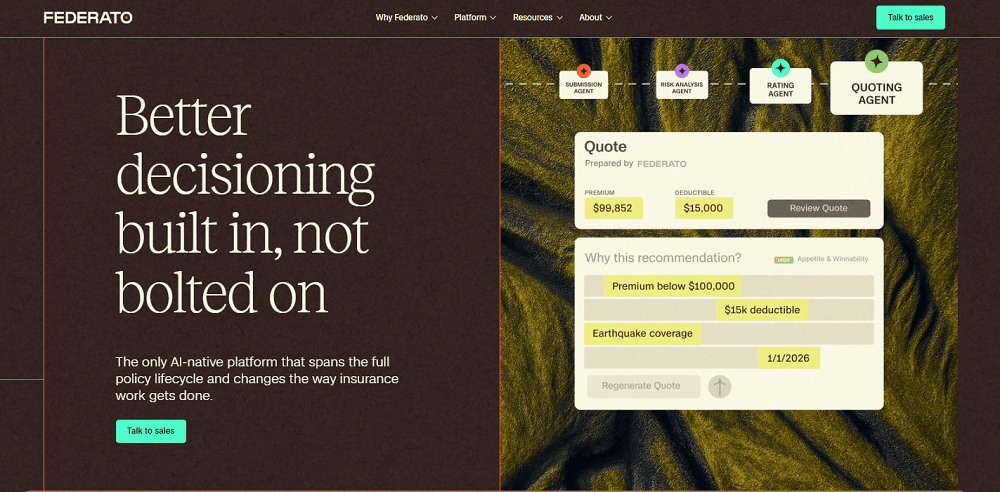
Federato is built for leaders at property and casualty insurance carriers and MGAs who set a strategy for their book and need it to hold in every submission, renewal, and claim, so they can grow premium without giving up margin. Its AI is part of the platform rather than added on top, so it works from the same rules, account history, and portfolio targets as the underwriters and adjusters who use it.
Core modernization is a big commitment, so for Insurity customers, how the move works is part of the decision. On average, a first Federato implementation takes 17 weeks, and each additional line of business averages about eight weeks after that.
Schema Sense, Federato's AI-assisted data mapping, maps up to 84% of an existing data schema automatically, reducing the manual work of moving data from older policy administration systems. Federato's own engineers also work alongside each customer's team to configure workflows and connect data sources, so standard deployments don't require a third-party system integrator.
Below, we look at Federato's approach in three areas: decisioning, agentic AI, and continuous improvement.
With Federato, every decision draws on the insurer's objectives, product rules, account history, and real-time portfolio data in one place. The core platform weighs each pricing change, new submission, or claims trend against the strategy leadership has set, so day-to-day work stays connected to business outcomes.
That shared context comes from the federated context graph, which maps how guidelines, product definitions, past decisions, claims histories, and billing insights relate to one another.
Underwriting, pricing, policy, billing, and claims teams all work from the same picture, so the information behind a decision doesn't depend on which screen someone happens to have open. When an account comes up for renewal, for example, Federato checks its loss history and payment record against the insurer's current appetite and portfolio position for that class, not only against last year's terms.
For Velocity Risk, a commercial excess and surplus property insurer, that meant writing more of the business it wanted. "By constantly iterating and improving our workflow with Federato, we've been able to 5.5x the percentage of our bound policies that meet our definition of high appetite," says Rod Harden, President and Head of Operations.
Writing more of the business an insurer wants takes more than giving every team the same view of an account. The strategy behind that appetite also has to shape what gets written.
Control Tower, Federato's portfolio oversight tool, helps with this in three ways:

For example, an objective might be a target loss ratio for a program or a cap on total insured value (TIV) for one type of building in one area. Controls then put it into practice on every risk that comes in. If TIV for frame apartment buildings in one metro area already stands at $47 million against a $50 million cap, a $5 million submission goes to review before anyone can bind it, so the limit holds without anyone monitoring it manually.
Insurers can set objectives and controls at whatever level fits the business. An insurance carrier might set them by line of business and program, while an MGA can give each program its own guardrails and still see its combined exposure across carrier partners. Insights then give risk, pricing, and finance teams, as well as reinsurers and capital partners, the same view of performance against plan.
When everyone works from this same set of numbers, it's easier to explain results, agree on course corrections, and keep the confidence of the partners who provide capacity.
Where policy, billing, and claims run as separate products, AI often depends on integrations to gather the information it needs. Federato's agents instead work from a shared data foundation, using account history, product rules, and portfolio objectives to assess submissions, prepare priced quotes, and support claims decisions. Team members then review and approve the results.
That starts the moment a submission arrives from a broker. Rather than passing it from intake to triage to pricing, Federato's AI takes it through each step and hands the underwriter a finished draft. It can:
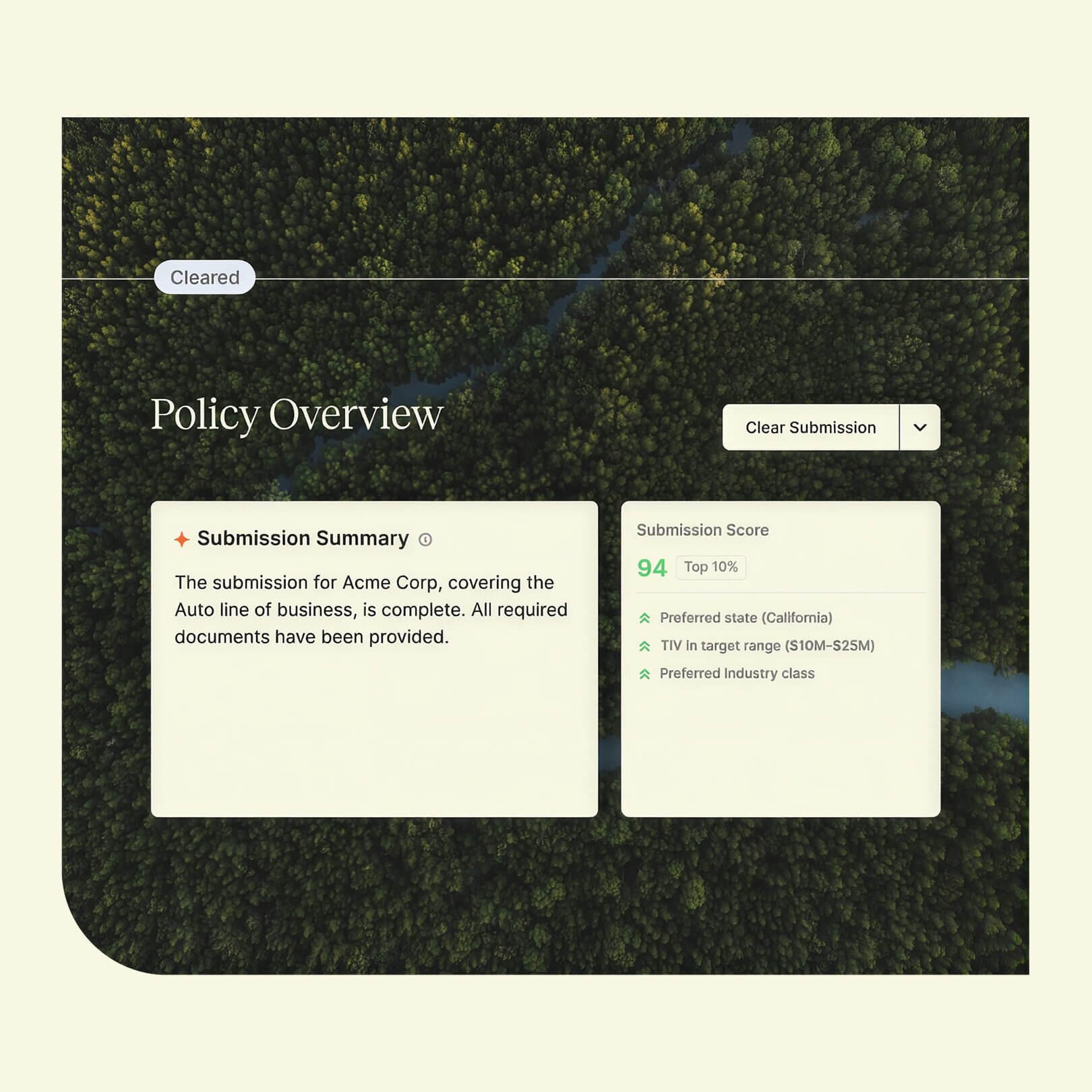
HDVI, a commercial trucking insurer, used to hand its underwriters about 50 printed pages of guidelines. It now runs those guidelines as rules in Federato, and each time a rule triggers, it saves an underwriter an estimated 10 to 15 minutes. Because those triggers happen dozens of times each day, the team saves hours in total, according to Chief Underwriting Officer Adam Barnett.
The same approach extends to claims management. Before an adjuster makes a coverage call, Federato Claims surfaces the relevant policy citations, missing information, and concerns, so the adjuster starts from the facts of the policy.
People stay in control throughout. Every recommendation shows its reasoning, so whoever reviews it can see how Federato reached it and adjust it before acting. The audit trail builds as the work happens, which gives compliance teams a clear record of each decision without asking anyone to document it separately. And because the AI works across connected steps, each gain in underwriting efficiency builds on the last.
Because Federato runs policy, billing, and claims on a shared data foundation, information about policy changes, payment behavior, and developing claims reaches pricing and product teams without having to be reconciled across separate systems. Leaders can use those signals to adjust portfolio controls, rates, and product rules, so what the insurer learns from existing business informs the next decisions it makes.
The process starts with what happens after an insurer binds a policy. Policy servicing reveals changes in insured risks, billing records reveal patterns in payment behavior, and claims data shows how losses are developing. Pricing and product teams can use that information to spot emerging problems and decide what to adjust.
Control Tower brings those signals together with premium, losses, appetite, and portfolio mix, and measures all of them against the insurer's objectives. If late payments start to climb in one program, or reserves in one class rise faster than planned, leaders can catch it early while a correction is still small.
Spotting a problem only helps if the fix can follow quickly. In Federato's 2026 State of P&C Insurance Technology report, 64% of insurers said they depend fully or mostly on IT to implement operational changes, which turns every rate change or rule update into a request in a development queue.
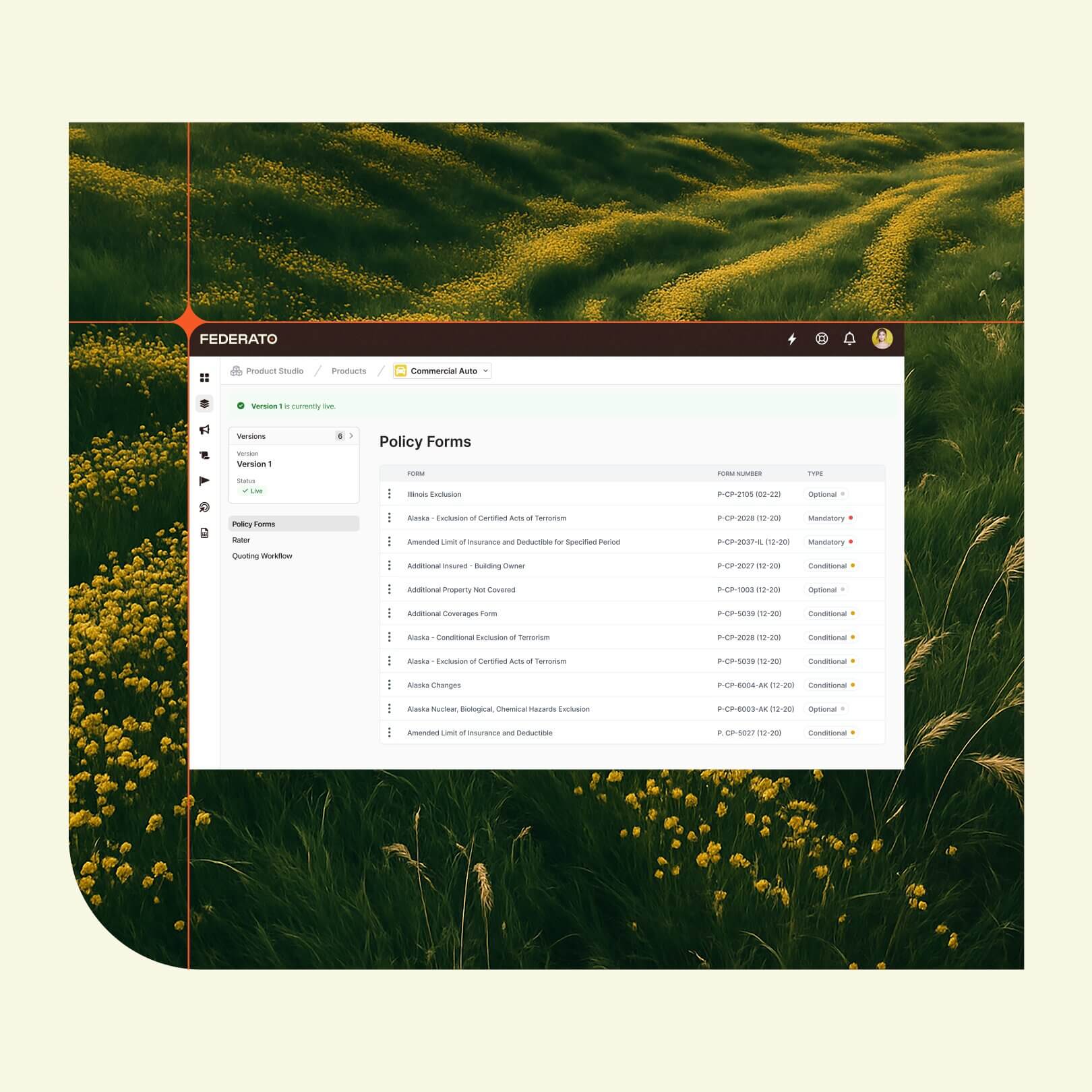
Product Studio, Federato's configuration layer for policy administration, lets product teams change rates, forms, and rules themselves, without code. Each change applies from its effective date, with a full record of who changed what. Each change then feeds the next round of results, so the core improves with every quote, bill, and claim it handles.
Federato supports insurance carriers and MGAs across multiple lines, teams, and distribution networks.
Want a closer comparison of Federato and Insurity? Get The Essential Guide to Federato for Insurity Customers to explore the differences between Insurity's modernization roadmap and Federato's AI-native core.
Request a live demo to see how Federato connects strategy, decisions, and outcomes on one AI-native core.
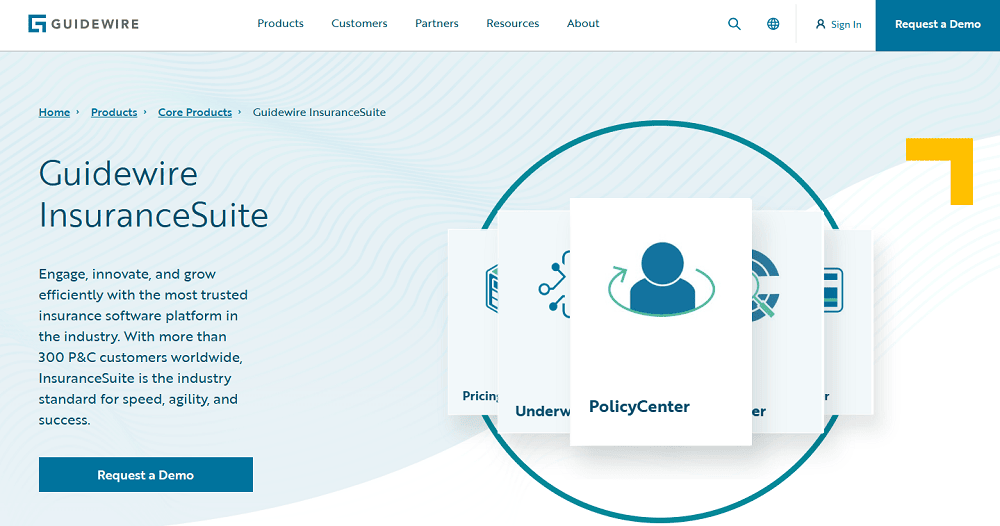
Guidewire is an Insurity alternative often considered by large carriers. Its flagship, InsuranceSuite, lets carriers design custom workflows across policy, billing, and claims. Guidewire also sells InsuranceNow, a separate core for regional and super-regional US insurers and MGAs.
Guidewire's potential depth comes with more technical work than an Insurity customer may be used to. Product teams can model products in Advanced Product Designer, but this doesn't remove the need for developers, and much of its configuration and integration work runs on Guidewire's own programming language.
For insurers evaluating Guidewire competitors, a key consideration is how much configuration and maintenance work each platform requires, and whether their own teams have the skills to handle it.
Key features
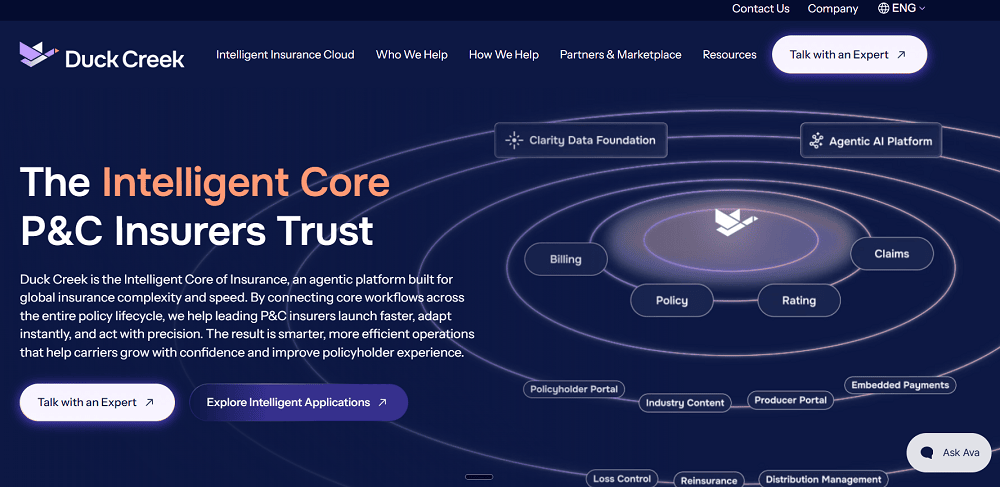
Duck Creek Technologies offers policy, rating, billing, and claims as one suite, delivered as SaaS through Duck Creek OnDemand, so it covers the same ground as Insurity's core products.
Duck Creek emphasizes rapid deployment through pre-built carrier playbooks and industry-standard processes, and much of the work of tailoring them falls to trained configurators. Insurers considering Duck Creek alongside Insurity may also want to examine Duck Creek competitors to understand how other core platforms differ in architecture, configuration, and AI capabilities.
Duck Creek is also building AI agents on top of its existing core products using shared data and APIs. Its Agentic Product Configurator, which turns product documentation into configuration, is offered in controlled availability through Duck Creek's Professional Services team as a statement-of-work engagement, rather than as a tool insurers run themselves.
Key features
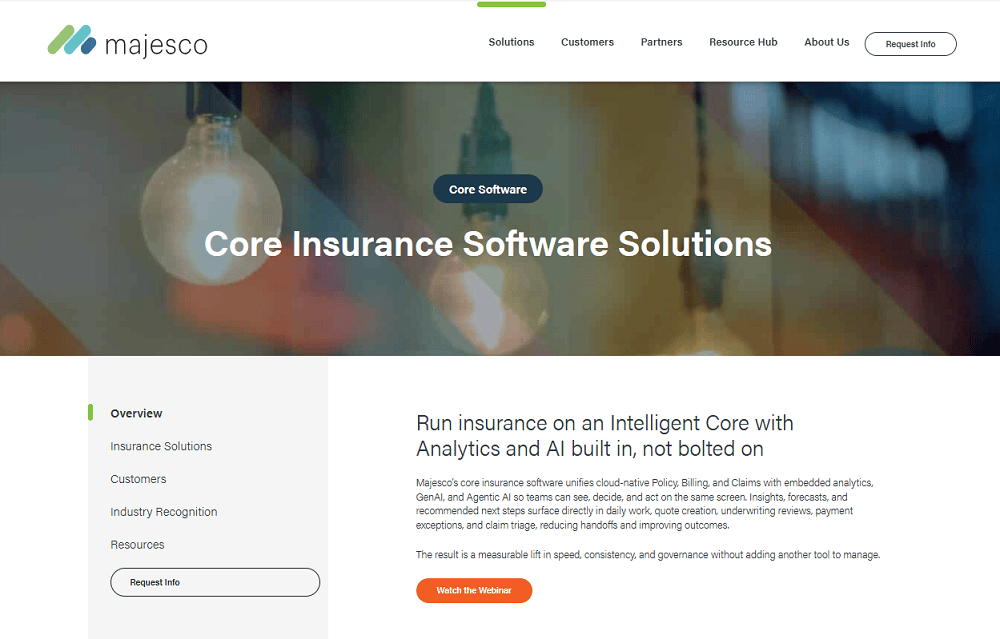
Majesco sells two P&C cores, each aimed at a different type of insurer. Intelligent Core for P&C covers policy, billing, and claims for commercial, specialty, and multi-line insurers, with support for personal lines and workers' comp. That makes CoreConnect worth examining for MGAs comparing specialty insurance software, particularly those looking for a preconfigured starting point.
The cores are only part of the package. Majesco sells Enterprise Rating, Intelligent Underwriting, and Loss Control as separate solutions, so an insurer's final scope depends on which pieces it adds and how they connect. Majesco's P&C business also sits within a wider portfolio that covers life, annuity, health, and retirement.
Majesco has added five machine learning models that surface risk signals, quote acceptance likelihood, and extracted document data within the workflow, alongside Majesco Copilot, its generative AI assistant.
Key features
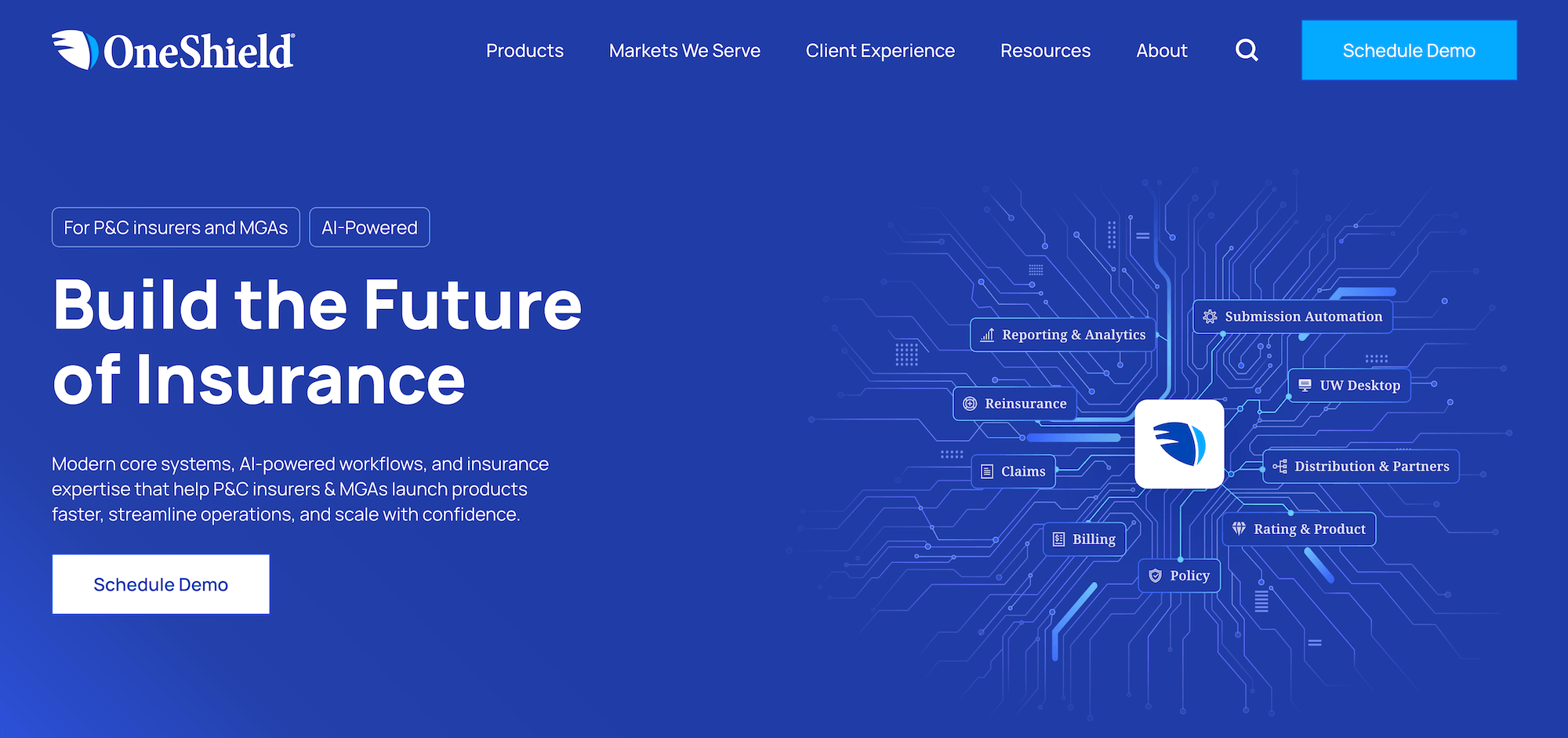
OneShield offers two core platforms for insurers and MGAs across personal, commercial, and specialty lines. OneShield Enterprise combines policy administration, rating, billing, and claims, and OneShield Market Solutions is a fully managed core for commercial and specialty carriers and MGAs, from newly launched MGAs to established specialty insurers.
Product teams configure products, rules, workflows, and screens through OneShield Designer without custom code.
OneShield Enterprise includes AI tools, such as underwriting assistants, and OneShield also sells AI Hub, a set of AI plug-in applications. The plug-ins work alongside whatever core an insurer runs, which makes them easy to add but means the AI works through connections to the core rather than inside it.
Key features
BriteCore started in 2009, when six P&C insurers teamed up with a software developer to build a core around their needs. It still focuses on mid-size carriers and fast-growing MGAs, mainly in North America.
Where Insurity offers a range of products, BriteCore sells one platform for policy, billing, and claims. Insurers set up products, coverages, rates, and fees through a point-and-click interface, and portals for agents and policyholders come included, along with reporting tools.
BriteCore has launched its first AI copilots and added copilots for first notice of loss and for submissions and quoting, along with an Underwriting Workbench. Insurers interested in the platform for its AI should ask which capabilities are already in use with customers.
Key features

Socotra is built for insurance companies and MGAs with their own engineering teams. Rather than starting from packaged products, Socotra customers configure products graphically or with JSON. Insurers can run the implementation with their own team, with a partner, or with Socotra's professional services.
Socotra's products cover policy, billing, rating, and portals, and the platform records claims data from first notice of loss through reserves and payments. For full claims management, insurers can add systems from partners such as Snapsheet and Five Sigma through Socotra's app marketplace.
Socotra Assistant extracts data from submissions, checks applications against an insurer's risk criteria, and drafts underwriting summaries, making changes only with human approval.
Key features

Like Insurity, Sapiens offers several P&C core suites and has expanded its product portfolio through acquisitions.
For North American insurers, the main product is CoreSuite for P&C, which covers policy, billing, and claims, with an underwriting workbench and an agent portal. Its claims module handles personal and commercial lines, including workers' comp. Sapiens sells other suites in other regions, and features differ between them.
SapiensAIP, a newly announced AI platform added alongside its core suites, includes AI agents for data migration and AI-supported configuration. Sapiens says a third-party administrator is evaluating those tools, but the announcement doesn't give a general availability date, so insurers should ask what they can use today and what's still on the roadmap.
Key features
If you're approaching an Insurity renewal, consider how your current setup compares with the alternatives on data integration, reporting, and implementation requirements. The important question is whether another platform would address the limitations you're experiencing without introducing new ones.
See how Federato compares with your current setup.
Ready to get started? Request a live demo.