Insurance
Duck Creek vs Guidewire vs Federato: comparing P&C core platforms for carriers
Federato

October 19, 2026

Guidewire and Duck Creek are two of the most established names in P&C insurance software. Guidewire lets carriers architect custom workflows across policy, billing, and claims; Duck Creek emphasizes rapid deployment through prebuilt carrier playbooks and industry-standard processes. Both vendors also provide data and AI tools that connect information and workflows across their platforms.
For insurance companies, the question is how much work it takes to keep those applications in sync. Take a policy change: a broker requests a higher coverage limit, and the policy system updates the terms, the rating engine recalculates the premium, the document system generates a revised endorsement, and billing adjusts the next installment. Each step runs in a separate application with its own data model, connected by integrations built for specific cases.
When information fails to carry through correctly, staff end up reconciling conflicting records or finishing the transaction by hand. Adding an AI layer on top doesn’t remove these gaps, because an agent can only work through the same connections, and it can’t reliably fix records that the systems themselves don’t agree on.
Federato takes a different approach. Its AI-native platform brings policy administration, billing, and claims onto one shared data model. Product changes carry through the relevant workflows, while insights from billing and claims inform underwriting decisions as the business develops. AI agents also have access to the same policy context, rather than having to assemble it from separate core applications.
In this article, we compare Federato, Duck Creek, and Guidewire across four areas: platform architecture, the speed of product launches and quoting, how billing and claims data inform underwriting, and implementation timelines.
Below are four main questions to ask when comparing Duck Creek, Guidewire, and Federato:
Federato runs submissions, underwriting, policy administration, product configuration, billing, claims, and portfolio oversight on a single platform. Its Billing and Payments and Claims capabilities were developed on the same foundation as underwriting and policy administration, rather than acquired as separate systems and connected afterward.
That shared foundation has practical benefits. For example, billing shares one configuration with policy, so installment schedules, direct or agency billing, and taxes are set up as part of the product, and new products launch with light billing configuration. Every billing event also feeds back into underwriting, so patterns such as late payments and cancellations can inform what the carrier writes next.
At the center of the platform is the Federated Context Graph, a context layer built on a single data model. It maps how an insurer's guidelines, product definitions, underwriting decisions, billing activity, and claims history relate to one another. AI agents can use that connected context to work across the policy lifecycle, instead of reconstructing an account's history from separate applications.
For carriers, the benefit goes beyond connecting billing, claims, and underwriting data. Federato can also replace multiple tools and fragmented workflows, including those involved in document management, with a single working environment.
Adam Barnett, Chief Underwriting Officer at HDVI, described the change: "Prior to Federato, we had nine different systems throughout a submission process; we've consolidated that down to one."
Duck Creek offers Policy, Billing, and Claims as separate applications. The company’s Clarity Data Foundation brings policy, billing, claims, rating, distribution, and external data together in one consolidated view for reporting, analytics, and AI.
Duck Creek’s Agentic AI Platform builds AI agents on top of its existing core products, using shared data and APIs to connect them to policy, billing, and claims systems. Rather than rebuilding those products as a new system, the platform adds new layers of orchestration, governance, and insurance-specific models over the data and integrations already in place. Duck Creek Send follows a similar pattern in underwriting: it operates as a standalone engine that connects with multiple core systems, with deeper integration into the Duck Creek platform for shared customers.
In 2026, Guidewire launched an Agentic Framework on Guidewire Cloud Platform, the foundation under its InsuranceSuite of policy, billing, and claims applications. Through the framework, Guidewire has begun rolling out agents for specific areas of the core, such as claims and underwriting, that can handle basic tasks within those areas.
Like Duck Creek’s platform, the framework sits on top of existing core systems, which brings familiar challenges: data that doesn’t always agree across records, context that can degrade as a transaction moves through multiple steps, and tooling that offers agents a limited set of actions. Guidewire describes its approach as keeping agents close to core data and letting insurers choose the AI model for each task.
Product Studio brings rating, eligibility rules, forms, and coverages into a single, governed product definition, connecting document management with the rules that determine which forms apply to each policy.
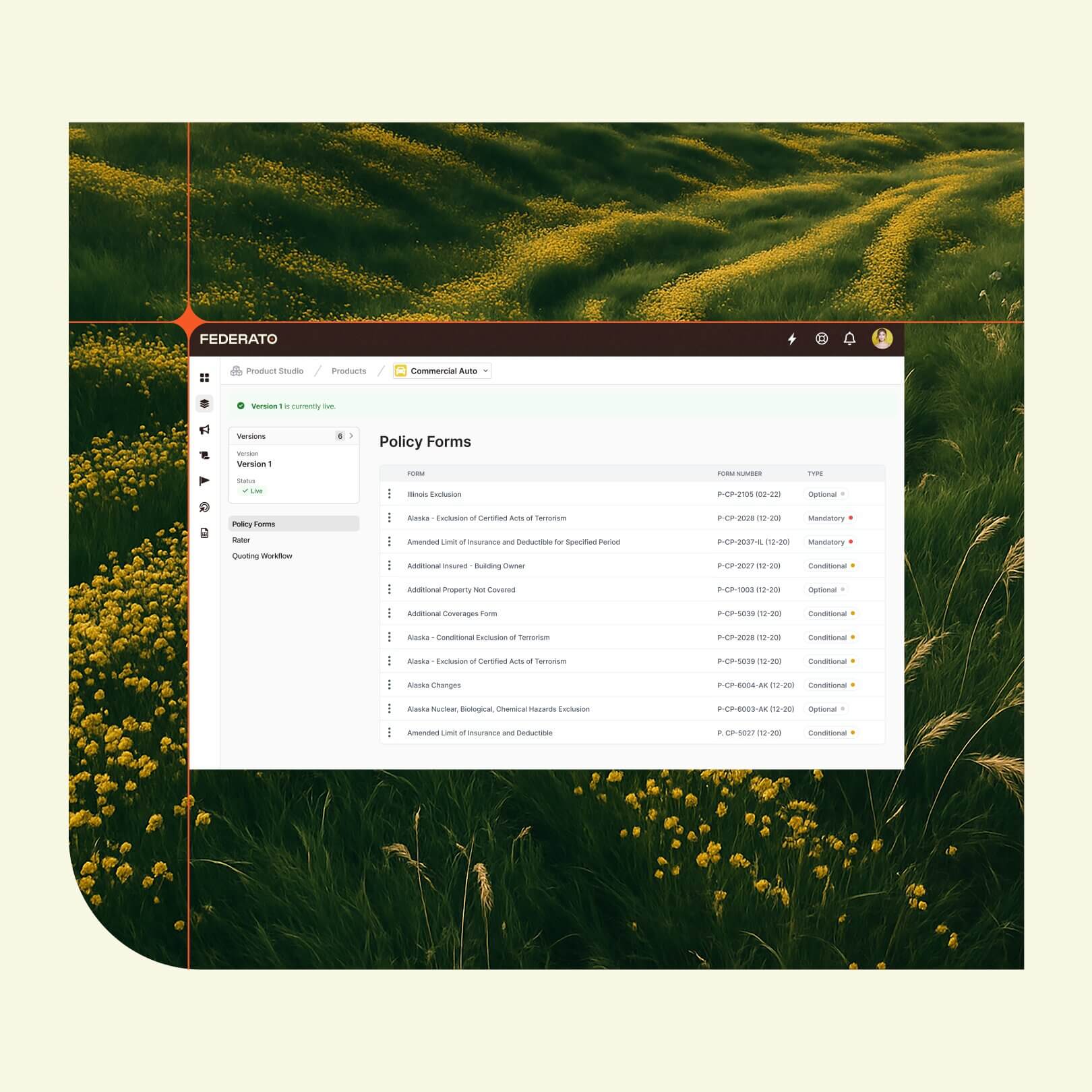
Policy forms are one part of that definition. Document management for forms and endorsements takes place in a shared library, where rules determine which documents attach at quote and at issuance.
Insurers also don't have to build every product from scratch. They can start with line-of-business templates that already contain coverages, eligibility rules, and rating factors. Teams can define a base product and apply state-specific overrides where needed, which makes it possible to manage a product across all 50 states without maintaining 50 entirely separate versions.
Billing is part of the same configuration process. Business teams can set up installment schedules, direct or agency billing, and applicable taxes without relying on developers for every adjustment.
Once the product is live, Federato Policy Administration receives submissions, checks them against the carrier's appetite, and prioritizes opportunities based on their likelihood of binding (i.e., winnability).
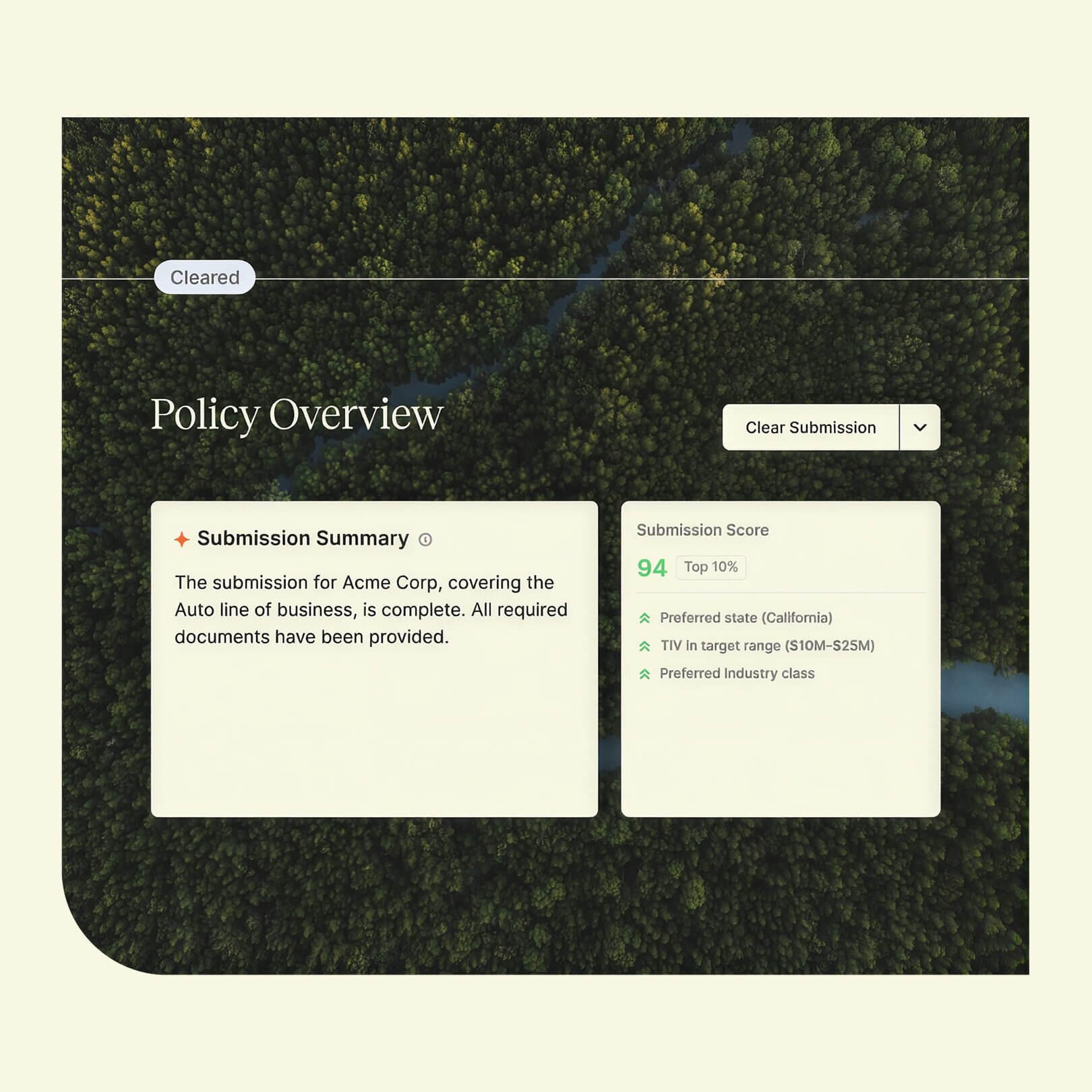
Submissions that are clearly outside appetite or have low predicted winnability can be declined automatically. For the submissions that fit the carrier's appetite and have a strong likelihood of binding, Federato's AI agent drafts priced indications.
Each drafted quote links supporting data back to its source, and the agent records its rating rationale. This lets an underwriter review how the agent arrived at the proposed price.
The impact shows up in customer results. For example, within two months, Velocity Risk cut the time from completed risk modeling to an issued quote from 21 days and 11 hours to 2 days and 8 hours, an 89% reduction. Velocity Risk also reported a 3.7x increase in bound policies that met its high-appetite definition.
Duck Creek's product configuration lets business teams update rates, rules, forms, and workflows with less reliance on developers, while IT keeps control over technical architecture and governance.
Duck Creek also offers prebuilt industry content, including bureau rates, rules, and forms from ISO, AAIS, AIB, NCCI, and state workers' compensation bureaus. These resources support product configuration and document management, while templates and circular adoption tools help insurers keep their products current without rebuilding configurations from scratch.
For new business, Agentic Underwriting Workbench handles AI-assisted submission processing. It automatically extracts and enriches submission data, checks it against underwriting criteria, and prepares decision-ready files, which reduces the manual work underwriters do before they evaluate a risk.
The Send module handles end-to-end underwriting orchestration, connecting submission intake, risk assessment, pricing, approvals, binding, and post-bind workflows. But Send coordinates existing core insurance systems and rating tools instead of replacing them, so how much pricing work it automates depends on the connected systems and how they're configured.
Guidewire's Advanced Product Designer, used with PolicyCenter, helps teams define insurance products more systematically. Guidewire software also offers a Product Design Assistant, which uses AI to support configuration work.
More complex customization requires developers who know Gosu, Guidewire's programming language. As a result, launch timelines can depend on how much a new product differs from existing configurations and how much custom development it requires.
For new business, UnderwritingCenter uses AI to read and triage submissions, incorporate third-party information, and prepare a risk summary that helps underwriters assess opportunities. It then coordinates the handoff to policy administration for downstream processing.
Launch and quote timelines with Guidewire therefore depend on each carrier's configuration, integrations, and underwriting workflow.
Federato keeps post-bind billing and claims activity on the same platform and data foundation as the policy and its underwriting history.
Billing adds information that wasn't available when the risk was written. It shows which segments pay late, which distribution channels produce more cancellations, and whether those patterns change the economics of the business.
Claims management adds another layer. Adjusters can see the policy terms and underwriting history behind a risk, while Claims records the policy clauses involved in each coverage decision and the reasoning behind any change to reserves.
Because that information stays connected to the policy and its underwriting history, teams can identify emerging patterns and use them to change what they write next. For example, if losses in a segment start developing faster than expected, underwriting can tighten appetite or change terms before writing more of the same business.
If claims in a segment keep developing above their initial reserves, pricing teams can reassess the rates offered on new business and renewals, while risk managers may need to review the implications for reinsurance coverage.
The same connection informs product and distribution decisions. If one clause keeps causing coverage disputes, product teams can revise the relevant forms and rules in Product Studio for future policies. And if a segment regularly pays late, or a broker's business cancels at a higher rate, leaders can factor that behavior into which risks and distribution partners they prioritize.
Control Tower ties those decisions to the carrier's broader strategy. Leaders can track premium, losses, appetite, and portfolio mix against business objectives, then adjust the controls that guide underwriting. This can help prevent teams from making decisions that make sense individually but collectively push the portfolio past its limits.

For example, say a carrier caps TIV accumulation for restaurants in a region at $50 million and already insures $46 million there. A new submission with $5 million in TIV may meet the published underwriting guidelines, but binding it would push accumulation past the cap. With live portfolio context, the team can flag that conflict before binding the risk, instead of discovering it in a month-end report.
When leaders update appetite rules or portfolio controls, those changes can guide how later submissions are evaluated, referred, or declined. Strategy becomes part of the underwriting workflow, rather than a document that teams are expected to consult.
Duck Creek Billing manages invoicing, collections, and payment follow-up. It also gives finance teams information on outstanding premiums, delinquency rates, and cash flow.
Duck Creek Claims supports claims management, including reserve management, fraud detection, catastrophe triage, and subrogation (recovering claim costs from responsible third parties).
Clarity Data Foundation provides prebuilt dashboards for tracking P&C insurance metrics such as premiums, loss ratios, financial results, and operational performance.
Guidewire BillingCenter manages direct, agency, and group billing, including payment processing, collections, automated reminders, and overdue receivables.
ClaimCenter handles claims management, while Industry Intel brings predictive analytics into claims processing workflows, including predictions of claim severity and the likelihood of attorney involvement.
Guidewire software also offers analytics for P&C insurance operations through two features:
Analytics from claims management and billing can inform underwriting reviews. But applying those findings to rates or appetite rules depends on how each carrier has configured its workflows.
Federato engineers work with a carrier's business and IT teams to configure workflows, connect data sources, and prepare the platform for production. This reduces the carrier's reliance on third-party systems integrators.
Data mapping is one part of that work. Data from a carrier's existing systems may use different field names, formats, and structures. Those differences must be accounted for when mapping the data to the new platform so it can be used reliably. Schema Sense uses AI to identify mappings between an insurer's existing data schema and Federato's data model.
With it, Federato can automatically map up to 84% of the source schema to the Federated Context Graph. The mappings and transformations stay visible and are version-controlled, so implementation teams can inspect how data moves into Federato, verify the results, and revise mappings where necessary.
After previous insurance technology transformation projects ran over budget or behind schedule, QBE North America deployed Federato in eight weeks, initially going live with 50 underwriters. The rollout later expanded to more than 300 underwriters and staff across seven lines of business, and QBE projects a payback period of less than 12 months.
Implementing P&C policy administration systems like Duck Creek Policy can involve the carrier, the software vendor's own teams, and third-party systems integrators. Project duration depends on which applications are being deployed, which products are being configured, and how much data conversion and integration work is required.
OnDemand manages cloud infrastructure, maintenance, and software updates through its SaaS delivery model, reducing the need for property and casualty insurance carriers to undertake large, periodic insurance technology upgrades. Carriers still need to maintain the product configurations, integrations, and business processes that support insurance administration and management as their requirements change.
In its 2026 annual report, Guidewire states that customer implementation and testing typically take six to 24 months or longer. The work can include configuring InsuranceSuite applications, integrating external systems, migrating policy and claims management data, integrating document management systems, building digital experiences, and testing the resulting workflows.
Implementation services and the carrier's internal project costs are separate from the insurance software subscription. Customizations and integrations can also create ongoing testing and maintenance requirements.
Insurance carriers modernizing their insurance technology by moving from self-managed Guidewire installations to Guidewire Cloud face a different type of project. This can involve updating their existing codebase, adapting integrations, moving data, and validating the configuration against Guidewire Cloud requirements.
Once on Guidewire Cloud, carriers receive regular platform updates, which reduces the need for traditional on-premises upgrade projects. They still have to account for testing and managing their own configurations and integrations.
Federato brings product configuration, underwriting, policy administration, billing, and claims together on one AI-native insurance software platform. Changes carry across workflows, and insights from billing and claims inform underwriting decisions while there's still time to act.
Request a demo to walk through these workflows with your team.