Insurance
6 Majesco competitors for carriers and MGAs
Federato

November 23, 2026

Majesco is well established among specialty commercial insurers, and it offers a separate core built specifically for MGAs. Its modular approach also gives insurers the flexibility to add rating and underwriting capabilities as they need them, without having to buy everything at once.
But insurers comparing Majesco alternatives should also look at how well each platform connects underwriting, policy administration, billing, and claims. This matters most when those functions need to share information or support AI-driven workflows. If they run as separate applications, a midterm policy change has to pass between systems before the billing system can adjust the premium, and an AI agent working across them depends on every one of those handoffs.
For insurers considering a move away from Majesco, a core that keeps these functions on a single data foundation removes those handoffs, so a policy change, a billing rule, and an AI-drafted quote all work from the same record.
In this article, we compare six leading P&C insurance software providers that compete with Majesco, starting with our own platform, Federato. We look at each vendor's core capabilities, its approach to data integration and AI, and its ability to support portfolio management.
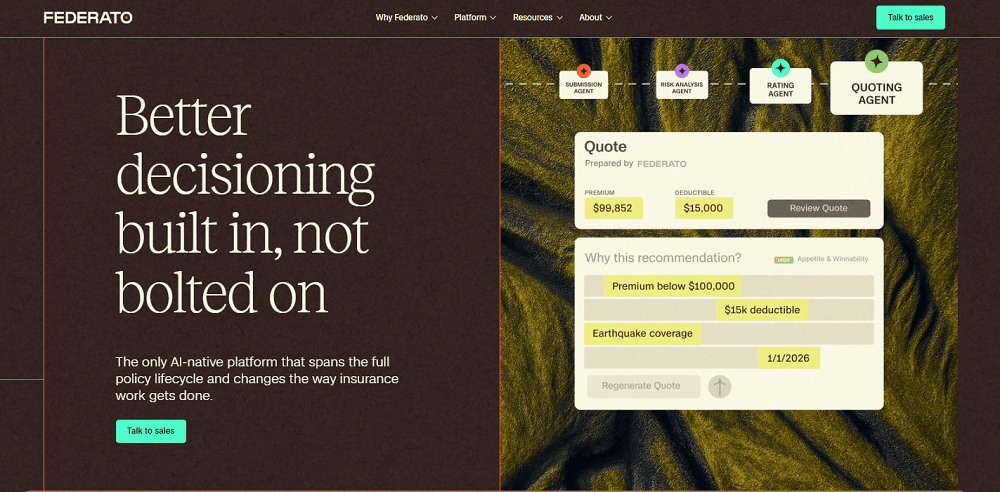
Federato is the only AI-native platform that spans the full policy lifecycle. Many established core vendors have added AI agents to their existing systems, while Federato builds AI into the core itself. This gives the AI direct access to the data, business rules, and workflows it needs to make decisions and carry out tasks fully autonomously.
Policy data, product definitions, billing activity, and claims history all live in one data model. A change made in one place carries through the rest of the lifecycle, and billing and claims data feed back into risk selection and pricing.
Insurance carriers and MGAs run on the same platform, each configured to its own products, programs, and carrier relationships. An insurer that writes both kinds of business doesn't need a separate core for each.
A first implementation typically takes about 17 weeks, and each additional line of business takes about eight weeks after that. Our team works alongside each insurer to configure workflows, connect data sources, and turn existing underwriting guidelines into automated rules, helping reduce reliance on third-party system integrators and the costs that come with them.
For example, during its Federato implementation, commercial trucking insurer HDVI converted 50 pages of printed underwriting guidelines into 30 rules that now automate 95% of its referrals.
Federato also uses Schema Sense, an AI-assisted data mapping tool that automatically maps up to 84% of an existing system's data schema to Federato’s data model.
Below, we look at Federato's data architecture, AI capabilities, and portfolio oversight in more detail.
Say a broker asks for a higher coverage limit partway through a policy term. In Federato, the updated terms, the recalculated premium, the endorsement document, and the next installment all draw on the same product definition and data as the original quote. Nothing has to pass between separately built applications, so no one has to reconcile conflicting records. The change also carries through to the rest of the account, including the next renewal.
Federato handles these workflows across four areas:
Because Federato's workflows share the same underlying data, insurers no longer need separate tools to gather account information, apply underwriting rules, and track decisions. This allows them to consolidate applications that previously handled different parts of the work. For example, QBE North America consolidated 14 tools into one, bringing together data from five systems of record across seven lines of business.
Product Studio also changes who can update a product definition. In Federato's 2026 State of P&C Insurance Technology report, 64% of insurers said they depend fully or mostly on IT to implement operational changes. When IT has to make every change, each new product, rate change, and rule update becomes a request in a development queue.
In Product Studio, product teams change pricing, coverage, and rules themselves, without code or an IT ticket. Each change applies from its effective date and is logged with a full audit history, so when a regulator asks what was in force on a given date, the answer is already on record.

For an MGA launching a new program or adjusting its delegated authority terms, this shortens time to market from months to weeks.
Agentic AI added to an existing core takes on that core's limits. To finish one task, an agent may have to pull data from one module, wait on another, and record the result in a third. Each handoff adds delay and another chance for records to go missing or disagree.
For example, a commercial property submission may list a building as masonry in the underwriting workbench and as wood frame in the policy system. The agent has no way to tell which record is right, so it hands the decision back to a person.
Federato's agentic AI avoids conflicts like that because it works inside the core, where each account has one record instead of copies in separate systems. The agents also draw on the federated context graph at the center of the platform. The graph maps how guidelines, underwriting decisions, product definitions, claims histories, and billing insights relate to one another. This lets the agents gather what a decision needs, apply the insurer's own rules, and produce a result for a team member to review and approve.
When a new submission comes in, Federato:
Every output cites the information it used, so the person reviewing it can see how a recommendation was reached and refine it before acting. An audit trail builds as the work happens, which gives leaders and compliance teams a record of each decision without anyone documenting it separately.
For insurers handling complex risks, specialty insurance software needs to help underwriters evaluate submissions against their appetite without slowing down the quoting process.
At Velocity Risk, a commercial excess and surplus property insurer, improvements to its underwriting workflow using Federato helped increase the share of bound policies meeting its definition of high appetite by 5.5 times. The time from completed risk modeling to issued quote also fell from 21 days and 11 hours to 2 days and 8 hours, an 89% reduction.
Propeller Bonds, a digital surety MGA, cut the time to write and deliver a surety bond by 93%, from 30 minutes to two minutes. It also grew from 12 bonds in its first month to 400 a day.
Much of what shows whether a book is on plan arrives after policies are bound. Say late payments start to climb in one program. When billing runs as a separate application from pricing and product, that pattern often reaches the people who set rates through a periodic report, after more of the program's policies have renewed on the same terms.
Control Tower, Federato's portfolio oversight tool, tracks premium, losses, appetite, and portfolio mix against the insurer's targets as business is written and claims develop. Leaders can set those targets by line of business, program, or distribution partner, such as a rate increase on a commercial property line or a cap on total insured value (TIV) accumulation in a coastal region.

Because Billing and Claims share a data foundation with the policy, their results feed into the same view. The pricing team can see late payments piling up in that program and review the rates before the policies renew. Other patterns reach the right team the same way:
Leaders can act on these patterns without leaving the platform, giving them a competitive advantage when market conditions change. A rate or form change made in Product Studio, or a revised target in Control Tower, guides new business and renewals from then on, and Control Tower shows whether the segment moves back toward plan.
For an MGA, each program can have its own targets, matched to what was agreed with each carrier partner. These roll up into one view of combined exposure and performance across programs, so the MGA can spot a program drifting from plan before it shows up in the bordereaux its carriers and reinsurers receive weeks or months later.
This kind of program-level oversight is an important capability to evaluate when choosing MGA insurance software, particularly for MGAs managing multiple carrier relationships.
Control Tower also gives risk, pricing, and finance teams, as well as auditors, reinsurers, and capital partners, the same view of performance against plan. That shared view makes it easier to explain results, agree on course corrections, and keep the confidence of the partners who provide capacity.
Request a live demo to see how Federato keeps rating, policy, billing, claims, and portfolio oversight on one AI-native core.
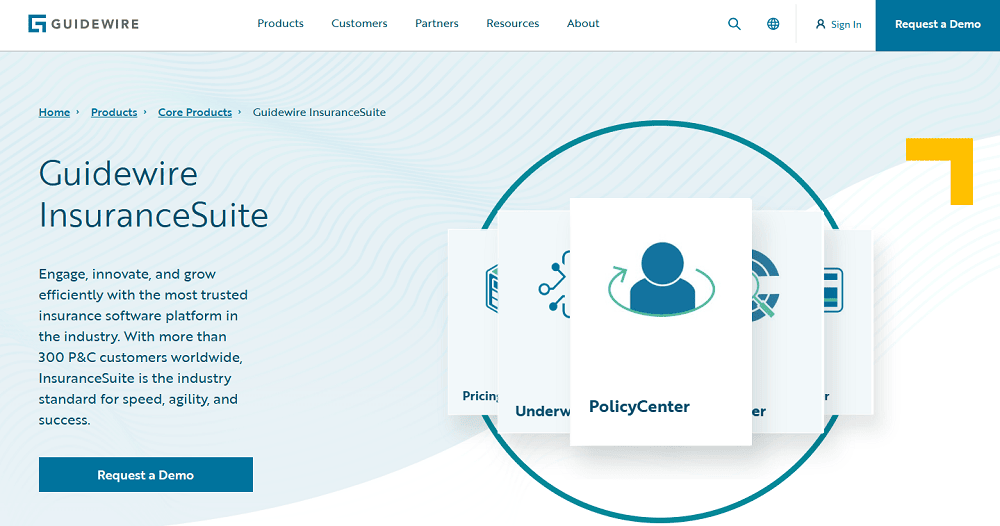
Guidewire is a P&C core platform that supports lines of business ranging from personal and commercial lines to excess and surplus and workers' compensation. Its flagship, InsuranceSuite, lets insurance carriers build custom workflows across policy, billing, and claims through three applications.
Like Majesco, Guidewire also sells separate cores for different kinds of insurers, so carriers, regional insurers, and MGAs are served by separate products. Its Agentic Framework adds agentic AI capabilities on top of PolicyCenter, BillingCenter, and ClaimCenter, which remain separate applications.
An agent completing a task that touches both the policy and the bill works through the connections between them.
(For a look at other alternative platforms, see our Guidewire competitors comparison.)
Key features
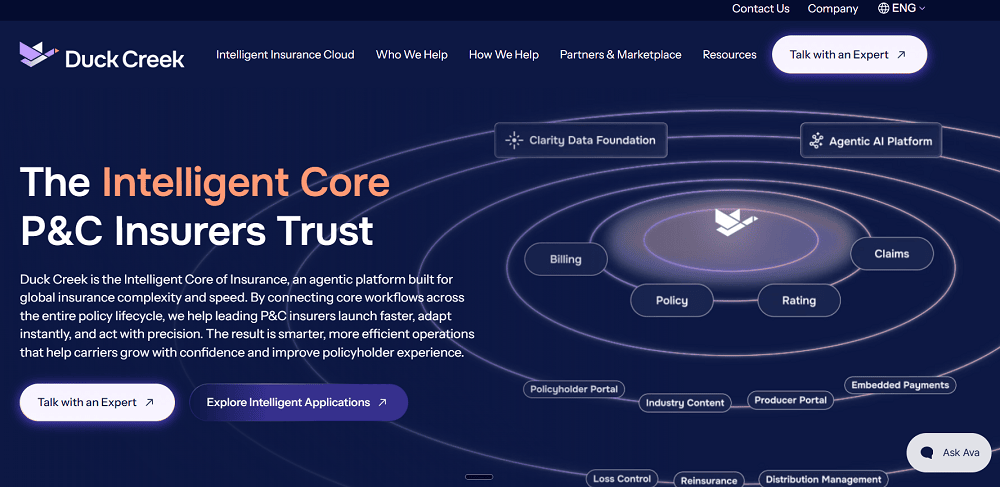
Duck Creek sells core applications for policy, rating, billing, and claims to carriers in personal, commercial, and specialty lines, and it also offers an enterprise rating engine as a standalone product. Insurers can buy these applications individually or as a full suite through Duck Creek OnDemand, its SaaS offering, which runs on Microsoft Azure.
Duck Creek also sells products beyond the core, including Loss Control, the Clarity data foundation for data and analytics, and portals for policyholders and producers.
(See our Duck Creek vs Guidewire comparison for more information on how the two platforms differ in their core applications, architecture, and integration capabilities.)
Key features
Insurity is an InsurTech provider that sells cloud-based core systems and analytics to P&C carriers, MGAs, and program administrators, with a focus on commercial and specialty insurers. Much of its product range came from acquisitions, including Instec, Valen Analytics, and SpatialKey, and it runs its cloud deployments on both AWS and Azure.
Insurers that write more than one type of business should check which combination of Insurity's P&C insurance software products they'd need. Insurity implements its products with its own services team, working alongside system integrator partners.
Key features
Sapiens provides insurance solutions for both P&C insurers and life and annuity insurers. It has grown through acquisitions, so its P&C products are one part of a wider portfolio.
Sapiens builds its P&C offering around regional markets, with a different core suite depending on where an insurer operates. For North American insurers, the main product is CoreSuite for P&C, which covers policy, billing, and claims.
Outside North America, Sapiens sells IDITSuite, a modular suite with multilingual and multicurrency support, along with other regional products. Features and roadmaps can differ between suites, so insurers with business in more than one region should check which suite would apply to each.
Key features
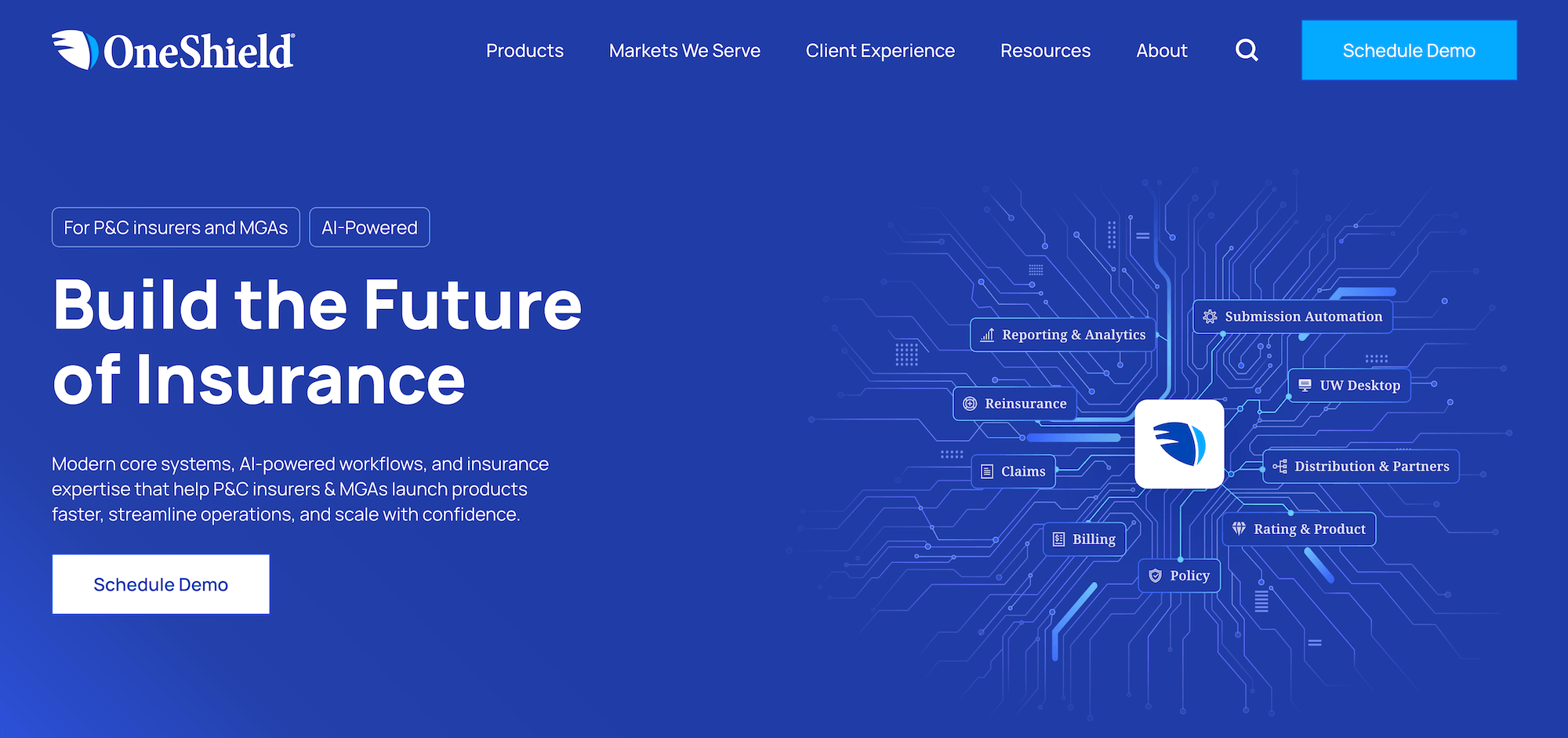
OneShield is an InsurTech provider that sells core systems for policy, rating, billing, and claims to carriers, MGAs, MGUs, and program administrators across commercial, personal, and specialty lines. Its customers range from startups to multi-billion-dollar insurers.
OneShield offers two core insurance solutions for different kinds of insurers. OneShield Enterprise is a configurable core whose modules, including reinsurance and relationship management, can be licensed together or one at a time. OneShield Market Solutions is a fully managed SaaS core for MGAs, program administrators, and commercial and specialty carriers.
Key features
A core contract renewal or a merger gives insurers a chance to look past individual features and evaluate how well a platform connects day-to-day operations with portfolio strategy to create a competitive advantage.
Request a live demo to see how Federato brings underwriting, policy administration, billing, and claims together, helping insurers keep decisions aligned with portfolio strategy from submission through renewal.