Insurance
Sapiens vs. Guidewire vs. Federato: choosing a core platform for commercial P&C
Federato

November 19, 2026
Sapiens and Guidewire are two well-established names in core insurance software and take different approaches. Guidewire lets carriers architect custom workflows across policy, billing, and claims. Sapiens covers more kinds of insurance, with software for P&C, life and annuities, and reinsurance, and sells different P&C core suites in different regions.
For commercial P&C carriers, the differences go beyond which features each platform offers. What matters is how easily information moves between underwriting, policy administration, billing, and claims, and how much manual effort it takes to keep those workflows in sync.
Say a carrier is renewing a commercial property account, and:
When these run as separate applications, each with its own data model, late payments and reserve increases reach the renewal only if the integrations pass that information along in time. If the payment record doesn't carry through, the account may renew on the same terms despite repeated late payments. If the reserve increase doesn't carry through, the renewal premium is based on understated losses. To avoid that, staff have to pull the records together manually before each renewal.
This matters even more as carriers add AI to their core systems. Sapiens and Guidewire both connect AI agents to their separate policy, billing, and claims products, so an agent preparing the renewal depends on information shared across those systems. If that information is incomplete or inconsistent, additional checks or reconciliation may be needed before the agent can use it.
Federato takes a different approach. Its AI-native platform runs policy administration, billing, and claims on one shared data model, so when an account comes up for renewal, its payment history and claims development are already in front of the team pricing it. AI agents work from the same full picture of each account.
In this article, we compare Sapiens, Guidewire, and Federato on platform architecture, product launches and quoting, billing and claims data, and implementation.
Sapiens, Guidewire, and Federato differ most in the lines of business they cover, how policy, billing, and claims connect, and how products launch and new business gets quoted.
Here's how they compare on each:
The sections below look at each of these areas in more detail, starting with how the three platforms connect policy, billing, and claims. For a wider view of the market, see our guides to Guidewire competitors and P&C policy administration systems, which also examine platforms like Majesco and BriteCore.
The first difference between the three platforms is structural. For insurance companies, the question of whether policy, billing, and claims run on one data model or as separate products shapes how information moves between them and what AI agents can see when they act. Adding AI to fragmented insurance systems doesn't automatically remove the integrations and manual handoffs needed to complete work across them.
Federato brings underwriting, policy administration, billing, claims, and portfolio oversight together on one platform, with integrated product configuration and submission intake. Its Billing and Payments and Claims capabilities were built on the same foundation as policy administration, rather than acquired and connected afterward, so every part of the policy lifecycle works from one data model.
At the center is the federated context graph, a context layer built from that shared data model. It maps how a carrier's guidelines, product definitions, underwriting decisions, billing activity, and claims history relate to one another.
AI agents work from that connected context. If an agent is preparing a renewal, for example, it sees the policy terms, the account's payment history, and any open claims together, without assembling them from separate systems.
That shared foundation creates real-time feedback loops across the policy lifecycle. Billing activity and developing claims can inform underwriting, pricing, and product decisions without relying on integrations between separate systems. A late payment recorded in billing, for instance, is already part of the account that underwriting sees, with no handoff between systems.
One platform also means fewer tools to maintain. Beyond linking submissions with billing and claims, Federato can take the place of several separate tools and disconnected workflows, with a single working environment for insurance administration and management. For example, commercial trucking insurer HDVI consolidated a submission process that ran across nine systems into one with Federato.
Sapiens CoreSuite for P&C is built from three core applications, PolicyPro, BillingPro, and ClaimsPro, which can be used alone or combined into one suite. BillingPro can be deployed separately and comes pre-integrated with Sapiens' digital portals.
On the AI side, SapiensAIP adds AI agents for underwriting and claims, natural-language reporting, and digital experiences to the Sapiens core, with audit trails and human review built in.
SapiensAIP is a layer on top of the core rather than a replacement. Because the agents sit outside the core, they can take only the actions the core exposes to them, and they work from data assembled from separate products at the moment they ask for it.
Guidewire InsuranceSuite is made up of PolicyCenter, BillingCenter, and ClaimCenter, separate applications for policy, billing, and claims. The Guidewire Cloud Platform includes an Agentic Framework that lets insurers build, deploy, and manage AI agents. Insurers can choose the AI model for each task, and agents get access to policy, claims, and billing data and workflows.
Guidewire's own agents cover claim summaries, policy changes, and first notice of loss. Some are apparently available only to early-access or restricted-availability customers. Guidewire also sells InsuranceNow, a cloud-based core that combines policy, billing, and claims, aimed at smaller insurers.
Who configures a product, and how far a change travels without extra work, shapes how quickly a carrier can respond to the market. When buying patterns shift or competitors move into a new segment, insurance carriers that can update products quickly are better positioned to protect or grow their market share. The three platforms each take different approaches to this challenge.
With Federato's Product Studio, rating, forms, eligibility rules, and coverages sit in one governed product definition. When a product team changes it, the change carries through the entire policy lifecycle.
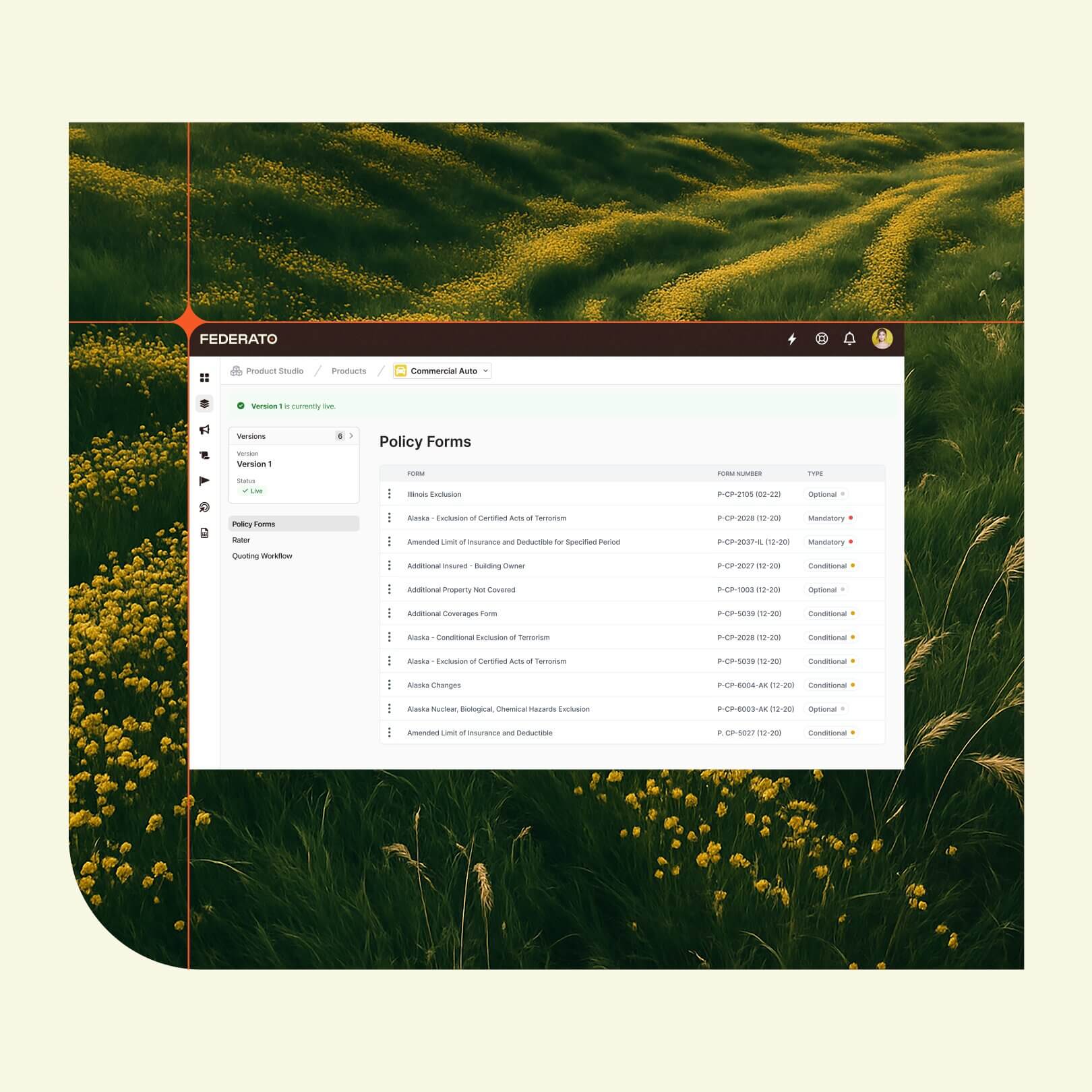
Billing is part of the same definition. Installment schedules, direct or agency billing, and taxes are set up with the product, so a new product launches with light billing configuration.
Across the lifecycle, the rater reflects a change at quote, forms and endorsements update at issuance, and the same rules apply at submission and renewal. Document management for forms and endorsements happens in a shared library, with rules that decide which documents attach to each policy.
Once a product is live, Federato’s agentic underwriting checks submissions against the carrier's appetite and portfolio goals as part of a risk assessment and prioritizes the ones most likely to bind based on the carrier's own broker and outcome history.
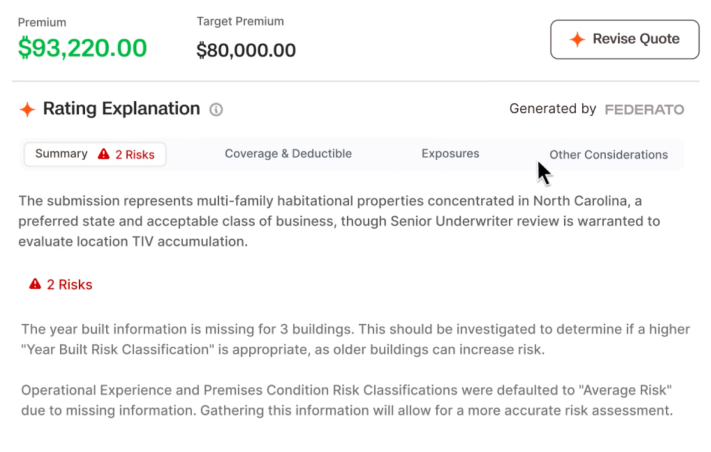
Submissions that are clearly outside appetite or unlikely to bind can be declined automatically. For those that fit, an AI agent drafts quotes priced on the carrier's own rater, linking each figure to its source and recording the rating rationale for underwriter review.
Customer results show what this looks like in practice. Within two months, Velocity Risk cut the time from completed risk modeling to an issued quote from 21 days and 11 hours to 2 days and 8 hours, an 89% reduction. It also increased the share of bound policies meeting its definition of high appetite by a factor of 5.5.
In CoreSuite for P&C, Sapiens' suite for insurers in the US and Canada, business teams can change forms, coverages, business rules, and rates without technical help. Sapiens sells different P&C suites depending on geography, including IDITSuite, and features differ between them. Insurers outside North America should check what their regional suite includes.
For new business, Sapiens uses AI to score and enrich submissions in an underwriting workbench and route straightforward risks onward. Its generative AI also drafts quotes, referral notes, and compliance documentation for review.
Advanced Product Designer (APD) is Guidewire's cloud-native tool for designing and managing insurance products across its applications, including Guidewire PolicyCenter. Product and delivery teams model a product visually, simulate it, and generate the product code.
Guidewire's developer blog explains that APD's code generation automates routine development but doesn't remove the need for developers, who complete the more complex parts of a product. Guidewire has Developer Assistants that help with work in Gosu, its own programming language, and with integrations.
For new business, UnderwritingCenter uses AI agents to read submissions, add third-party data and risk scores, and check risks against underwriting guidelines, then hands the work to policy administration for quoting and issuance.
In P&C insurance, what happens after a policy is bound shows a carrier whether its pricing and underwriting are working. What matters is how quickly that information reaches the people who set them.
With Federato, Billing and Claims share the policy's data foundation, so what happens after a policy is bound reaches the teams who set prices, underwriting strategy, and products.
Billing shows how each segment of the book pays. If one program's cancellations for nonpayment start to climb, or a broker's business pays late more often than the rest of the book, leaders can factor that into which programs and distribution partners they prioritize.
Claims fills in the other half of the picture. It records the policy clauses behind each coverage decision and the reasoning behind every change to reserves. This visibility is particularly valuable in specialty insurance software, where complex coverage terms and unusual loss patterns can make claims information important to future underwriting decisions.
If claims in a segment keep developing above their initial reserves, underwriting can tighten appetite or change terms before writing more of the same business, and pricing teams can reassess rates on new business and renewals. And if one policy clause keeps causing coverage disputes, product teams can revise the relevant forms and rules in Product Studio for future policies.
Federato's claims management runs from first notice of loss to payment. Claims processing starts from the policy terms and underwriting history behind each risk, and the system surfaces relevant citations and concerns before an adjuster makes a coverage decision. Because insurance claims management sits on the same platform as underwriting, emerging loss trends show up while claims are still open, rather than after they close.
Control Tower brings those signals together with premium, losses, appetite, and portfolio mix, and tracks them against the objectives leadership sets. For example, when a leader tightens a control, such as sending every new submission from a program with rising delinquency to referral, the change applies to the next submission rather than waiting for a month-end report.

Live portfolio context also catches conflicts that published guidelines alone would miss. Say a carrier caps total insured value (TIV) accumulation for restaurants in a region at $50 million and already insures $46 million there. A new submission with $5 million in TIV may meet those guidelines, but binding it would push accumulation past the cap. Because Control Tower tracks the book as it changes, it can automatically flag the submission for referral or decline it based on the insurer's configured rules, before the risk is bound.
In CoreSuite for P&C, ClaimsPro and BillingPro handle claims and billing, each with its own tools for monitoring performance. Reporting and dashboards across the core are now part of SapiensAIP.
ClaimsPro automates the claim lifecycle for personal and commercial lines, including workers' compensation. Its claims features include automated data collection, intelligent claim assignment, predictive models for initial severity, and automated fraud detection. On the billing side, BillingPro gives teams a view across billing, collections, and payments.
For reporting, SapiensAIP Insights lets users ask questions in natural language and generate reports and dashboards.
Guidewire BillingCenter and Guidewire ClaimCenter handle billing and claims, and Guidewire sells a portfolio of analytics products alongside them, including Compare and Predict.
Compare benchmarks a carrier's claims performance against anonymized peer data from the Guidewire Data Cooperative, which ClaimCenter customers contribute to. Predict provides predictive analytics for risk selection, pricing, claims triage, settlement, and litigation detection.
In both Sapiens and Guidewire, billing and claims analytics can inform underwriting reviews. But applying those findings to rates or appetite depends on how each carrier has configured its workflows.
A core replacement is a significant project with any vendor. The questions that matter are how long it takes, who does the configuration, integration, and data work, and what that means for the total cost of ownership (TCO). As part of any core modernization project, the new core has to connect with the systems around it, from rating tools and document systems to the carrier's CRM.
Federato's engineers work with a carrier's business and IT teams to configure workflows, connect data sources, and prepare for production, which eliminates the need for a third-party systems integrator. A first implementation typically takes 17 weeks, and each additional line of business takes about eight weeks once the first is live.
Data mapping is a large part of moving to a new core, because field names, formats, and structures differ between systems. Schema Sense uses AI to map a carrier's existing schema to Federato's data model, mapping up to 84% automatically. The mappings stay visible and version-controlled, so the implementation team can check and adjust them.
After earlier insurance technology projects had run over budget or behind schedule, QBE North America deployed Federato in eight weeks, starting with 50 underwriters. QBE has since expanded the rollout to more than 300 underwriters and staff across seven lines of business and projects a payback period of less than 12 months.
Sapiens offers its own professional services and cloud services, and works with partners on larger implementations. CoreSuite is designed to reduce implementation and maintenance costs by keeping customization and coding to a minimum.
Sapiens' partner ecosystem includes systems integrators such as CGI and Capgemini, which Sapiens says help it meet large implementation challenges. The partner network also offers standard point solutions from technology partners, which Sapiens says extend CoreSuite's integration options. For hosting, Sapiens Cloud runs on Microsoft Azure.
Guidewire has stated that implementation and testing typically take six to 24 months or longer. Like Sapiens, Guidewire works with systems integrator partners on implementations.
Guidewire's filings describe implementation of Guidewire software as typically involving integration with the customer's systems and moving the customer's data onto the platform. The same filings say timelines depend on the complexity of the customer's systems and the resources the customer devotes to the project.
Guidewire also offers its own professional services, including services to help teams adopt Advanced Product Designer.
The choice between Sapiens and Guidewire often comes down to how much a carrier wants to build and how many lines and regions it needs one vendor to cover. Federato offers a third option: the only AI-native platform that spans the full policy lifecycle, where product, policy, billing, and claims teams work from one shared data model, so you can see how each decision plays out across the book.
Request a demo to walk through product setup, policy administration, billing, claims, and Control Tower with your team.